

Indrictism
If one were to go anywhere in the Central Area of The Continent, an Indictrist would not be far away.
Indrictism is the worship of Ineyan, the supreme god. He is referred to as Ineyan in formal situations, but Indrictus in casual situations. Ineyan is seen as the god of everything, but is also often referred to as the god of such concepts as wisdom, magic, creation, war, the mind, freedom, and many others.
According to Indrictist tales, it was Ineyan who gave people the ability to use tools.
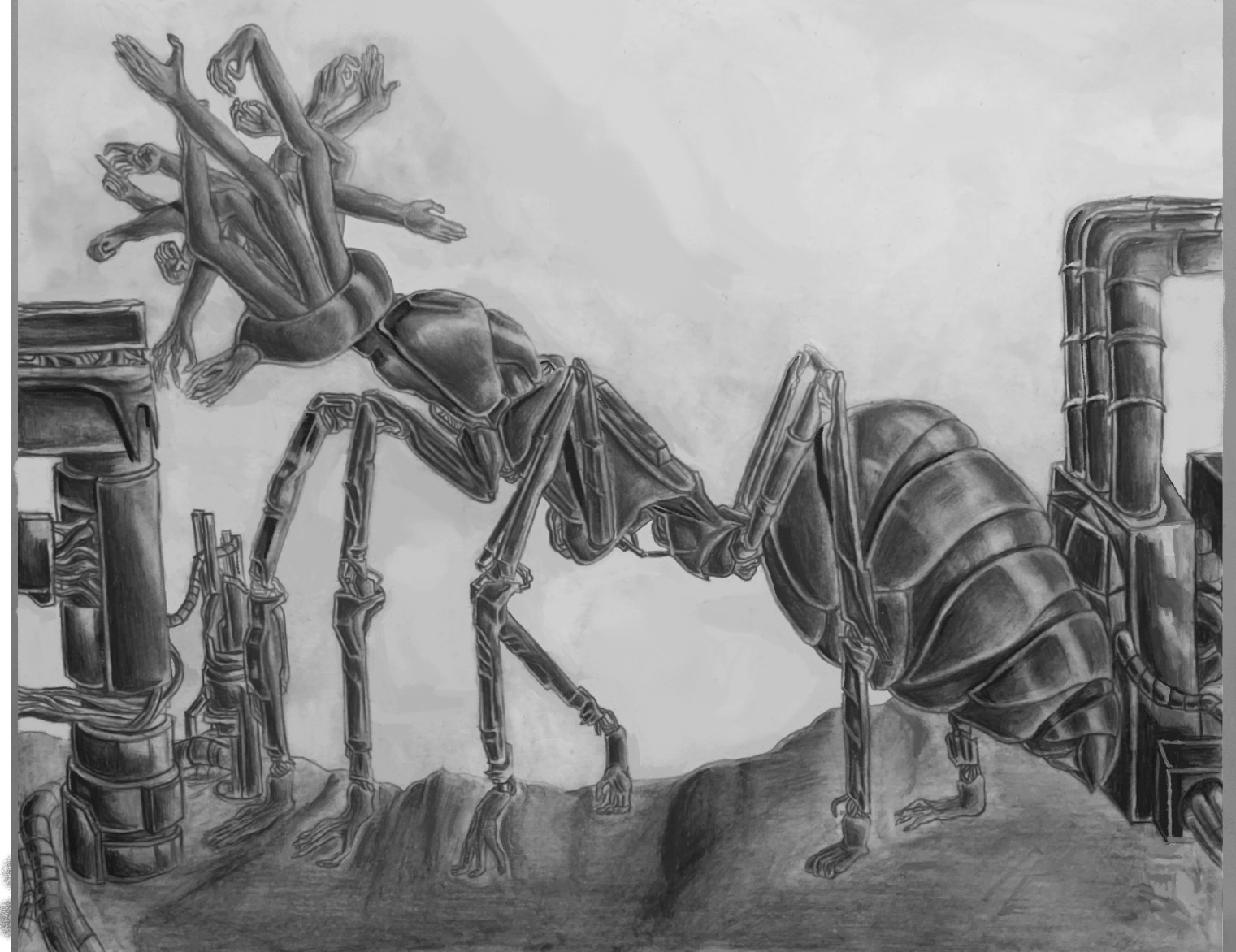 A depiction of Ineyan.
Most Indrictists will meet on Saturdays to pray in a Ziggurat. At the centre of this temple is a statue, which is said to be a vessel for Indrictus. A priest will lead the community in prayers towards the statue in an attempt to summon a piece of Indrictus within the statue.
These prayers are spoken, sung prayers are to be done entirely by Preistly Singers working for the ziggurat. During times when they are singing, the members of the congregation will all kneel in silence.
Indrictus temples have no chairs, with congregation members either kneeling or sitting on the floor.
At the end of every service, each member of the congregation will be given a stone with an inscription on it. They are then expected to get into a line and place the stone in a pool surrounding the statue while saying a simple prayer: “Thank you.” The inscription on the stone is what they are saying thanks for.
This pool is generally full of water, but during the Fall Solstice, it will be drained and filled with gasoline, and then set on fire. In Daghur and Daghur only, it will be filled with oil.
A depiction of Ineyan.
Most Indrictists will meet on Saturdays to pray in a Ziggurat. At the centre of this temple is a statue, which is said to be a vessel for Indrictus. A priest will lead the community in prayers towards the statue in an attempt to summon a piece of Indrictus within the statue.
These prayers are spoken, sung prayers are to be done entirely by Preistly Singers working for the ziggurat. During times when they are singing, the members of the congregation will all kneel in silence.
Indrictus temples have no chairs, with congregation members either kneeling or sitting on the floor.
At the end of every service, each member of the congregation will be given a stone with an inscription on it. They are then expected to get into a line and place the stone in a pool surrounding the statue while saying a simple prayer: “Thank you.” The inscription on the stone is what they are saying thanks for.
This pool is generally full of water, but during the Fall Solstice, it will be drained and filled with gasoline, and then set on fire. In Daghur and Daghur only, it will be filled with oil.
Daghurian Indrictism:
The key difference between the Daghurian form of Indrictism and the other forms is that the Daghurians claim that The Electric Empress, who will be discussed later, was a prophet of Indrictus, and so some Daghurians worship her alongside Indictrus. The various other differences will become apparent in the religious section of other countries.Dredakin Indictrism:
This sees Indrictus as not only the god of magic and wisdom, but also the sky, and it often reduces the wisdom aspect. A good way of showing the difference between Dredakin Indrictism and Daghurian Indrictism is through the prayers. The Praising of Indrictus is a prayer said by both Dredakins and Daghurians at both the beginning and end of temple meetings, but its wording varies. This is the Daghurian version: “Praise be upon you, Ineyan! You are who blessed mortalkind with the gifts of magic and science, and the minds to understand them both! Your wisdom is infinite, as is your magic!” This is the Dredakin version: “Praise be upon you, Ineyan! You are who blessed mortalkind with the minds to make magic and the hands to make tools. From your heavenly palace in the sky you reign!”Kavtin Indictrism:
The Kavtin version of Indrictism sees Indrictus/Ineyan as not only associated with wisdom and magic, but also the sky. The version of Indrictism practised in the south is nearly identical to the Hadiyan form, while the version practised in the north is very similar to the Kaichin way. Similar to the Hadiyans, the Kavtins believe in ghosts, and also believe that they are created when someone’s spirit can’t combine with its parallel version. However, their beliefs often have the ghosts taking up certain physical characteristics. When a child dies young, their soul is too innocent to combine with their parallel version, and so it lingers as a Shuvam, a spirit which looks like a child, but with the beak, wings, and legs of a bird. It is said that this spirit can be guided to the underworld where it can combine with its parallel version with the help of a shaman. A belief held by those in northern Taylar is that of a three tiered universe, divided between the realms of heaven, earth, and hell. Rainbows are said to be bridges to this heavenly place. It is said that heaven is where Indrictus lies, as do the souls of good people. Bad people descend into hell. Descriptions of this place vary from tribe to tribe, as well as what defines a “bad person”. In certain places near the Toglar mountains, there is a belief in an opposite to Indrictus, a being of evil known as Erlik. His lower body is that of a human, but he has the head of a pig with three eyes, two horns, and a crown with five skulls on it. Reportedly, he was once a human who separated his soul from the light of Indrictus, and now resides within the depths of hell with a thousand brides. It is said that women who are unfaithful to their husbands are added to his addition of brides. Their bones will turn to tar and they will live in his palace made of obsidian. Apparently, the children of these brides are all evil spirits which represent various different diseases. Belief in Erlik is rare, shared only by a couple thousand people. Many historians believe Erlik was a deity from a much older religion who was folded into Indrictist belief.Kaichin Indictrism:
Kaichin religion was once devoted to the god of war, Yamat, but in the past thousand years, Indrictism had slowly replaced it as the dominant religion. Differing from other Indrictists, a majority of Kaichins will not go to temples, but instead pray to Indrict Markers. These are simple stone statues of Indrictus situated along roads and paths. They often have holes drilled through them, which often produce sounds when the wind flies through them. This has the side effect of the Indrict Markers helping people who are lost. The exception to this are the urban Kaichins living near the Chaulaan River, who generally have miniature Indrict Markers in their own home.
Type
Religious, Other
Remove these ads. Join the Worldbuilders Guild




Comments