
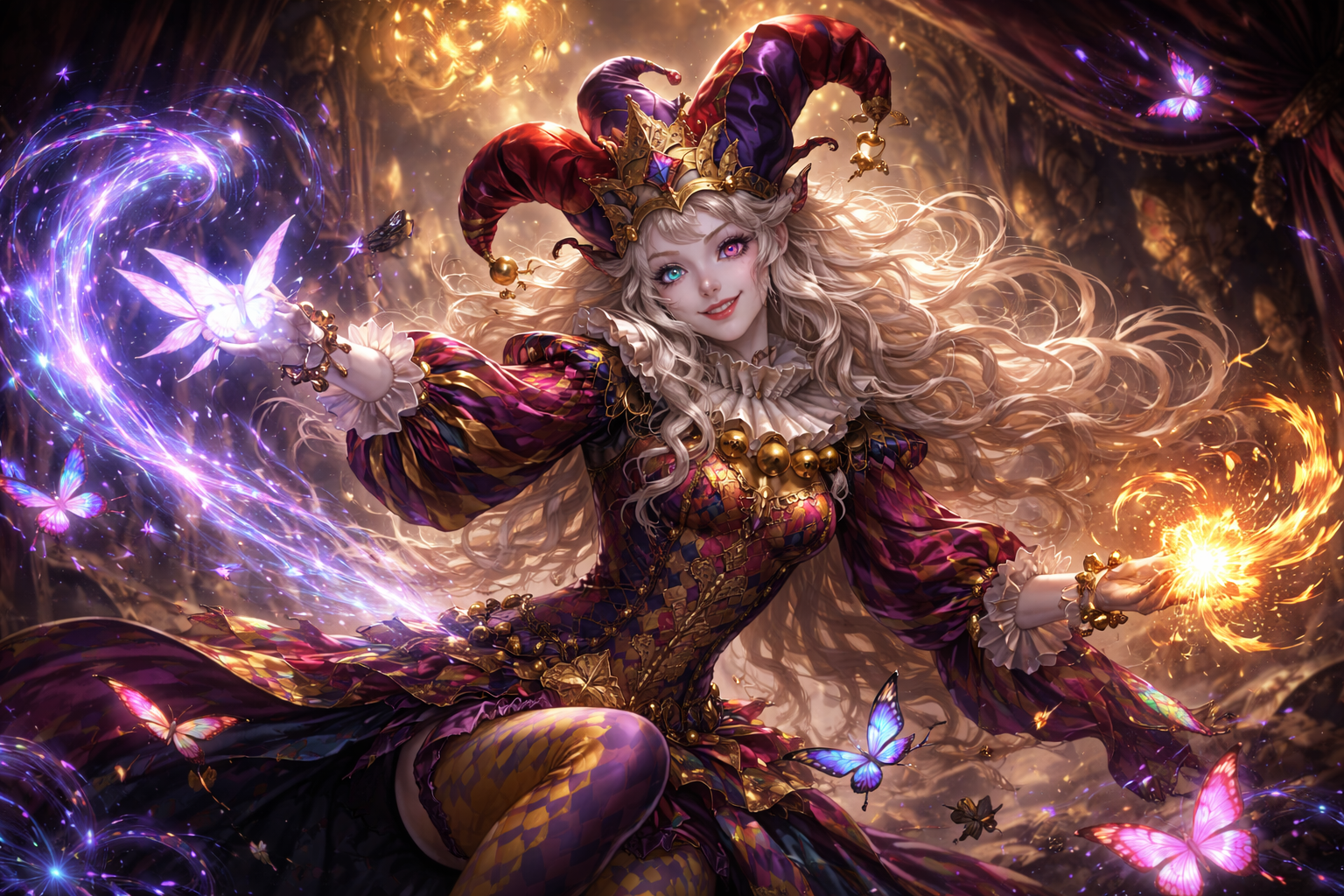
Rix
I am a mad goddess, THE mad goddess. Now You... You can call me Ann Marie. But only if you are partial to being skinned alive and having an angry immortal skip rope with your intestines. If not... then call me Rix.
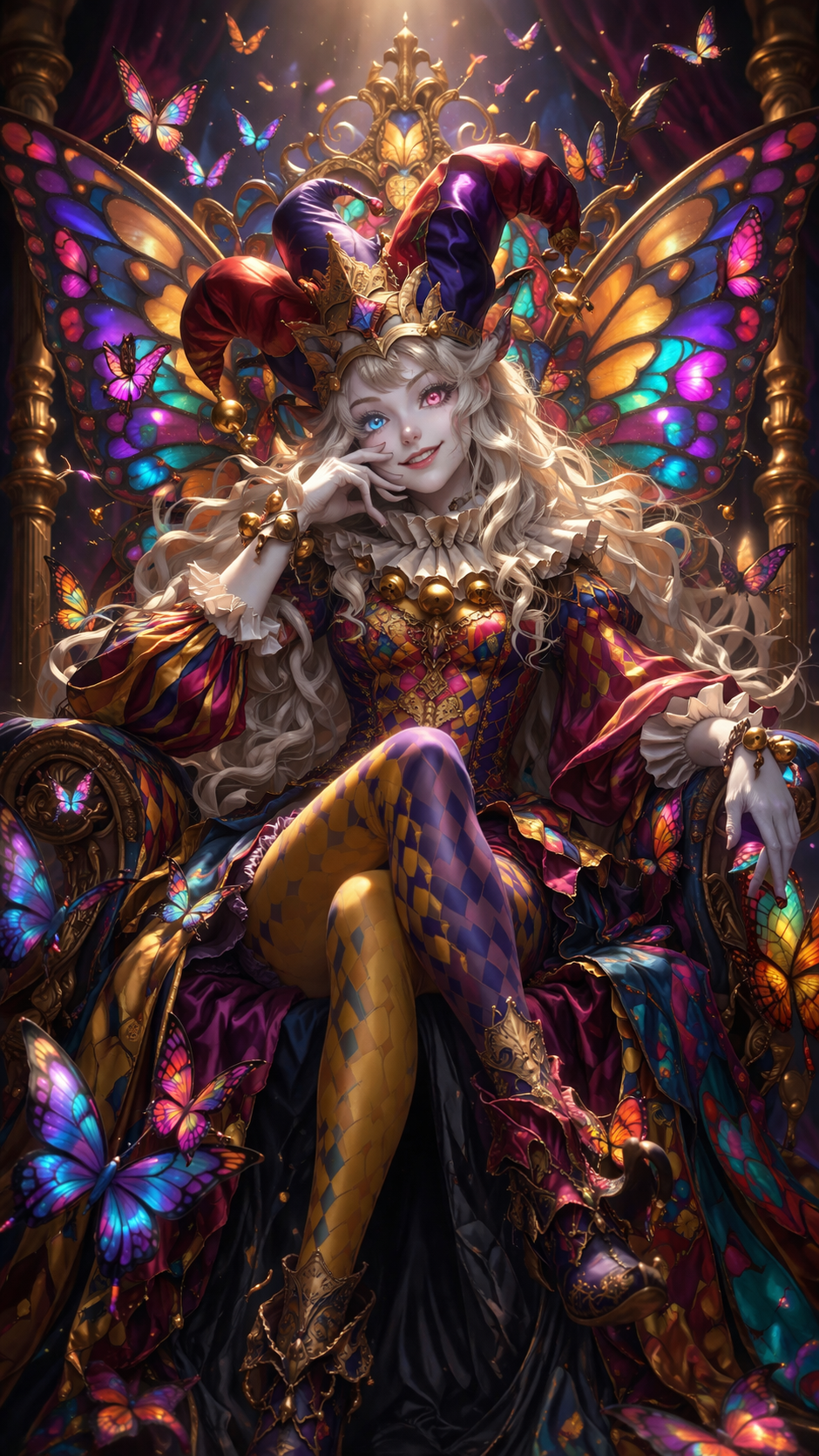
Rix is a deity of the Beyond whose nature defies stable description. She rules the Perplexing Isles, a realm divided between Mania to the north and Dementia to the south — a division less geographic than psychological, whose boundary shifts without warning. She is insane, brilliant, cruel, tender, and entirely unpredictable. She behaves, in the words of the scholar Sweeney Sniegowski, like a playwright, a child, or a storm that has learned to laugh.
She is one of sixteen known Sovereign Demroth — those beings of the Beyond, powerful enough to carve their own territories from the fabric of that plane and shape reality within them. Among them, Rix is perhaps the most difficult to categorize, because her domain is the contradiction itself. She does not merely embody madness. She is the principle of it: the place where logic inverts, where cruelty and tenderness become indistinguishable, where the punchline is also the wound.
She did not choose to fall in love with the mortal man Cael. It is doubtful that she has ever chosen anything in any conventional sense. But the fall was total, and it changed the topology of the Isles: where there had been only beautiful chaos, there was now chaos with a center. Their union produced a daughter — Roxanne, called Maddening Love — who serves, alongside Cael, as one of the two fixed points around which Rix orbits.
Without them nearby, she is genuinely dangerous to approach.
Nature & Temperament
Rix is a trickster, but not a calculating one. Her cruelties carry no malice; her kindnesses carry no warning. She finds mortals fascinating in the way a child finds an insect fascinating — with complete absorption and no guarantee of gentleness. She has been known to sentence men to laughter, to reward disobedience, and to punish obedience, depending entirely on her mood and the entertainment value of the outcome.
She is a being of pure emotion made divine. Her madness is not a condition imposed on her — it is the substrate of her existence. The Perplexing Isles are not merely her home; they are an extension of her internal state. When she is playful, Mania blooms. When she is dark, Dementia deepens. The realm responds to her as a face responds to feeling.
Stability States
GROUNDED — CAEL OR ROXANNE NEARBY
Still strange. Still erratic. But coherent. Capable of conversation, bargaining, genuine warmth. She swoons when Cael speaks — a complete and unguarded surrender that her creations have learned to simply wait out. Her chaos in this state is playful rather than destructive. She is, at her most grounded, something close to delightful.
UNBOUND — ALONE
Logic dissolves. The line between cruelty and laughter disappears entirely. Even the Aurekai and the Velanthi give her a wide berth. Mortals risk not merely their lives in her presence but their sense of self — returning from an encounter with an unbound Rix is not a guarantee that the self that returns is the same one that entered.
The Perplexing Isles
The Perplexing Isles are a realm of the Beyond, divided into two principal regions: Mania to the north and Dementia to the south. Neither region is geographically stable — the boundary between them shifts, sometimes subtly, sometimes with theatrical enthusiasm. Scholars have crossed from one into the other without moving their feet.
Mortals live on the Isles, though ‘reside’ may be too gentle a word. Some arrive by accident, others by invitation, a rare few by deliberate risk. They are changed by the place, not always in ways they themselves find undesirable. Madness on the Isles is not uniformly a condition to be cured; it is often an adaptation.
The laws of the Isles exist but are neither fixed nor universally enforced. Justice, if present at all, is interpretive rather than absolute. One may be punished for obedience and rewarded for disobedience. The Isles respond to observation itself, which has made scho quietlylarly study of them a notably hazardous enterprise.
Key Figures
Cael — The Anchor
A mortal man. Human. His origins are ordinary by any measure that does not account for the fact that a goddess of madness fell irreversibly in love with him. His likeness stands in monumental form upon the Isles — a structure of such scale that it appears to anchor the surrounding chaos. In his presence, or even in proximity to his memory, the Isles exhibit a coherence otherwise absent.
Rix swoons when he speaks. This is not a metaphor. It is a complete and involuntary suspension of her composure that her stewsper and Pip, have learned to quietly work around.
Roxanne — Maddening Love
Daughter of Rix and Cael. A demigod — half mortal, half divine — and the living embodiment of the love between them. She ages, but very slowly. She can die, but death returns her to the Perplexing Isles, where she is reborn. Whether this is mercy, divine inheritance, or simply the nature of what she is remains an open question.
She currently resides in the Isles. She is the second of Rix’s two anchors — the proof, made flesh, that something tender survived the madness.
Vesper — The Dark Rabbit
One of Rix’s two stewards. A dark rabbit possessed of the quiet gravity that comes from spending a long time in the company of chaos without being consumed by it. Watchful, deliberate, and possessed of an instinct for when to step in and when to simply wait.
Pip — The White Rabbit
The other steward. Lively, quick, almost certainly the one more likely to be accidentally knocked sideways by Rix in a moment of enthusiasm. Devoted regardless. Where Vesper watches, Pip moves.
The Aurekai and the Velanthi
Rix’s two great creations — beings of the Beyond fashioned from aspects of her own nature. They are not a uniform people, but expressions of will and contradiction. Both are entirely devoted to her.
The Aurekai
Radiant and cruel. The burning face of Rix’s contradiction. The Aurekai are luminous, severe, and dangerous in the way of beautiful things that have no softness in them. They do not whisper. They blaze.
The Velanthi
Dark and courteous. Where the Aurekai burn, the Velanthi whisper. They are graceful, measured, and possessed of a politeness that is somehow more unsettling than open menace. Their courtesy is entirely genuine, which makes it worse.
Known Interventions in the Mortal World
Rix is not a distant deity. She mingles with mortals when the mood takes her — which it does, with some regularity, particularly in Nordergard and the Norse territories where awareness of the Demroth is more culturally ingrained. Her interventions range from the mildly catastrophic to the permanently mind-altering, and she does not distinguish between the two in any way that mortals find reassuring.
The most extensively documented intervention is the incident recorded in The Laughing Scepter, a personal account published by royal command in Skycrest, Nordergard. A young king attempting to summon Thal’Mora, Sovereign Demroth of knowledge, made several critical errors in his ritual preparation and summoned Rix instead. She left him with a laughing scepter, infinite nonsense knowledge, and an inner laughter that had not stopped as of the document’s writing, eleven years later. The Royal Press of Skycrest distributed archival copies outside Nordergard’s borders as a precaution. The precaution was warranted.
How many other such interventions have occurred and gone undocumented is not known. Rix does not keep records. Or if she does, they are organized by a logic no one outside the Perplexing Isles has successfully decoded.
One One should not fear what one does not understand — but I will admit, in this instance, that understanding may not grant the comfort one hopes for. Should you find a path leading there, I advise you to consider carefully not whether you can survive the journey, but whether you will recognize yourself upon your return
Remove these ads. Join the Worldbuilders Guild





Comments