
Common
The Common language is the most widely spoken and understood language across the Material Plane. It serves as the primary means of communication between various races, cultures, and nations, facilitating trade, diplomacy, and shared knowledge. While regional dialects and accents exist, the core structure of the language remains largely consistent.
Origins
The origins of the Common language are traced back to the early days of civilization on Leo, particularly during the rise of the Aurelian Empire. As the empire expanded, it sought to unify its diverse subjects under a single linguistic standard to streamline governance, military coordination, and commerce. Over time, this standardized language spread beyond the empire’s borders, adopted by merchants, scholars, and travelers who recognized its practical utility.
Linguists and Magisters theorize that the Common language evolved from a blend of older regional tongues, incorporating elements from Elven, Dwarven, and Orcish, as well as ancient dialects that have since faded from everyday use.
Structure and Characteristics
The Common language is designed for clarity and efficiency, making it easier to learn compared to more complex languages like Ether or Dunelarian. It follows a straightforward grammatical structure with relatively simple conjugation rules, making it accessible to speakers from different linguistic backgrounds.
Key characteristics of the Common language include:
- Phonetics: A balanced range of consonants and vowels, avoiding overly harsh or fluid sounds.
- Syntax: A subject-verb-object (SVO) order, similar to many mortal languages.
- Lexicon: A vocabulary that borrows from multiple languages, making it highly adaptable.
- Writing System: The script is composed of clear, angular letters, designed for legibility and ease of inscription on various materials.
Cultural and Political Influence
As the Aurelian Empire imposed its rule over vast territories, the Common Language became a symbol of unity and control. Even after the empire fractured due to civil wars and political upheavals, the language endured, continuing to serve as a lingua franca across different regions. Today, it remains the official language of the empire and is spoken by nearly all educated individuals, merchants, and diplomats.
Outside the empire, the Common Language has become indispensable for trade and international relations. Even those who retain their native tongues often learn Common as a second language to facilitate interactions with outsiders.
Regional Variants and Dialects
Despite its widespread use, the Common Language has developed distinct regional variations. Some notable examples include:
- Aurelian Common: The formal, standardized version taught in imperial institutions and used in official decrees.
- Dunelarian Common: A variant spoken in Dunelar, which incorporates elements of the Dunelarian Language, including unique idioms and pronunciations.
- Drakthari Common: Influenced by Orcish dialect, this version tends to have a more guttural pronunciation and shortened sentence structures.
- Northern Common: Spoken in Frostheir, with a slower, more deliberate cadence and a vocabulary adapted to the harsh, icy environment.
Role in Magic and Scholarship
While the Common language is not inherently magical, it is often used in the transcription of Magisterial texts and scholarly works. Most modern spellbooks and arcane treatises include Common translations alongside their original Ether inscriptions, making magical knowledge more accessible to a broader audience.
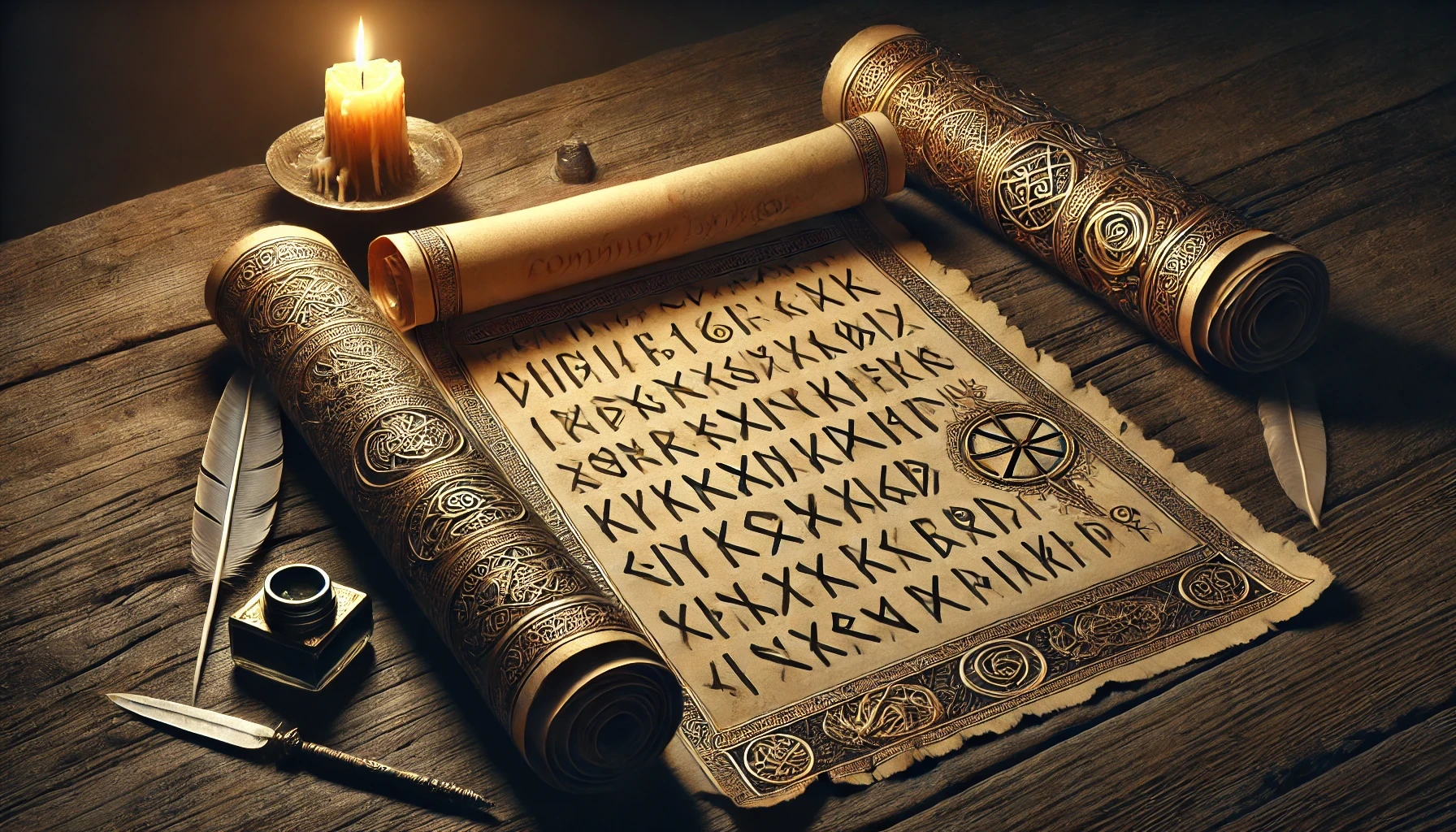
A scroll written in Common.
Remove these ads. Join the Worldbuilders Guild


Comments