Archon of the Unclaimed


GM-Info!
Work in progress!
Slightly NSFW!
FEATURED
Oren comes in when an object leaves the ownership of a person forever: the ring dropped in the harbour mud, the toy left on a travelling coach that moved on too fast, the regimental banner planted in a field the army no longer holds. Farenians across the Empire recognise that moment with sayings.
"Storm took my good top hat last night. It's Oren's now." -- unknown noble
Every abandonment releases a residue of grief, panic, or resignation, and Oren draws strength from it in proportion to what the object meant to the owner. A soldier's dented signet sustains him for a season. A dropped copper coin barely has any effect. Oren's claim begins earlier, at the moment of surrender, before decay has had time to start. His name derives from the Old Farenian orennan, "to set down and not return for".
Aspects of Oren
The Grief of Letting Go: Oren's power rises with every deliberate or forced abandonment, from a child's outgrown toy to a fleeing army's discarded banners.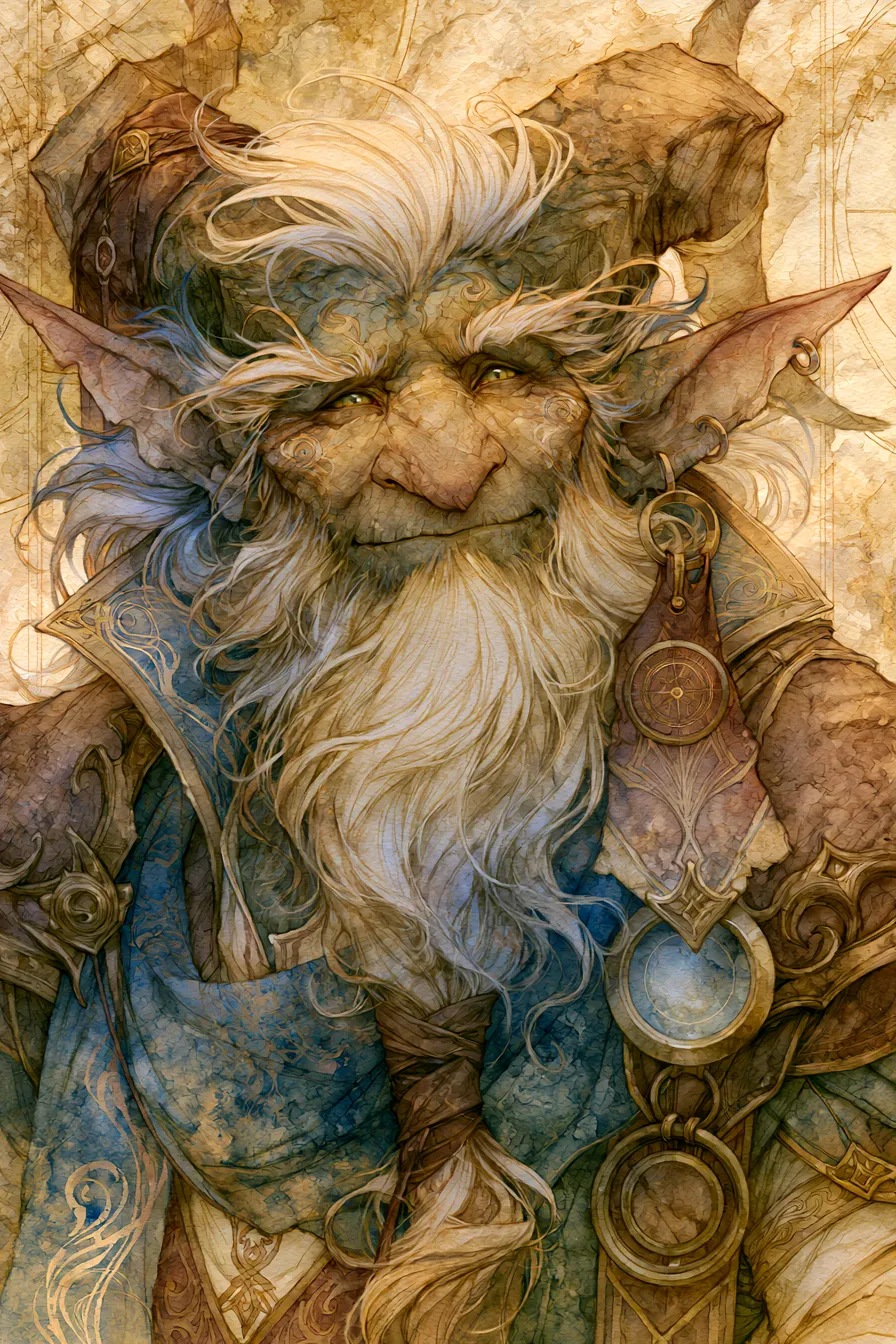
Oren by Tillerz using MJ
The Weight of Sentiment: an item's value to Oren sits in the feeling attached to it, its price is not relevant to him. A cracked wedding band outweighs a chest of coins, which is why his clergy have not so much interest in collecting treasure.
The Unclaimed Estate: Bridgeport's Council of Ten codifies abandoned property after a year and a day, at which point it reverts to the crown or the finder under the Empire's salvage law. Oren's clergy consider that a full year and a day of wasted feeding, and their shrines exist to collect what people give up on far sooner.
The Deep Salvage: in the tunnels of Magramine, cave-ins bury tools, ore carts, and sometimes miners faster than any recovery crew can work. What the Technocracy cannot dig out in time, Oren claims, and a handful of dwarven salvage crews have learned to make that arrangement work for them rather than against them.
Appearance & Manifestation
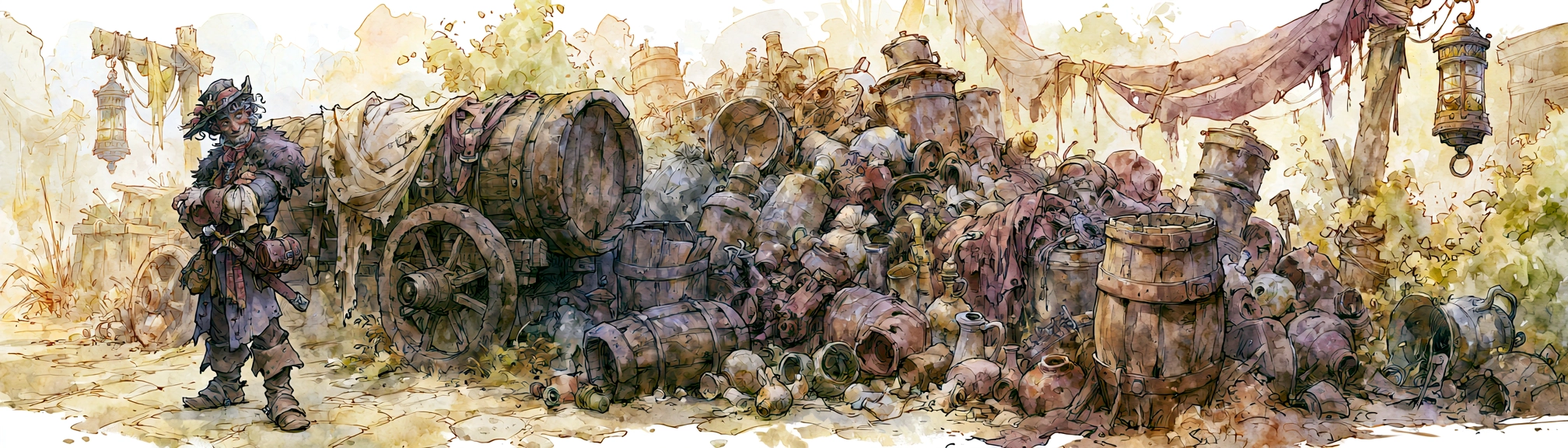
The Scarp-King: Oren manifests as a large, troll-like humanoid being, shovelling through a giant pile of post items.The Voice: he speaks with a deep voice, echos can be heard even if there should be none.
The Aura: anyone standing close to him carries away the smell of old paper, rain-soaked wool, or rusty iron.
The Cult of the Discarded
Oren draws no nobles and no guild patrons. His clergy are rag-pickers, mudlarks, and the sweepers who follow adventuring parties into cleared dungeons to collect what the heroes did not think worth the weight in their packs.The Scavengers: his priests hold no formal ordination. A scavenger becomes clergy by dedicating a decade's finds to Oren's shrines rather than selling them.
Shrines of the Lost: none are built from cut stone. They are alcoves in the Sewers of Bridgeport, hollowed junk heaps behind tanneries, and crossroads cairns where travellers leave what they can no longer carry. Every Farenian settlement of any size has at least one, usually unmarked and known only by word of mouth.
The Catalog of Shadows: Oren maintains a single copy of this ledger, an ever-thickening volume recording every object currently lost in the world and the name of whoever lost it. Entries write themselves into the book at the moment of loss, in a handwriting no living scavenger has ever seen before.
Worship in Farenia and Magramine
The Temple of the Five in Bridgeport has no shrine for Oren and no plans to add one; he is not one of the Old Gods, and his clergy have never petitioned to become one. That suits both parties. The Council of Ten tolerates unlicensed shrines it considers beneath legal notice, and Oren's followers have no interest in a congregation large enough to attract notice in the first place.Dwarven worship follows a narrower, more practical logic. Durngrym remains the Ironforged Warlord's exclusive claim on martial honour and the forge, and his priesthood regards any rival devotion as a species of weakness. Tunnel salvage crews in Magramine worship Oren anyway, unofficially and specifically: after a cave-in, it is Oren's clergy who are called to name the tools, the ore carts, and the miners a collapse has claimed, and to mark them properly lost rather than leaving the Technocracy's ledgers open indefinitely. The Ironforged priesthood has not moved against the practice. It saves them the paperwork.
Scratched into the sewer brick above a Bridgeport shrine, in at least four different hands over what must be decades:
"Left my father's knife here in '58. Didn't want it. Wanted to want it. Still don't."
"Bootlace, one. Wasn't much but it was mine and now it's yours."
"For the third bell of the Iron Gate garrison, lost at Calder's Ford, and for every man who marched under it."
"Left my father's knife here in '58. Didn't want it. Wanted to want it. Still don't."
"Bootlace, one. Wasn't much but it was mine and now it's yours."
"For the third bell of the Iron Gate garrison, lost at Calder's Ford, and for every man who marched under it."
Mechanical Blessings & Curses
Rite of the Object's History: a dedicated follower of Oren may touch any genuinely abandoned object and learn its last owner, how it came to be lost, and the emotion felt at the moment of loss. The object must have no living claimant actively searching for it. Exception: items lost fewer than a day ago yield only an impression, not a clear answer.Blessing of the Salvager: once per session, a follower may reach into any refuse heap, sewer, or overstuffed pack and produce exactly one mundane tool needed at that moment (a crowbar, a vial of oil, a specific key). The item crumbles to dust within the hour. It cannot be a weapon, a magic item, or worth more than a few copper coins.
Oren's Curse (The Forgotten): desecrating a shrine of Oren triggers this curse automatically. For 1d4 days, small unattended items slip from the offender's pockets and vanish. Returning an item of equivalent sentimental weight to any shrine of Oren ends the curse immediately. Unless amends are made, it must run its full course.
Reclaiming What Oren Holds
Nobody needs clergy standing, a shrine dedication, or even faith in Oren to ask for something back. Any petitioner who can name the object, describe how it was lost, and show some real connection to it may lodge a claim at any shrine of the Lord of Leftovers, or with the scavenger-priest who tends it.The toll scales with what the object cost the person who lost it, not with what it would fetch at market.
Trivial losses (a common tool, an ordinary coin): the toll is an object of comparable value, handed over on the spot. Most petitioners never notice they have paid one.
Sentimental losses (heirlooms, love tokens, a unit's banner): the toll is something of matching weight from the petitioner's own life, not bought and not borrowed for the purpose. It must be a thing they would genuinely grieve losing.
Irreplaceable losses (the last portrait of a dead child, a book with no second copy): Oren does not want an object back for these. The toll is a memory surrendered, a relationship deliberately severed, or a loss the petitioner must cause somewhere else, matching what they are asking to undo.
The petitioner must hand over the toll before the item is returned, never after. Oren's clergy may refuse a toll they judge insincere, without explanation and without appeal. The toll cannot be paid in Farenian Crowns or any other coin, regardless of the sum offered; a scavenger-priest can tell a genuine surrender from a purchase made to look like one, and turns the second kind away.
A petitioner may argue a toll down by one tier with Haggle DC 15 (WFRP4e: Haggle Hard -20%, Cypher: Haggling difficulty 5, Dragonbane: Bartering), convincing the clergy that a lesser sacrifice carries the same weight. Exception: irreplaceable losses cannot be haggled. The toll for those is fixed, and arguing it only insults the priest hearing the claim.
This is GM information
Secrets
- The oldest entries in the Catalog of Shadows predate the Farenian Empire and describe objects that match no known culture; some scavenger-priests suspect Oren has been harvesting the grief of the vanished predecessor civilisation for as long as its ruins have existed.
- Since the Council of Ten outlawed Zaroth's worship, at least two of Bridgeport's "unmarked" shrines have served double duty, sheltering Zaroth's underground cult behind Oren's far less threatening reputation.
- The Catalog of Shadows has begun, in the last decade, to record the names of people still alive whose closest relations are actively forgetting them, not merely their possessions.
Plot Hooks

- The Relic of Regret: a thief lifts a rusted dagger from an Oren shrine. It carries the grief of a betrayed knight, and the god sends animated junk constructs, the Reclaimed, to hound the city until it is returned.
- The Forgotten Army: a century-dead legion vanished into a magical mist, leaving its gear behind. Oren has animated the abandoned armour and weapons into a wordless honour guard defending his grandest scrap-cathedral.
- Divine Ransom: a player character loses an item central to their backstory. A priest of Oren offers to trade it back, but only for a task that will force someone else to abandon something they treasure just as much.
- The Predecessor Find: the party recovers a fragment of the vanished civilisation from what looked like an ordinary junk shrine. Oren's clergy want it back; it is one of the richest sources of feeding the god has had in a generation.
- Cover Story: Black Guard investigators trace outlawed Zaroth worship to a shrine believed to belong to Oren. The party must determine which god's followers actually control the site before the Guard burns it to the ground.
