Mount Saint-Mikkel
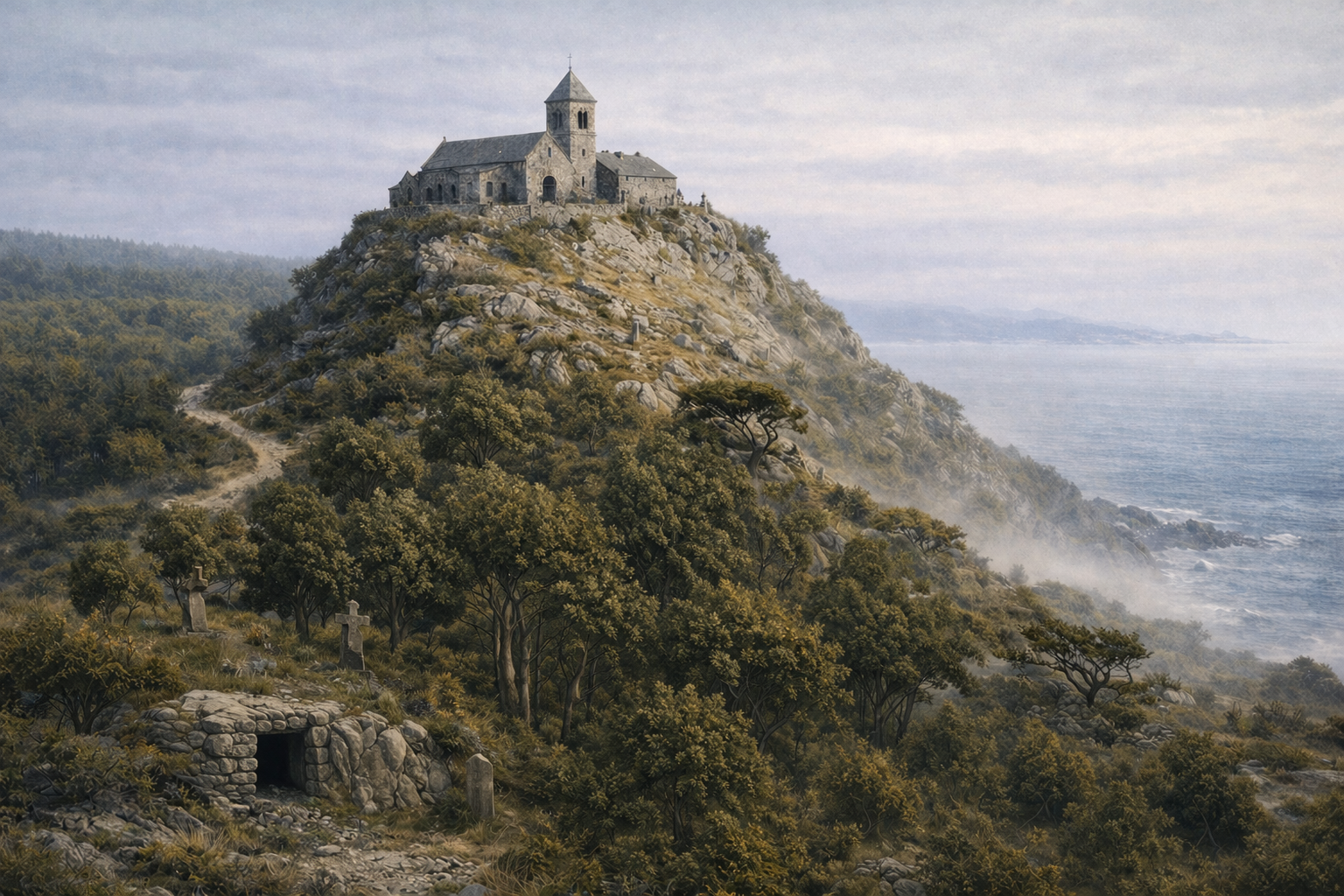
Mount Saint-Mikkel is a low, solitary hill located roughly 25 miles from the capital of Asperia. At its summit stands an ancient temple-monastery, once a cornerstone of the kingdom’s spiritual life. Though still in use, it has long since faded into quiet obscurity, serving now as a place of burial rather than belief.
Geography
The mount rises above the surrounding lands and ocean, its slopes dotted with tombs and burial markers stretching outward. The soil is considered sacred, and much of the surrounding area has been consecrated for interment.
A single winding path leads to the summit, where the temple overlooks the surrounding.
Ecosystem
Mount Saint-Mikkel sits at a natural boundary.
To the east, the hill opens toward the sea, exposed to wind and salt air. To the west, it meets a dense inland forest, where the main road approaches through the trees. The mount itself rises out of this transition, its slopes mostly open, shaped more by wind and stone than by heavy vegetation.
The ground is made of friable granite, which drains quickly and does not hold deep roots well. Because of this, the hill never developed thick woodland. Instead, it remains covered in grasses, low growth, and scattered trees that never quite take hold.
The burial grounds blend into this landscape rather than overtaking it. Graves are spaced across the slopes, following the natural lines of the terrain instead of forming rigid rows. From a distance, the hill looks untouched—only closer inspection reveals how much of it is given to the dead.
Localized Phenomena
There is nothing supernatural about Mount Saint-Mikkel, but it has a distinct presence.
The sea wind is constant. It moves across the eastern slope and over the summit, carrying moisture and keeping the air clear. Even on warmer days, the hill rarely feels heavy or stagnant.
Mists form occasionally, especially in the morning, drifting in from the coast and thinning as they climb the slope. They never linger long.
From the summit, the contrast is immediate—forest behind you, open sea ahead. It gives the place a sense of distance from everything else, without ever feeling isolated.
Fauna & Flora
Vegetation on the mount is shaped by poor soil and exposure.
Grasses dominate most of the hill, growing in uneven patches that shift constantly with the wind. Low shrubs take root where the ground is more stable, especially along paths and around older graves. Trees are present but sparse—usually small, wind-shaped, and leaning slightly inland.
Closer to the western edge, where the soil deepens and the forest begins, plant life becomes denser. This is where most animals enter the area.
Wildlife is ordinary and unremarkable. Birds from the coast drift over the hill, while forest animals occasionally wander its lower slopes. They do not avoid the burial grounds, but they do not linger either.
The old mines beneath the mount have long since collapsed or been sealed. Some small animals make use of shallow openings along the lower slopes, but nothing larger ventures below. The ground there is unstable, and locals avoid disturbing it.
Natural Resources
Mount Saint-Mikkel was once a minor but valuable extraction site, known for both friable granite and coal deposits beneath the hill.
The granite, pale and easy to shape, was widely used in the early development of the capital of Asperia. Many older structures in the city are said to have been built, at least in part, from stone taken from the mount. It was also used locally for funerary markers, sarcophagi, and temple construction.
Beneath the granite, shallow veins of coal were extracted through a network of small mines. This fuel source supported nearby settlements and contributed modestly to the region’s early growth.
Extraction never reached an industrial scale. The ground was unstable, and the granite fractured easily, leading to frequent collapses in the lower galleries. Over time, the risks outweighed the benefits.
As the Order of Saint-Mikkel declined and the site took on a funerary role, mining operations were abandoned. Most entrances were sealed or left to collapse naturally.
Today, no organized extraction remains. The mount is no longer seen as a source of material, but as a place to be left undisturbed.
History
Mount Saint-Mikkel was once one of the most influential spiritual centers in the Kingdom of Asperia.
The Order of Saint-Mikkel established the temple as a place dedicated to the doctrine of balance, attracting scholars, monks, and pilgrims from across the region. At its height, the mount shaped cultural and philosophical thought throughout the kingdom.
Its decline was gradual:
- The ideology lost influence as Asperia shifted toward more pragmatic and secular values
- The order diminished, losing members and purpose
- The temple’s role shifted from guidance to ritual, then from ritual to function
Tourism
Mount Saint-Mikkel no longer draws crowds, but it is not abandoned.
Visitors come for different reasons:
To accompany the dead
To visit ancestral graves
To experience its quiet, reflective atmosphere
Occasionally, followers of older traditions or monks of Triolism make solitary visits, treating the site as a place of origin rather than authority.
There is no active effort to attract visitors. Those who come do so by choice, not invitation.
Attention!
Cette page est en construction...
CHARACTER CREATION PROCEDURE
Rules
Class
Species
Spells
Player rules
Fight rules
Gear rules
Craft rules
Other rules
Class
Subclass
Species
Rule: Magic School
Magic School
Select a tab for search...
Attention!
Cette page n'a pas encore été rédigé...
Type
Mountain / Hill
Location under
Owning Organization