
Ironvine


GM-Info!
Work in progress!
Slightly NSFW!
FEATURED
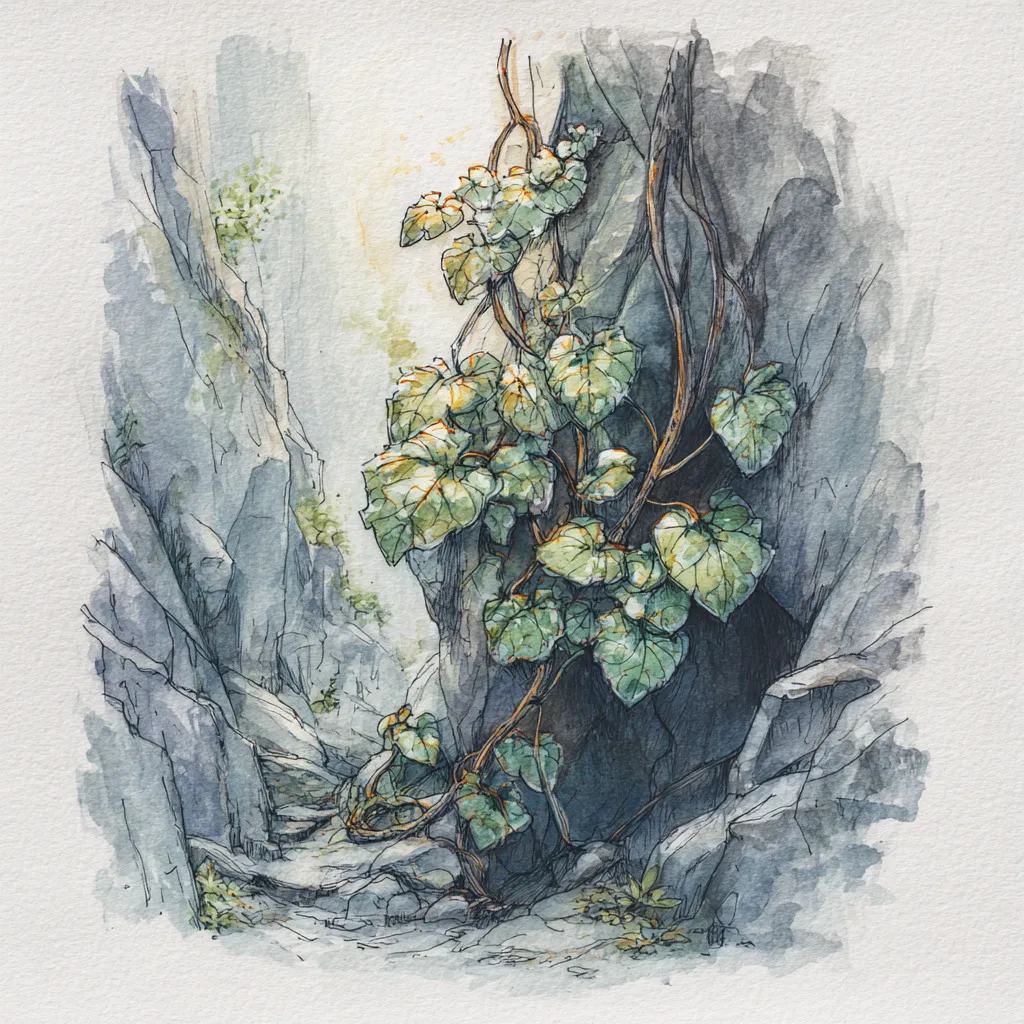
Ironvine is a low-growing climbing plant with dark green leaves edged in dull silver. Its stems are fibrous, dense, and unusually rigid, with a surface texture closer to braided wire than to wood. Mature vines develop thin metallic filaments running lengthwise through the stem, visible when cut or split. These filaments do not rust and resist bending, snapping back into shape after moderate force. The leaves are small, tough, and faintly magnetic, often catching iron dust or filings from nearby forges.
Ironvine grows primarily in mountainous regions and stone-heavy terrain, especially along cliff faces, abandoned quarries, and the outer walls of old fortifications. It favours mineral-rich rock and avoids loose soil entirely. The plant anchors itself deep into cracks, widening them slowly over decades. Dwarven prospectors often spot Ironvine before discovering usable ore veins, as the plant seems to favour stone saturated with trace metals. Young Ironvine is useless. Only vines that have grown undisturbed for many years develop the dense internal structure required for harvesting.
Few animals feed on Ironvine. Mountain goats and Stoneback Rams avoid it, possibly due to the sharp fibres that splinter when bitten. Small insects shelter beneath the leaves but do not consume them. Titanforged have been observed deliberately pulling Ironvine free from walls and wrapping it around damaged joints, suggesting an intuitive understanding of its binding properties.
Ironvine’s primary value lies in reinforcement. When wrapped around metal, leather, or wood, the vine tightens slightly over time, conforming to the object’s shape. Armourers use it to strengthen joints and seams without adding bulk. Weaponsmiths bind it around hafts and grips to improve durability. Builders weave Ironvine into scaffolding and suspension supports where flexibility and strength are both required. When treated improperly, however, the vine becomes brittle and loses its binding effect entirely.
Harvesting Ironvine requires careful cutting and immediate treatment. If the vine is torn free rather than cut, the internal filaments unravel and the material becomes useless. Once removed, the vine must be kept damp and shaped within hours. Left unattended, it stiffens permanently. Many regions restrict Ironvine harvesting due to its slow growth and importance to structural integrity in old stoneworks.

Primary Use: Armour or shields reinforced with Ironvine gain +1 AP. The wearer suffers –10 Agility due to reduced flexibility.
Secondary Use: Tools or weapons reinforced with Ironvine gain +10 to one Test to resist breaking or damage.
Harvest: Hard (–20) Outdoor Survival or Trade (Herbalist). Failure ruins the vine.
Price: Raw mature vine bundle: 2–4 gc, Treated reinforcement strips: 5–8 gc

Primary Use: Equipment reinforced with Ironvine gains +1 Armour but hinders Speed defence rolls by one step.
Secondary Use: Provides an asset on one task to resist equipment damage or destruction.
Harvest Difficulty: 5
Price: Raw vine bundle: 60–100 shins, Treated material: 150–250 shins
Ironvine grows primarily in mountainous regions and stone-heavy terrain, especially along cliff faces, abandoned quarries, and the outer walls of old fortifications. It favours mineral-rich rock and avoids loose soil entirely. The plant anchors itself deep into cracks, widening them slowly over decades. Dwarven prospectors often spot Ironvine before discovering usable ore veins, as the plant seems to favour stone saturated with trace metals. Young Ironvine is useless. Only vines that have grown undisturbed for many years develop the dense internal structure required for harvesting.
Few animals feed on Ironvine. Mountain goats and Stoneback Rams avoid it, possibly due to the sharp fibres that splinter when bitten. Small insects shelter beneath the leaves but do not consume them. Titanforged have been observed deliberately pulling Ironvine free from walls and wrapping it around damaged joints, suggesting an intuitive understanding of its binding properties.
Ironvine’s primary value lies in reinforcement. When wrapped around metal, leather, or wood, the vine tightens slightly over time, conforming to the object’s shape. Armourers use it to strengthen joints and seams without adding bulk. Weaponsmiths bind it around hafts and grips to improve durability. Builders weave Ironvine into scaffolding and suspension supports where flexibility and strength are both required. When treated improperly, however, the vine becomes brittle and loses its binding effect entirely.
Harvesting Ironvine requires careful cutting and immediate treatment. If the vine is torn free rather than cut, the internal filaments unravel and the material becomes useless. Once removed, the vine must be kept damp and shaped within hours. Left unattended, it stiffens permanently. Many regions restrict Ironvine harvesting due to its slow growth and importance to structural integrity in old stoneworks.
Ironvine
Type: Special Plant Material (Uncommon to Rare)Primary Use: Armour or shields reinforced with Ironvine gain +1 AP. The wearer suffers –10 Agility due to reduced flexibility.
Secondary Use: Tools or weapons reinforced with Ironvine gain +10 to one Test to resist breaking or damage.
Harvest: Hard (–20) Outdoor Survival or Trade (Herbalist). Failure ruins the vine.
Price: Raw mature vine bundle: 2–4 gc, Treated reinforcement strips: 5–8 gc
Ironvine
Type: Crafting materialPrimary Use: Equipment reinforced with Ironvine gains +1 Armour but hinders Speed defence rolls by one step.
Secondary Use: Provides an asset on one task to resist equipment damage or destruction.
Harvest Difficulty: 5
Price: Raw vine bundle: 60–100 shins, Treated material: 150–250 shins

Comments