

Metaphysics & Cosmology
in Unknown Shores"Reality is not a wall. It is a tide that forgets where it began. Every law we name, every truth we measure, is only the brief moment when the current slows enough for us to think we are standing on land."
The study of Aerith’s metaphysics begins with one unavoidable truth. The world should not exist as it does. Every law that defines its reality is a remnant of an earlier design, broken and rebuilt so many times that cause and effect no longer agree on what came first. To speak of Aerith’s nature is to study a wound that never closed. It is not a perfect system of creation but a memory of one.
Scholars, mystics, and priests each describe this condition in their own language. Some claim that the world is held together by faith and repetition, that its continuity depends on collective belief. Others argue that unseen forces, older than time and indifferent to it, continue to weave the fabric of existence from the threads left behind by the Circle of Nine. Whatever the truth may be, every tradition agrees that reality is unstable, and that all things within it persist through motion rather than stillness.
The Great Umbra defines much of this understanding. It is the shadow cast by something far beyond mortal comprehension, a boundary between worlds that does not behave like space or distance. Through it, the realms of Aerith touch countless others. Some scholars call it a reflection of infinity, a scar where the structure of creation thinned until light itself could not pass without bending. Others treat it as the living proof that no world is truly separate. To observe the Umbra is to witness the world remembering that it was once part of something greater.
From this perspective, Aerith’s cosmology is not a ladder of heavens and hells, but a constellation of fractures. Each realm beyond the Umbra is both part of the same whole and wholly independent, governed by its own rules of time, matter, and magic. Travelers who return from these crossings speak of places where the ground breathes, where thought shapes the landscape, and where death functions as a kind of metamorphosis rather than an ending. To move between such planes is to step from one dream into another, with only memory left to confirm that either was real.
Within Aerith itself, the weave of existence behaves like an imperfect current. Energy, emotion, and intent all influence its flow. Magic operates as both symptom and instrument of this pattern. When a spell is cast, the caster is not creating power but borrowing alignment, forcing the world to remember a shape it once knew. The Shattering disrupted this harmony, tearing through the unseen lattice that connected all planes. Every act of magic since then has been an act of persuasion, a negotiation with a world that no longer trusts its own design.
The relationship between mind and matter is equally uncertain. Some philosophers claim that thought precedes form, that what is believed becomes what is. Others counter that consciousness is a byproduct of the world’s instability, a spark created when physical law fails to contain itself. To those who live by faith, the question does not matter. The gods exist because belief demands them. To those who study the weave, the question remains open, and perhaps unanswerable.
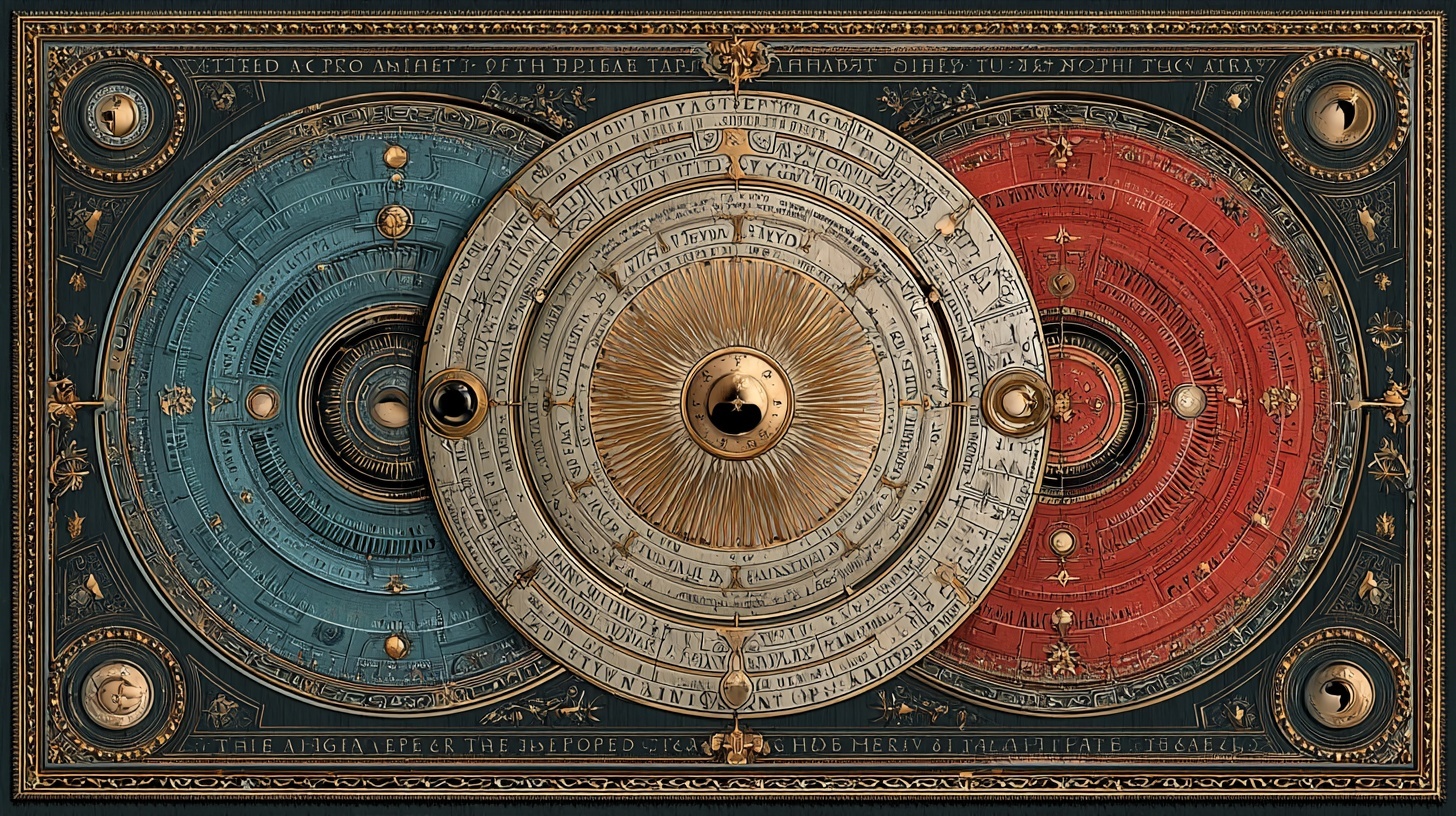
Mortals describe the structure of reality in metaphors that vary by culture but share a single theme. The world is imagined as layered, each plane overlapping the next like thin sheets of glass. The material realm sits at the center, its reflection mirrored above and below by dimensions of spirit, shadow, and dream. The Umbra cuts through these layers, binding them together even as it divides them. It is the thread that holds the tapestry in place while also fraying it at every edge.
This fragility shapes every philosophy and every act of creation. When an Arcanist records the behavior of light near the Umbra, or when a priest defines the boundaries of a soul, both are engaging with the same uncertainty. Neither can claim to know where one reality ends and another begins. The stars themselves do not obey consistent motion, and the passage of time bends more sharply near the edges of the known world. These inconsistencies are not errors. They are the natural state of a cosmos that remembers too many versions of itself.
For those who seek meaning in this instability, metaphysics offers both comfort and danger. To understand the laws that bind Aerith is to risk seeing how easily they can be undone. To learn how thought shapes reality is to recognize how fragile thought itself can be. Yet it is within this uncertainty that life continues. Creation did not end with the Shattering. It adapted, fractured, and began again. Every act of will, every story told, every spark of magic becomes another small attempt to rebuild what was once lost.
In the end, Aerith’s cosmology is not a hierarchy of divine order or a map of fixed stars. It is an ongoing act of remembrance. The world endures not because it is whole, but because it refuses to forget what wholeness felt like. Every realm, every soul, every echo that crosses the Umbra contributes to that memory. The study of metaphysics is not the search for perfection. It is the attempt to understand a world that continues to exist in defiance of its own destruction.

Unless otherwise noted and displayed here here, all "art" is the creation of SolomonJack through Dall-E, Midjourney, Stable Diffusion & LeonardoAI
© Brian Laliberte 1993 - 2026. All rights reserved.
Unknown Shores is an original fantasy setting. Unauthorized reproduction, distribution, or adaptation without permission is prohibited.
This work includes material from the System Reference Document 5.2.1 (“SRD 5.2.1”) by Wizards of the Coast LLC, available at D&D Beyond