

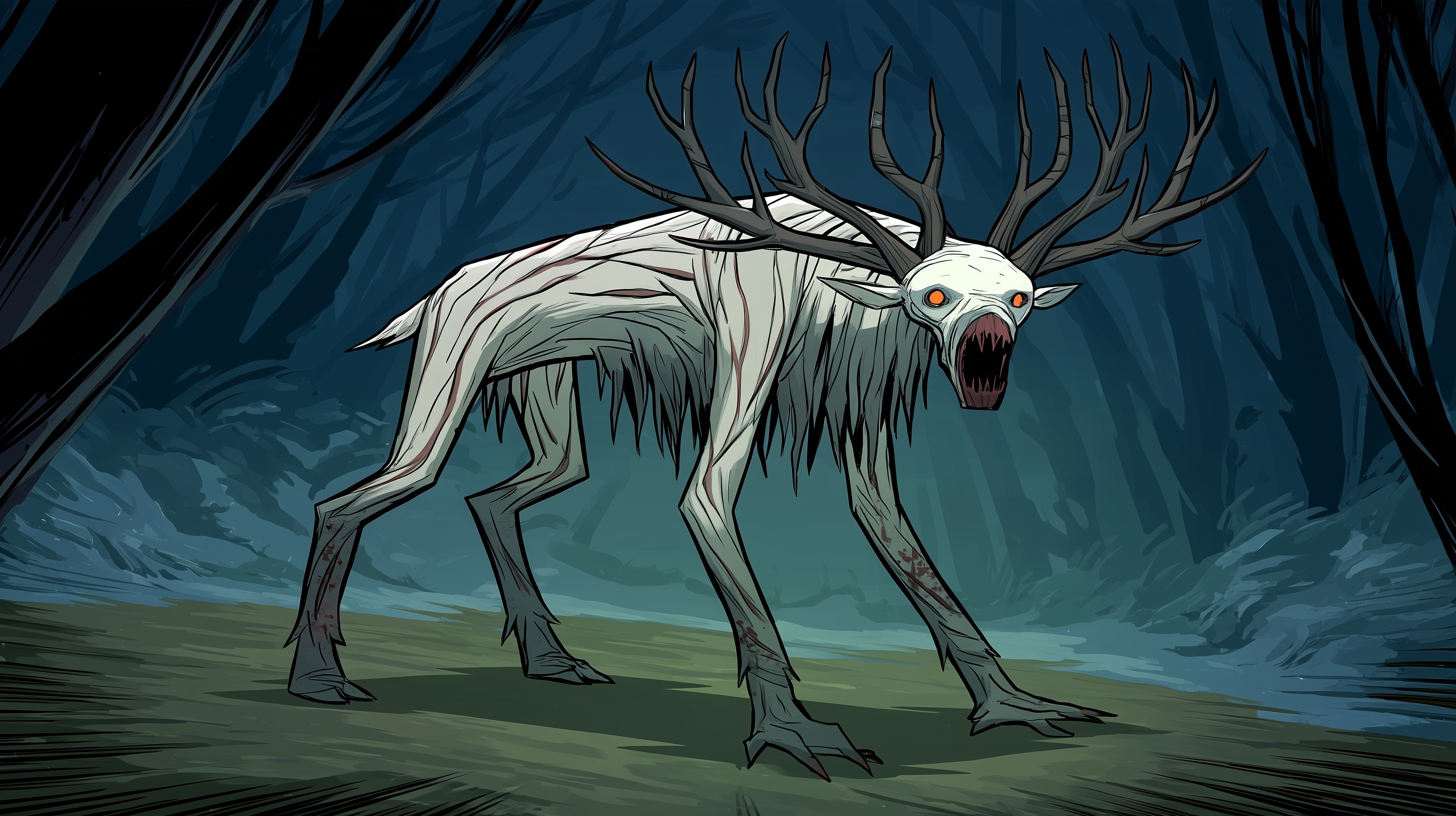
Vareth

Silent Horror

"The loudest warning the forest can give is birdsong. The last warning it gives is silence."
— The White Crown, Act II, Scene IV
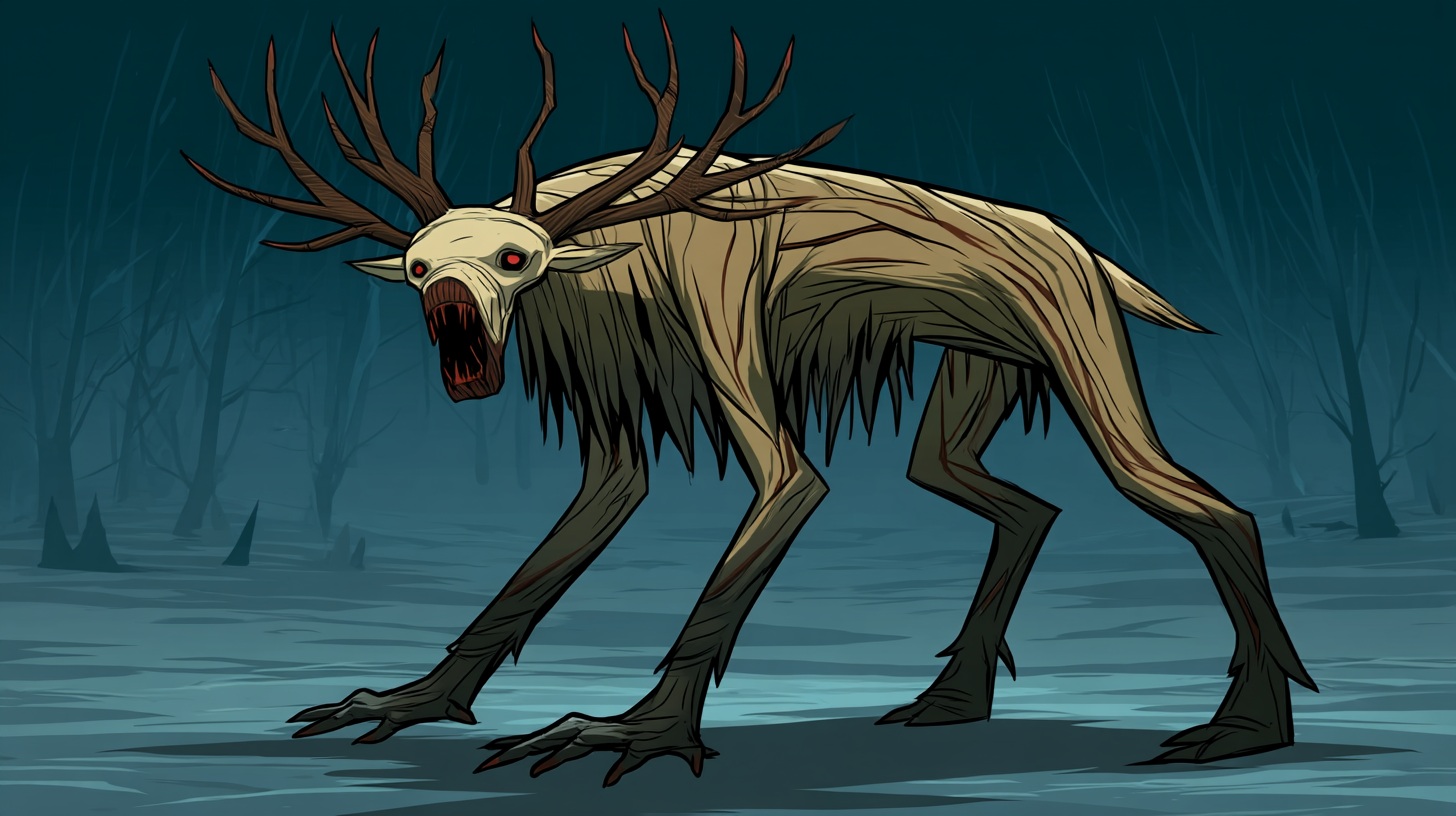
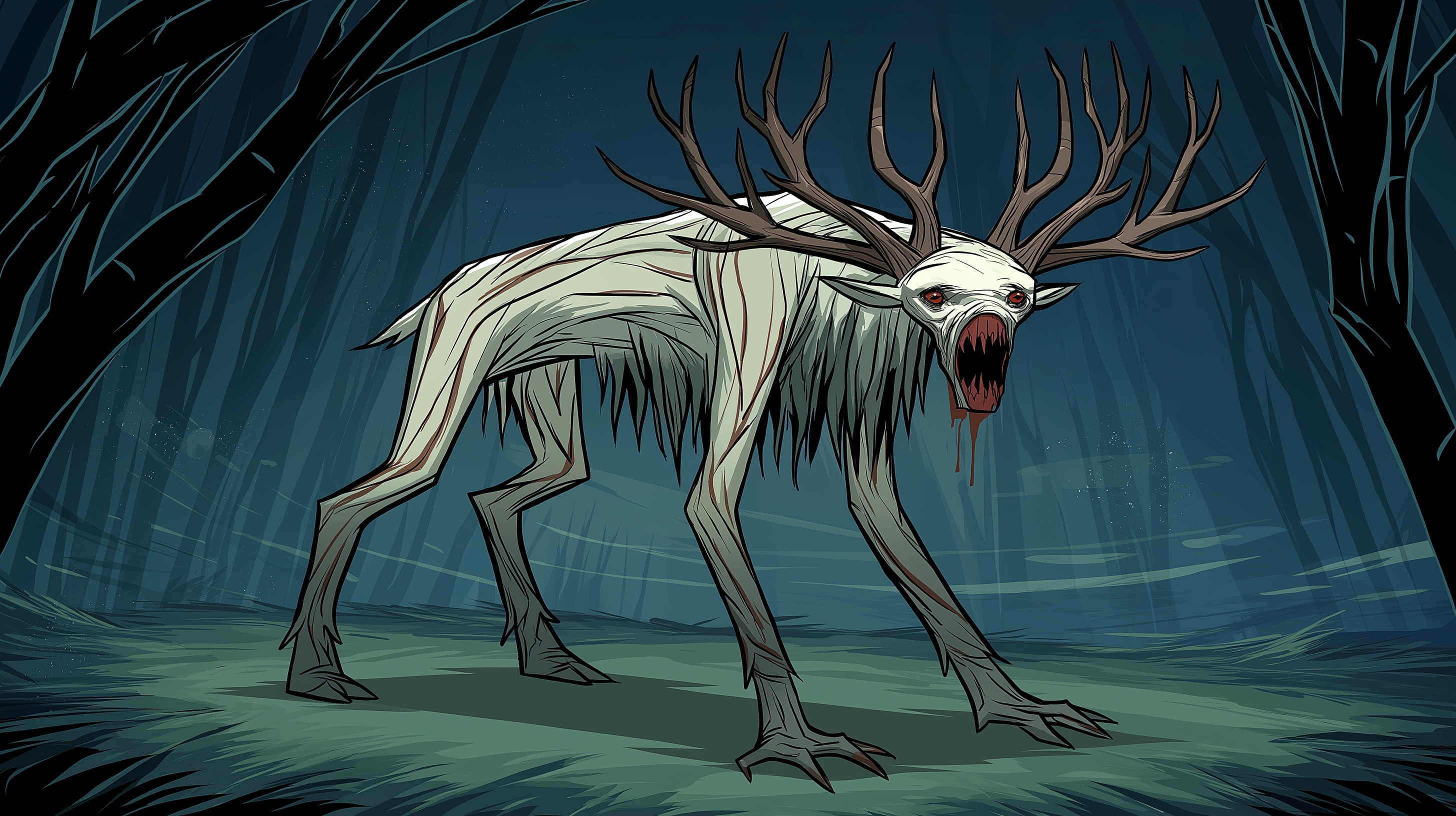
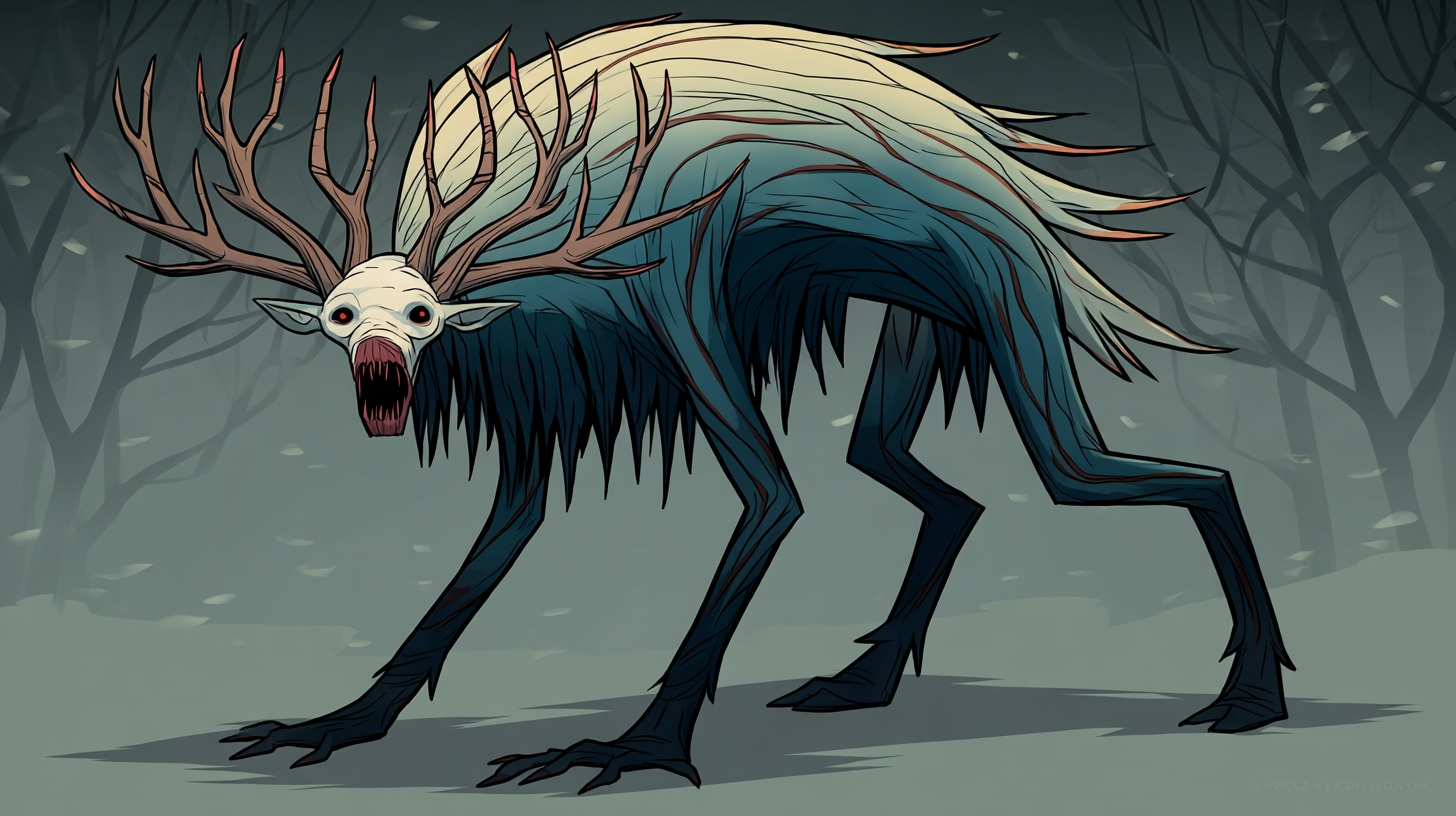
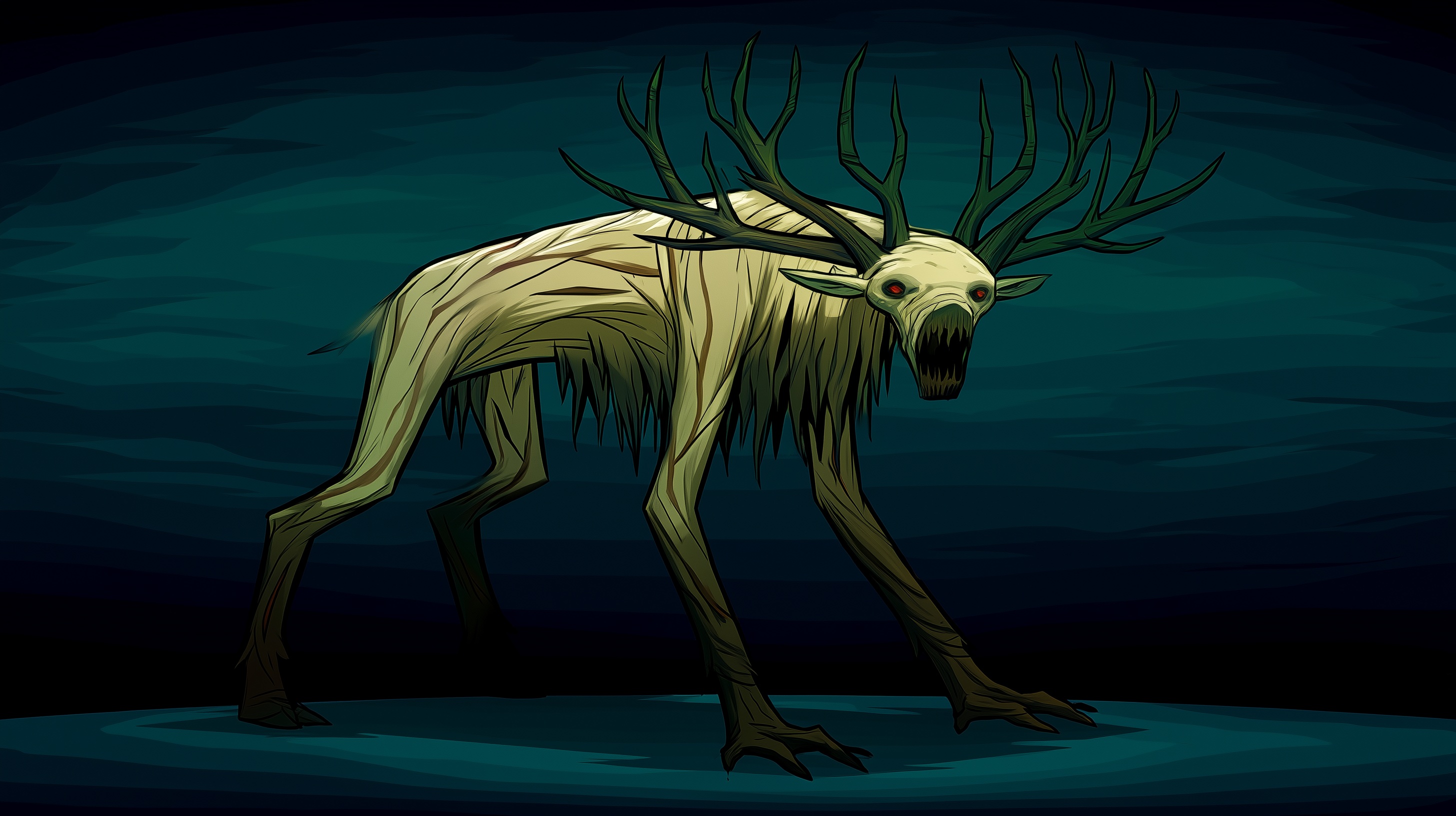
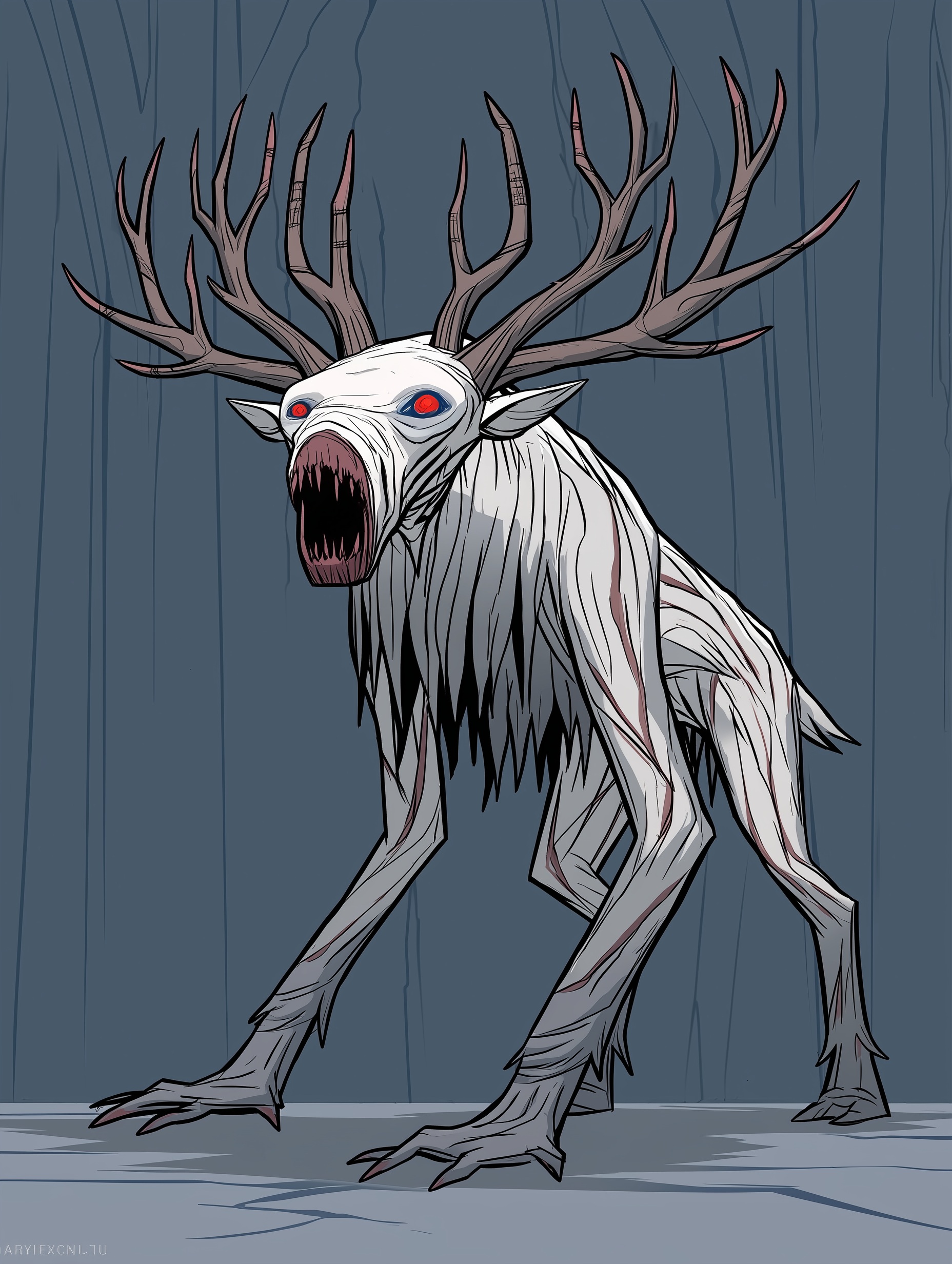
The Vareth is among the most infamous predators ever born of the Sylvan Plague, a creature whose very presence has reshaped both the forests it inhabits and the folklore of those who live nearby. Although its distant silhouette resembles that of a pale stag standing motionless beneath ancient trees, the resemblance ends there. Its elongated limbs terminate in grasping claws instead of hooves. A sprawling crown of living antlers rises above a head dominated by a permanently open mouth lined with barbed mandibles. Tiny crimson eyes stare vacantly into the forest, contributing almost nothing to how the creature perceives the world.   That appearance is no accident.   Every aspect of the Vareth's anatomy has been refined for a single purpose: becoming the perfect ambush predator. It does not rely on keen eyesight, speed over distance, or overwhelming strength alone. Instead, it experiences the forest through a bewildering array of specialized sensory organs capable of detecting the faintest movement of air, the slightest vibration beneath the earth, and the invisible chemical traces carried upon the wind. By the time most creatures realize a Vareth is nearby, it has often been aware of them for hours.   Unlike wolves, bears, or other apex predators, the Vareth possesses extraordinary patience. Individuals have been observed remaining perfectly motionless for days, becoming so completely integrated into their surroundings that moss, lichens, and even nesting birds begin to treat them as part of the forest itself. Only when prey enters striking distance does the illusion end, as the creature erupts into explosive motion with terrifying speed before vanishing back into stillness once the hunt is over.   Today, the Vareth survives only within the oldest forests, where abandoned shrines, forgotten druidic circles, and ancient wounds left by the Sylvan Plague still linger beneath the trees. It is rarely seen, seldom understood, and almost never survived by those careless enough to mistake its silence for safety. Across countless cultures it has become less a beast than a warning, a living reminder that there are places where nature itself was changed into something profoundly and irrevocably wrong.


Basic Information

Anatomy

"I watched it for nearly a minute before I realized the moss on its antlers was swaying in the wind... and the antlers weren't. Then it breathed."

— Willem Hurst, survivor of the Black Briar Expedition
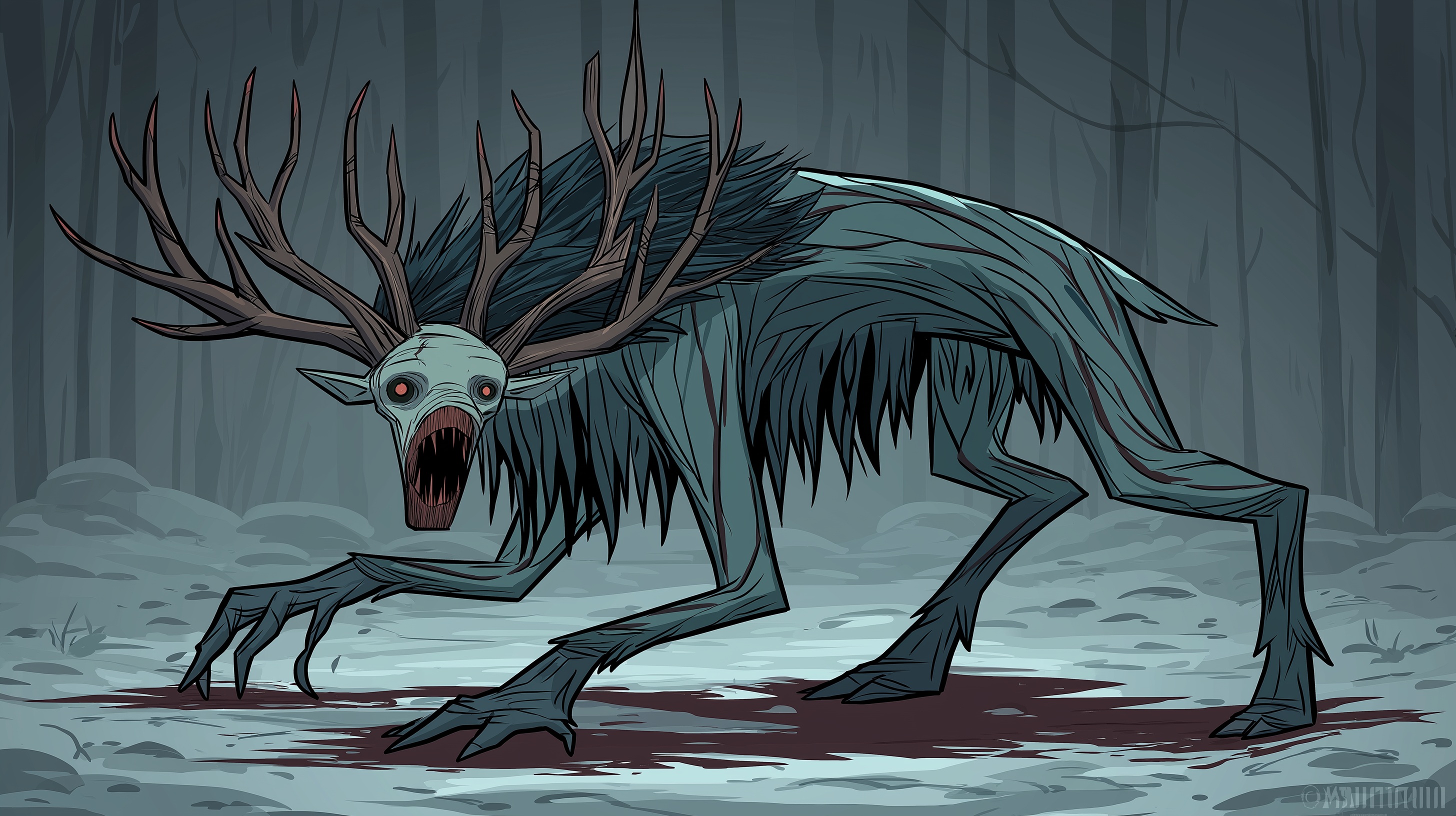
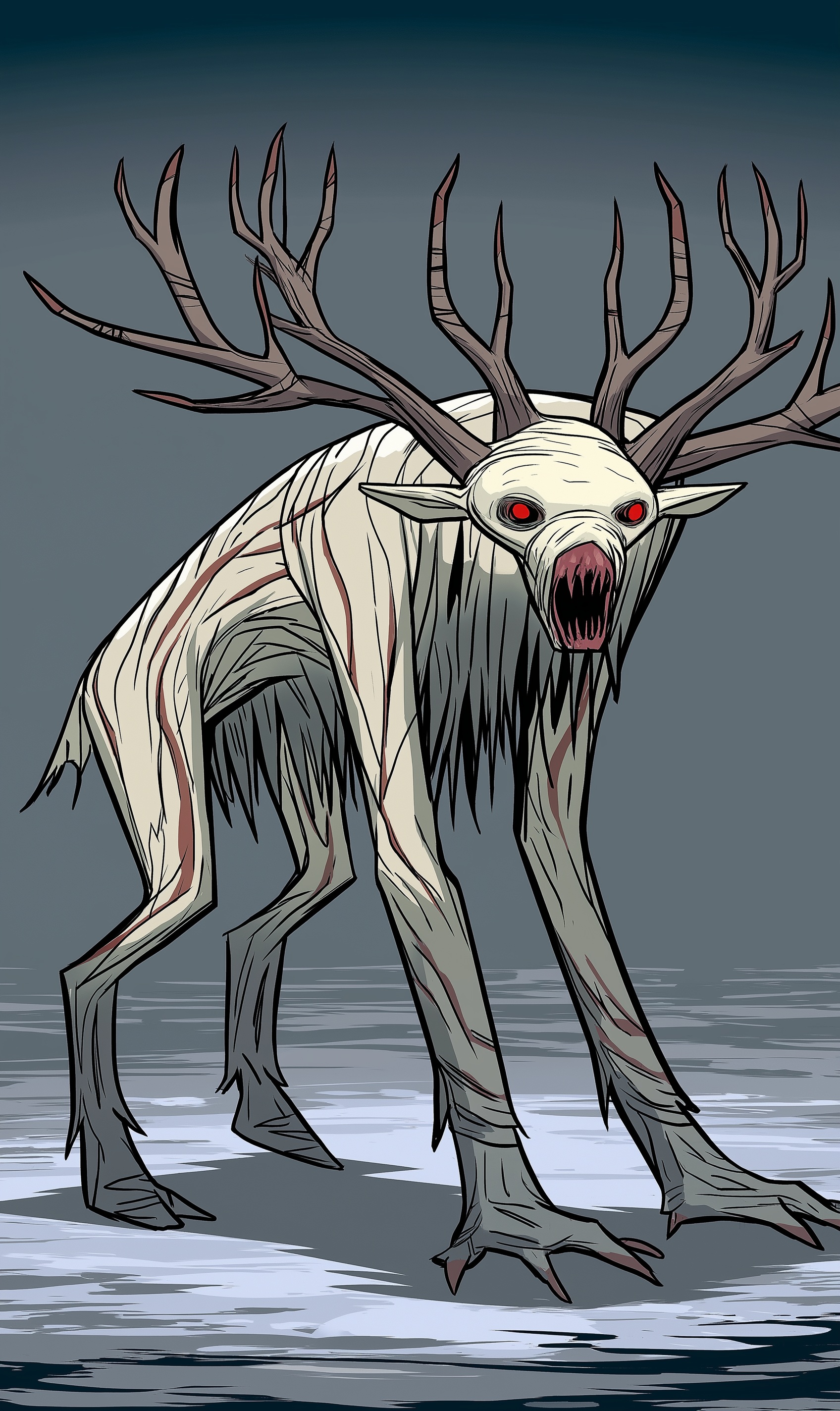
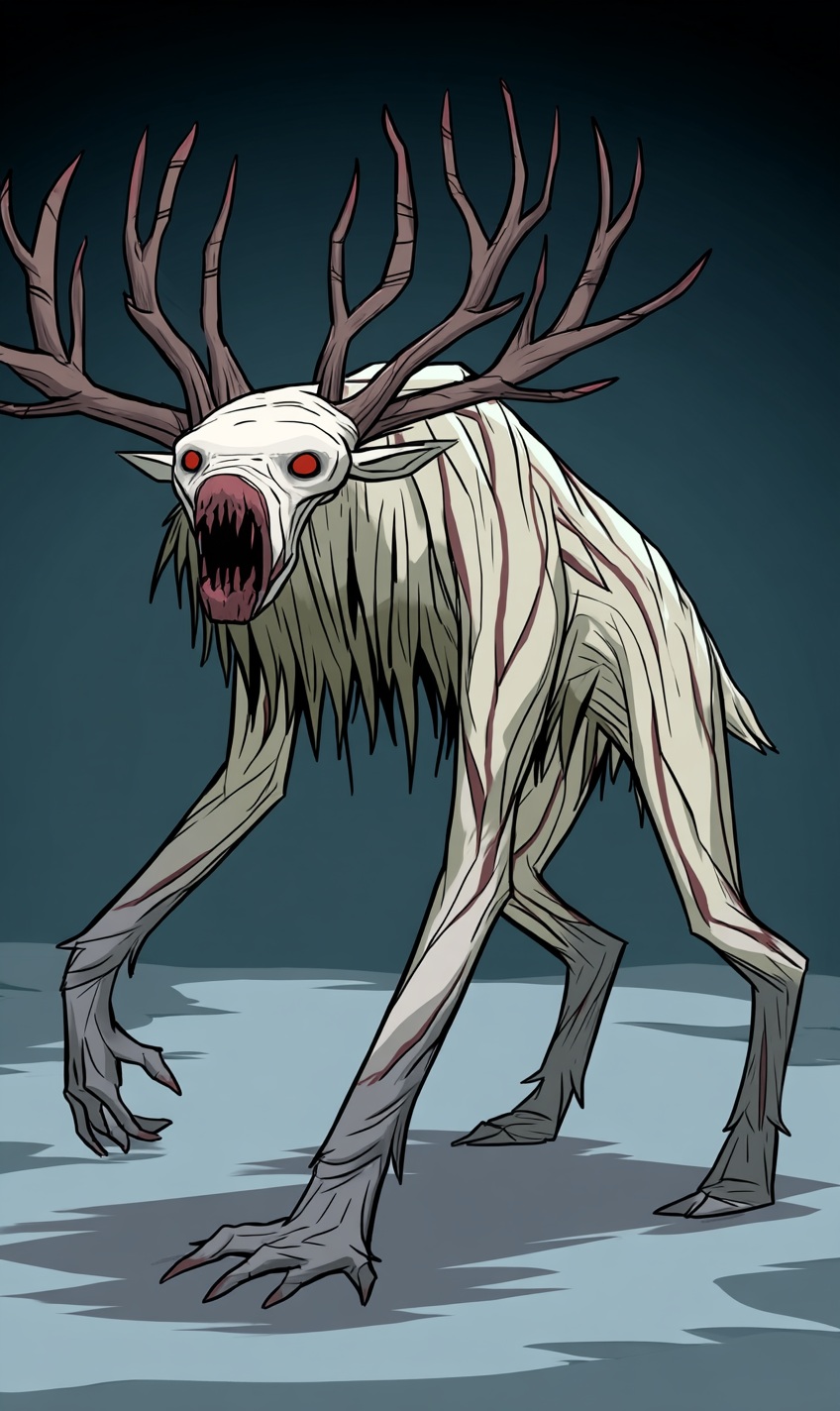
The Vareth's appearance has inspired countless legends, most of them wrong. Travelers describe it as a cursed stag, a malformed spirit, or a forest demon wearing the shape of a deer. Such comparisons, while understandable, fail to capture the unsettling precision of its anatomy. Nothing about the Vareth appears accidental. Every distortion serves a purpose. Every apparent deformity has become an adaptation.   From a distance, the creature's silhouette is unmistakably cervine. It stands upon four long limbs beneath a broad crown of branching antlers, often motionless enough to be mistaken for an old stag grazing beneath the trees. Only when viewed closely does the illusion begin to unravel. The proportions are subtly but profoundly wrong. The shoulders rise too high above the hips. The neck is unnaturally slender. The forelimbs are disproportionately long, ending not in cloven hooves but in four immense grasping claws capable of manipulating prey with frightening dexterity.   Adult Vareths possess a lean, almost skeletal physique despite weighing nearly half a ton. Their bodies contain remarkably little excess fat, instead concentrating dense bands of muscle around the shoulders, spine, and hindquarters. This gives the creature an appearance of perpetual starvation that belies its tremendous physical strength. The elongated frame acts much like a coiled spring, storing energy while the animal remains motionless before releasing it in a single explosive burst capable of covering astonishing distances in moments.   The hide itself is equally distinctive.   Rather than fur in the conventional sense, the Vareth is covered in coarse, pale fibers resembling weathered bark, dried grass, or dead moss. Their coloration ranges from chalk white to faded gray depending upon age and environment, allowing dust, fungal spores, fallen leaves, and patches of moss to accumulate naturally across the body. This living camouflage becomes more convincing with every passing season. Ancient specimens often appear less like animals than sections of forgotten woodland that have somehow learned to breathe.   The creature's most recognizable feature remains its crown.   Unlike the antlers of true deer, which are shed and regrown annually, a Vareth's crown is permanent living tissue that grows continuously throughout its life. Every branch remains vascularized and richly supplied with nerves, producing an intricate latticework that expands year after year without ever being discarded. Young adults possess relatively compact crowns with smooth branching tines, while older individuals develop immense, sprawling structures whose oldest sections eventually die, crack, and weather beneath the forest canopy. Mosses, lichens, bracket fungi, climbing vines, and even nesting birds frequently colonize these dead portions, making venerable Vareths nearly indistinguishable from ancient trees until they move.   Beneath the surface of this crown lies one of the most sophisticated sensory structures known in the natural world. Millions of microscopic mechanoreceptive hairs cover every living branch, detecting disturbances in moving air with astonishing precision. These sensory hairs continue across much of the creature's exposed skin, effectively transforming its entire body into an immense pressure-sensitive organ capable of perceiving movement long before it could ever be seen.   The head departs dramatically from that of any natural cervid.   Its eyes are tiny, deeply recessed, and permanently blood-red, serving primarily to distinguish light from darkness. The reduced visual apparatus gives the creature an unnerving, vacant stare, as though it constantly looks through rather than at those standing before it. Anatomically, the eyes are among the least important organs the Vareth possesses.   Far more striking is its mouth.   The jaws never fully close. Elongated lower mandibles project upward into a cage of recurved barbs that permanently expose the mouth's interior. This arrangement appears grotesquely impractical until one recognizes its dual function. It allows uninterrupted airflow across highly specialized chemoreceptive tissues lining the oral cavity while simultaneously creating one of the most effective anchoring mechanisms found in any terrestrial predator. Once those barbs penetrate flesh, escape becomes extraordinarily difficult without outside assistance.   The Vareth's forelimbs complete this anatomical design. Long and heavily muscled, they terminate in four hooked claws capable of tremendous grip strength and surprising dexterity. Unlike the crushing paws of bears or the slicing talons of great cats, these claws exist primarily to stabilize and tear. After the mandibles secure a victim, the forelimbs become the principal killing tools, repeatedly raking exposed tissue while the jaws prevent escape. The result is a feeding strategy unlike that of wolves, felines, or raptorial birds, combining elements of each into something uniquely horrific.   Its hind limbs tell a different story.   Massive tendons and enlarged muscle groups provide explosive acceleration rather than sustained endurance. The Vareth is capable of astonishing bursts of speed across short distances, but prolonged pursuit is neither necessary nor desirable. Every aspect of its lower body reinforces the same biological strategy: remain perfectly still until the precise moment action becomes unavoidable, then close the distance before prey can react.   Taken as a whole, the Vareth's morphology reflects extraordinary specialization. It has sacrificed speed over distance for speed at the moment of attack. It has exchanged visual acuity for overwhelming sensory awareness. It has abandoned conventional jaws in favor of a living grappling mechanism, and transformed a stag's crown into one of the most sophisticated sensory arrays ever observed.   It is, in every respect, an organism built not to chase its prey.   Only to ensure that escape is never an option once it decides to move.

Biological Traits

"Nothing in this world or the next should stand that still... or move that fast."
— Dain Dryen, big game hunter
The Vareth is a masterpiece of biological specialization, though one born from profound corruption rather than natural evolution. At first glance, nearly every aspect of its anatomy appears grotesque or malformed. Closer examination reveals the opposite. Every feature, from its elongated limbs to its permanently open jaws, serves a precise purpose. Nothing about the creature is ornamental. Every structure contributes to a hunting strategy refined around overwhelming sensory awareness, explosive acceleration, and the rapid incapacitation of prey.   Its skeletal frame is remarkably light for an animal of its size. Long, narrow bones reduce overall mass while providing broad attachment points for dense musculature concentrated around the shoulders, spine, and hindquarters. This arrangement allows the Vareth to remain motionless for extended periods with minimal energy expenditure before unleashing bursts of extraordinary speed over short distances. It is built not for endurance, but for violent acceleration.   The creature's pale hide further distinguishes it from the forests it inhabits. Rather than fur, much of its body is covered by a thin layer of coarse, colorless fibers resembling weathered bark or dried moss. These fibers readily collect dust, lichens, leaves, and fungal spores, allowing a motionless Vareth to gradually become part of its surroundings. Older individuals often appear partially overgrown, their bodies supporting patches of moss and climbing ivy that remain undisturbed for months at a time. The camouflage is so effective that even experienced woodsmen have mistaken a resting specimen for nothing more than an unusually twisted tree stump.   The crown remains the defining feature of the species.   Unlike the seasonal antlers of true deer, a Vareth's branching crown is permanent living tissue that never completes ossification. It grows continuously throughout the creature's life, producing increasingly elaborate branching structures with age. Young specimens possess relatively compact crowns, while ancient individuals may support antlers extending several feet beyond their bodies in every direction. As these immense structures continue growing, older sections gradually die, fracture, and become colonized by mosses, fungi, lichens, and even nesting birds, giving venerable specimens the appearance of living trees.   The crown's true purpose, however, lies beneath its surface. Every branch remains densely supplied with nerves and covered by countless microscopic sensory hairs capable of detecting the faintest disturbances in moving air. Similar structures extend across much of the creature's body, effectively transforming the entire animal into a living pressure sensor. This remarkable adaptation allows the Vareth to perceive movement with extraordinary precision while remaining almost entirely independent of vision.   Its eyes reflect this specialization.   Tiny, crimson, and often appearing unfocused, they provide only limited information regarding light, darkness, and broad movement. Anatomical examinations suggest the optic nerves are dramatically reduced compared to those of similarly sized mammals, while the regions of the brain devoted to processing tactile and chemical information are exceptionally well developed. The Vareth has not lost its sight through degeneration alone. It has traded one sense for several others far better suited to its environment.   Perhaps no feature is more unsettling than its mouth.   The permanently open jaws cannot close completely due to the elongated, barbed mandibles that protrude from the lower jaw. This apparent deformity is entirely functional. Specialized sensory tissues lining the mouth and throat continually sample airborne chemicals, allowing the creature to detect blood, decay, smoke, predators, prey, and countless other environmental cues. The constantly open mouth ensures uninterrupted airflow across these organs, sacrificing conventional feeding mechanics for vastly superior chemical perception.   When prey is finally captured, the jaws reveal their second function.   Rather than delivering crushing bites like those of wolves or bears, the Vareth's mandibles act as biological anchors. Curved barbs drive deep into flesh before locking into place, making escape extraordinarily difficult without outside assistance. Once attached, the creature relies upon its elongated forelimbs to inflict the majority of the fatal injuries, using powerful claws to tear repeatedly while the jaws prevent the victim from escaping.   The forelimbs themselves are unlike those of any known cervid. Long, flexible wrists terminate in four immense claws capable of grasping, stabilizing, and rending prey with horrifying efficiency. Their range of motion allows the Vareth to manipulate struggling victims far more effectively than most quadrupedal predators, while the shortened hindquarters generate the explosive force necessary to launch the initial ambush.   Internally, the species possesses an exceptionally efficient cardiovascular and respiratory system capable of sustaining sudden bursts of intense exertion. This efficiency is balanced by surprisingly low metabolic demands during periods of inactivity, allowing a Vareth to remain perfectly motionless for days while expending remarkably little energy. Such patience forms the foundation of its entire hunting strategy.   Taken together, these adaptations reveal an organism that has abandoned versatility in favor of absolute specialization. The Vareth is not built to chase, defend territory through prolonged conflict, or compete with other predators. It is built to wait, perceive, accelerate, and kill.   Everything else has simply become unnecessary.

Ecology and Habitats

"The first Vareth wasn't created by hatred. It was created by those who believed they could command powers holier than themselves."
— from The Lament of Hollow Grove
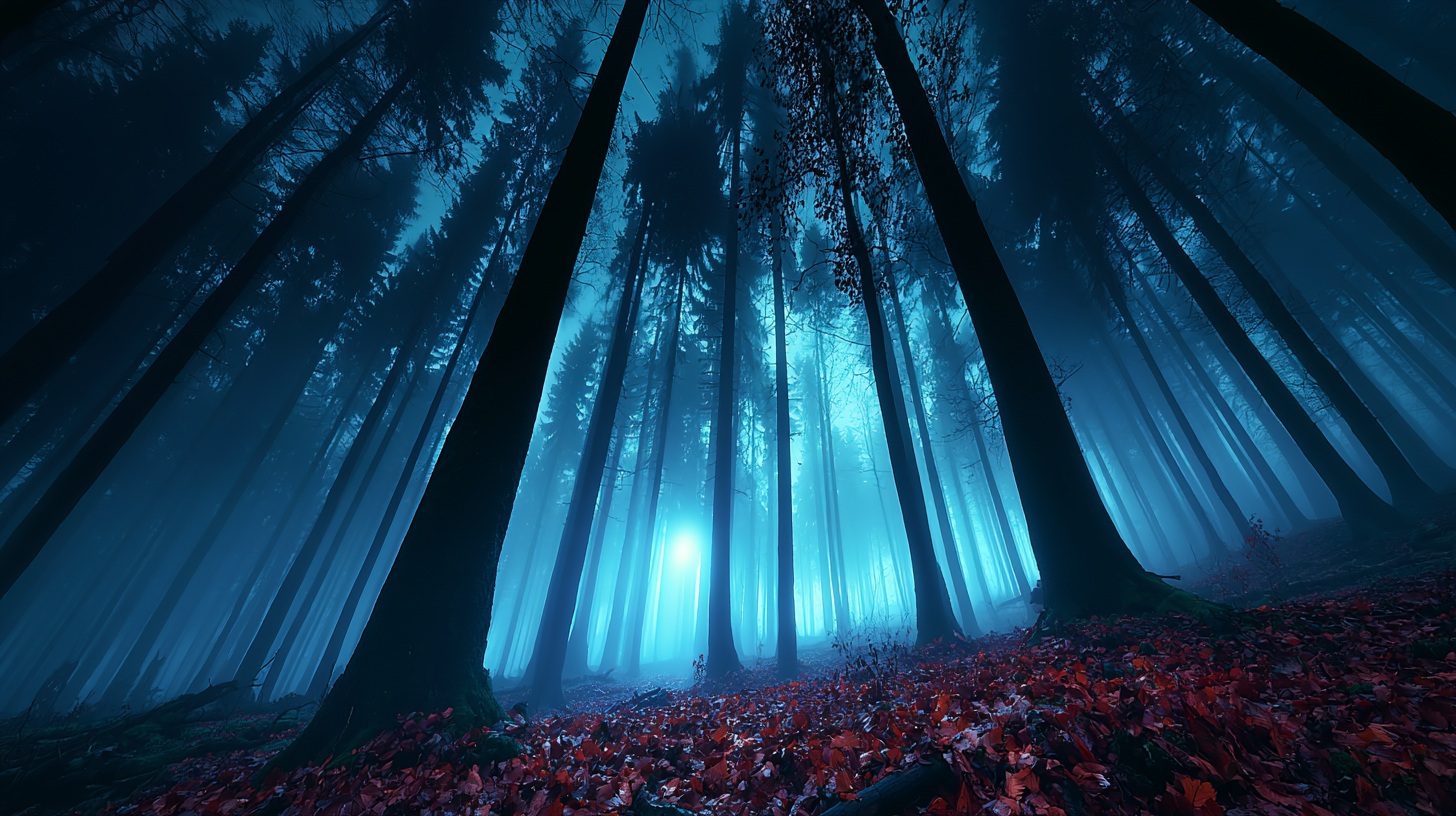
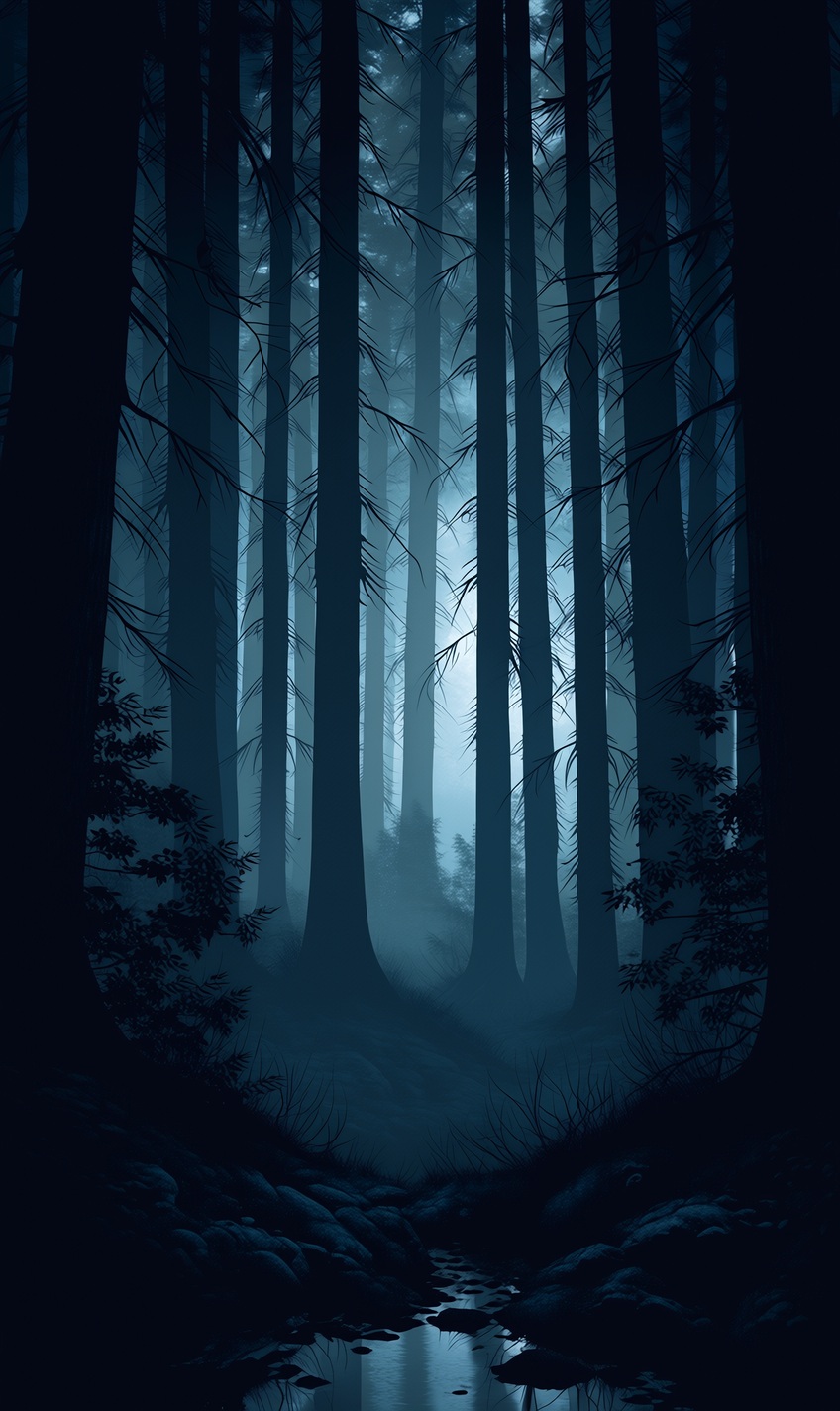
The Vareth exists only where forests have been allowed to grow old enough to remember another age. Every confirmed specimen has been documented within ancient woodland, almost always surrounding forgotten shrines, abandoned druidic circles, ruined temples, or other sacred places scarred during the earliest years of the Sylvan Plague. Whether these sites continue to sustain the species through lingering magical corruption or merely provide the undisturbed habitat it requires remains a matter of considerable debate. Whatever the explanation, the relationship between the creature and these ancient forests appears inseparable.   A single Vareth occupies an immense hunting territory.   Unlike wolves, bears, or great cats, it displays little interest in defending clearly defined borders. Instead, it drifts silently through a vast range, often remaining within one grove for weeks before relocating to another without any apparent pattern. Rangers who have attempted to chart these movements have found no regular patrol routes or favored circuits. The Vareth simply appears where conditions favor the hunt, then vanishes again before anyone can predict where it will emerge next.   Despite this seemingly random movement, its influence upon the surrounding ecosystem is unmistakable.   The most obvious sign is silence.   Bird populations gradually abandon nesting sites within its territory. Herd animals alter migration routes that may have existed for generations. Smaller predators disappear entirely, either displaced through competition or killed outright. Even scavengers become noticeably scarce. The result is not an empty forest, but one that feels profoundly unnatural to anyone accustomed to healthy woodland. The insects remain. The trees continue to grow. The wind still moves through the canopy.   Yet something essential is missing.   The forest no longer speaks.   Naturalists believe this silence develops over many years rather than appearing immediately after a Vareth claims a territory. Individual animals that survive encounters learn to avoid areas where the creature frequently hunts. Their offspring inherit those altered behaviors through experience rather than instinct, gradually reshaping the movement of entire populations. Over decades, familiar game trails vanish beneath new growth, nesting grounds stand abandoned, and once-busy clearings become eerily still. To experienced foresters, this absence of ordinary woodland life is often the earliest warning that a Silent Crown has made the forest its home.   The Vareth itself appears remarkably well suited to such environments.   Its pale body collects mosses, lichens, fungal spores, bark fragments, and fallen leaves with astonishing efficiency, allowing older individuals to blend seamlessly into forests that have remained undisturbed for centuries. Ancient specimens often become miniature ecosystems in their own right. Dead sections of their ever-growing crowns support moss gardens, bracket fungi, climbing vines, and even the nests of unsuspecting birds. Insects burrow into weathered antler tissue. Small amphibians shelter within rainwater trapped among the branching tines. Entire communities of woodland life may unknowingly establish themselves upon one of the forest's deadliest predators.   Until it moves.   Unlike many apex predators, the Vareth exerts relatively little direct pressure upon prey populations through sheer numbers. Solitary by nature, each individual kills only what it requires to survive. Nevertheless, its extraordinary hunting efficiency ensures that few animals willingly remain within its preferred hunting grounds. The ecological consequences therefore arise less from predation than from avoidance. Whole communities simply relocate, creating curious pockets of forest where vegetation flourishes despite the conspicuous absence of browsing herbivores.   These changes ripple outward through the ecosystem.   Young saplings survive in unusually high numbers where deer no longer graze. Certain flowering plants become unexpectedly abundant. Smaller predators establish territories along the edges of a Vareth's range, feeding upon displaced prey while carefully avoiding the silent heart of the forest. Even fungal communities appear unusually diverse, benefiting from the undisturbed accumulation of fallen timber and leaf litter.   Whether the Vareth itself contributes to these ecological shifts intentionally is doubtful.   Everything about its behavior suggests a creature acting entirely according to instinct. It neither cultivates nor defends its environment. The transformed forest is simply the inevitable consequence of an apex predator so efficient that nearly every other animal learns to live somewhere else.   One mystery continues to perplex scholars above all others.   No reliable observer has ever documented two adult Vareths sharing the same territory. Whether they recognize one another through scent, avoid occupied forests by instinct, or simply eliminate rivals before such encounters can be witnessed remains unknown. Equally puzzling is the complete absence of confirmed juveniles. If the species reproduces naturally, it does so with extraordinary secrecy. Some natural philosophers have even proposed that every living Vareth may be a survivor from the earliest years of the Sylvan Plague, explaining both their apparent rarity and their strong association with ancient sacred sites.   For now, such ideas remain speculation.   What is certain is that forests inhabited by a Vareth possess a character unlike any other wilderness. They are not lifeless. They are simply cautious.   Every creature within them behaves as though it has learned the same lesson.   Some things survive by remaining unseen.   Others survive by ensuring nothing else ever forgets they are there.

Dietary Needs and Habits

"Nature can forgive an axe. It can forgive a fire. But when the profane is driven into the heart of something sacred, the wound doesn't always heal. Sometimes... it learns to hunt."
— Brother Caspian, Meditations on the Sylvan Plague
The Vareth is an obligate carnivore whose entire anatomy is specialized for the rapid capture and complete consumption of large prey. Unlike many apex predators, however, it is neither an opportunistic scavenger nor an indiscriminate hunter. It feeds infrequently, relying upon extraordinarily successful ambushes rather than repeated pursuits to satisfy its considerable nutritional needs. A healthy adult may consume only a handful of large animals each month, yet each successful kill provides enough nourishment to sustain the creature through long periods of inactivity.   Large herbivores form the foundation of its diet. Deer, elk, wild cattle, musk oxen, giant boars, and similarly sized animals are taken whenever available. Smaller prey such as rabbits, foxes, or birds are largely ignored unless larger game has become unusually scarce. The energy required to launch an ambush simply outweighs the nutritional value of such modest meals.   Humanoids are neither preferred nor avoided.   To the Vareth, they are simply another large mammal moving through the forest.   This indifference has fueled countless superstitions. Many rural communities believe the creature actively seeks out travelers, pilgrims, or woodcutters, when in reality it responds only to opportunity. A lone hunter crossing an ancient grove presents no meaningful biological distinction from a stag following the same trail moments earlier. The Vareth does not recognize species in the way humans do. It recognizes movement, scent, size, and vulnerability.   Its method of killing is as distinctive as its appearance.   Unlike wolves, which rely upon exhaustion, or great cats, which suffocate struggling prey, the Vareth is built around immobilization. Its initial rush is intended to close the distance before its target can react. Once within reach, the elongated mandibles drive deeply into flesh, their recurved barbs locking into muscle with astonishing force. The bite itself is rarely fatal. Instead, it serves as an anchor, preventing escape while the forelimbs become the principal killing tools.   Repeated slashing wounds rapidly weaken even the largest animals. Blood loss, shock, and catastrophic soft tissue damage eventually end resistance, often within moments of the initial attack. The Vareth shows little interest in prolonging the struggle. Every movement suggests an instinctive drive to silence its prey as efficiently as possible.   Once the animal ceases struggling, the feeding process begins almost immediately.   The Vareth displays none of the territorial defensiveness commonly associated with predators feeding upon a fresh kill. It neither drags carcasses into concealed dens nor attempts to cache excess food beneath soil or vegetation. Instead, it feeds where the animal fell, relying upon the extraordinary isolation of its territory rather than concealment to protect its meal.   Consumption is remarkably thorough.   Powerful digestive enzymes and specialized dentition allow the Vareth to process nearly every edible tissue. Muscle, organs, connective tissue, cartilage, marrow, and even much of the skeleton are gradually consumed. Only the densest materials typically remain. Hair accumulates in loose windblown clumps. Teeth resist digestion entirely. Antlers, horns, and polished sections of major bone are often left scattered beneath nearby trees alongside buckles, tools, jewelry, and other indigestible objects carried by unfortunate travelers.   These unusual remains frequently provide the first tangible evidence that a Vareth inhabits the surrounding forest.   Recovered skeletons display another peculiarity.   Unlike carcasses consumed by wolves or bears, Vareth kills often exhibit surprisingly few conventional bite marks. The anchoring mandibles leave deep punctures near the initial point of capture, but much of the remaining damage consists of long, parallel tears created by the foreclaws rather than the jaws. Larger bones frequently remain articulated even after soft tissues have disappeared almost entirely, producing eerily intact skeletons stripped with almost surgical efficiency.   Following a substantial meal, the Vareth may not hunt again for days or even weeks.   It returns to stillness, selecting a favorable position within its territory before becoming nearly indistinguishable from the surrounding woodland once more. During these extended periods of inactivity its metabolic demands appear remarkably low, allowing the creature to conserve energy until another suitable opportunity presents itself.   Curiously, the Vareth displays little interest in defending partially consumed carcasses.   Scavengers bold enough to approach after the predator has departed often feed undisturbed, provided they do not encounter the creature itself. Ravens, foxes, insects, fungi, and countless smaller organisms eventually reclaim what little remains, returning nutrients to the forest in much the same way as any natural predator.   This behavior reinforces an important truth about the species.   Despite its terrifying appearance, the Vareth does not kill indiscriminately.   It does not hunt for sport.   It does not collect trophies.   It does not revel in suffering.   Like every true apex predator, it kills because it must, consumes what it requires, and then quietly disappears back into the forest, leaving only silence, polished bones, and the unsettling certainty that it is already waiting for the next creature careless enough to disturb its woodland home.

Additional Information

Geographic Origin and Distribution

"Walk long enough beneath ancient boughs and you'll discover wonders beyond imagining. Pray they discover someone else instead."
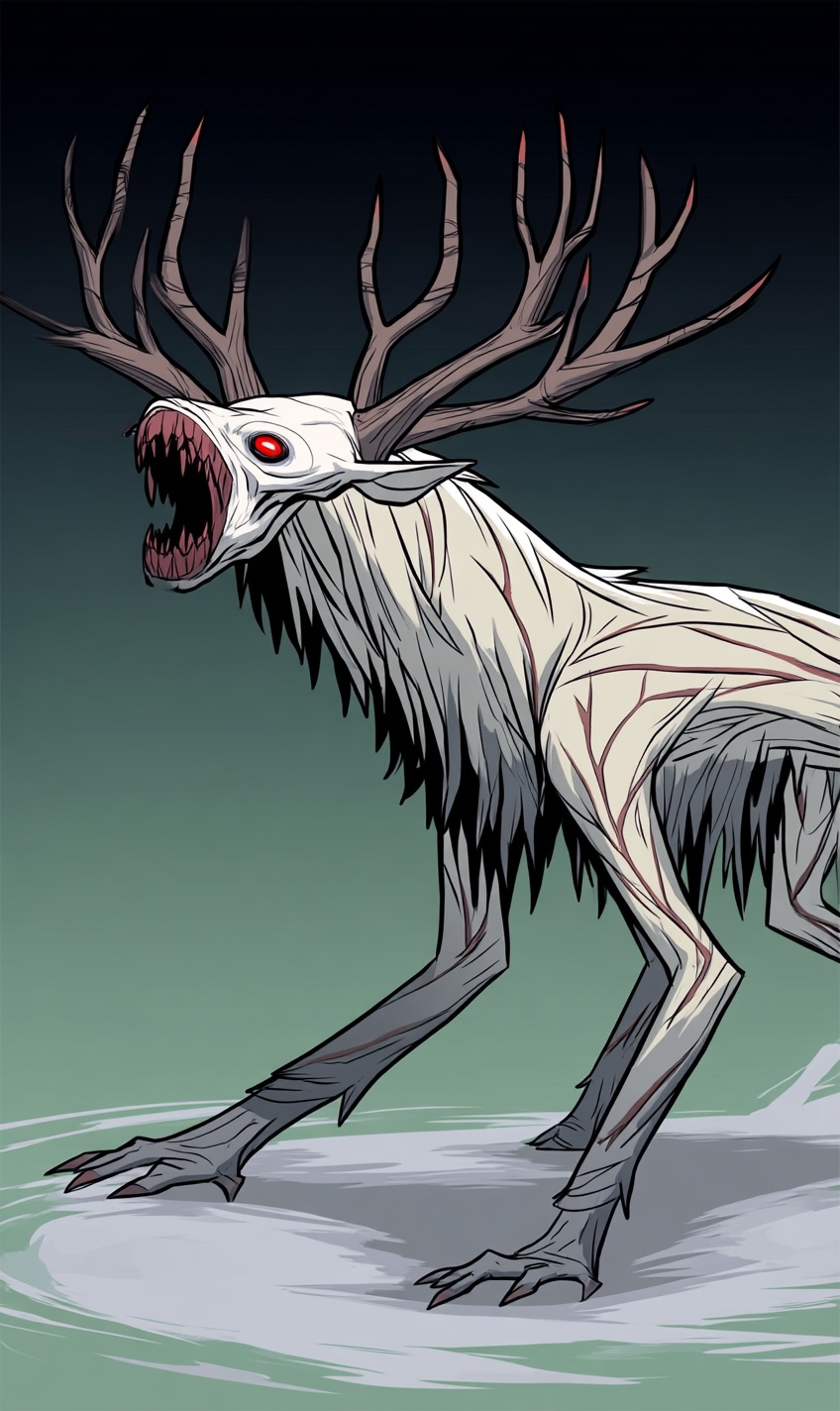
— The Pilgrim's Road, Act III, Scene I
The Vareth is among the most geographically restricted apex predators known. Despite centuries of exploration and countless recorded encounters, every verified specimen has been found within the oldest surviving forests of Aerith, almost always in places where the scars of the Sylvan Plague still linger upon the land. No confirmed Vareth has ever been documented in open plains, mountain ranges, deserts, marshes, or cultivated woodland. Whatever created the species appears inseparably tied to ancient forests that have remained largely untouched since the earliest days of the Plague.   Its distribution is therefore determined less by climate than by history.   Across every continent where the Sylvan Plague once took root, there exist forgotten pockets of woodland abandoned long ago by civilization. Ancient temples crumble beneath towering oaks. Overgrown shrines vanish beneath ivy and moss. Druidic circles stand broken among roots that have reclaimed their carved stones. These places, where the boundaries between the natural world and something profoundly unnatural were once violently disturbed, are where Vareths are most commonly encountered.   Naturalists have long debated whether these locations are merely favored habitat or whether they are essential to the creature's continued existence. Some believe the lingering magical corruption within these forgotten sanctuaries continues to sustain them. Others argue that the ancient forests simply provide the dense vegetation and stable ecosystems their remarkable hunting strategy requires. Neither theory fully explains why suitable forests untouched by the Sylvan Plague have never produced a confirmed sighting.   A single Vareth commands an astonishingly large territory.   Adult specimens appear fiercely solitary, patrolling hunting grounds that may encompass dozens of square miles of uninterrupted woodland. The exact boundaries are difficult to define because the creature itself moves with extraordinary patience, often remaining within a single grove for weeks before silently relocating to another corner of its domain. Rangers attempting to chart these territories have discovered that the Vareth does not patrol them in predictable circuits. Instead, it seems to drift through its forest according to patterns known only to itself, making encounters almost impossible to anticipate.   The effects upon the surrounding ecosystem become apparent long before the creature itself is ever seen.   Bird populations gradually abandon nesting sites within its territory. Herd animals alter migration routes that may have existed for generations. Predatory mammals become noticeably scarce, either driven away through competition or killed outright. Even insects often appear less abundant in the immediate vicinity of frequently used hunting grounds. To experienced woodsmen, the silence is unmistakable. A healthy forest is alive with constant movement and sound. A forest claimed by a Vareth feels as though every living thing has learned that remaining unnoticed is the safest path to survival.   Curiously, these ecological changes rarely extend beyond the creature's territory. A traveler may pass from vibrant woodland filled with birdsong into an unnaturally quiet stretch of forest in the space of only a few hundred yards. Such abrupt transitions have become one of the most reliable indicators that a Vareth occupies the area.   No reliable account has ever documented two adult Vareths sharing the same hunting grounds. Whether they actively seek one another out to compete, simply avoid territories already claimed, or possess some instinctive means of recognizing occupied forests remains unknown. The absence of confirmed juvenile specimens has only deepened this mystery. If the creatures reproduce naturally, they do so with extraordinary secrecy.   As a result, each known Vareth is treated by scholars less as part of a widespread population and more as an isolated ecological phenomenon. Individual specimens become known through local folklore, earning names that persist for generations. Entire forests are abandoned because of a single animal whose descendants, if it has any at all, may never be seen.   For those who study the Sylvan Plague, this limited distribution raises an unsettling possibility.   The Vareth may not be expanding its range because it no longer can.   Or perhaps it has simply never needed to. A single Silent Crown is often enough to convince an entire region that some places within the forest are better left unexplored.

Perception and Sensory Capabilities

"A quiet forest isn't always a dangerous forest. But if the birds stop singing after you call out, don't waste another breath. Something else already heard you."
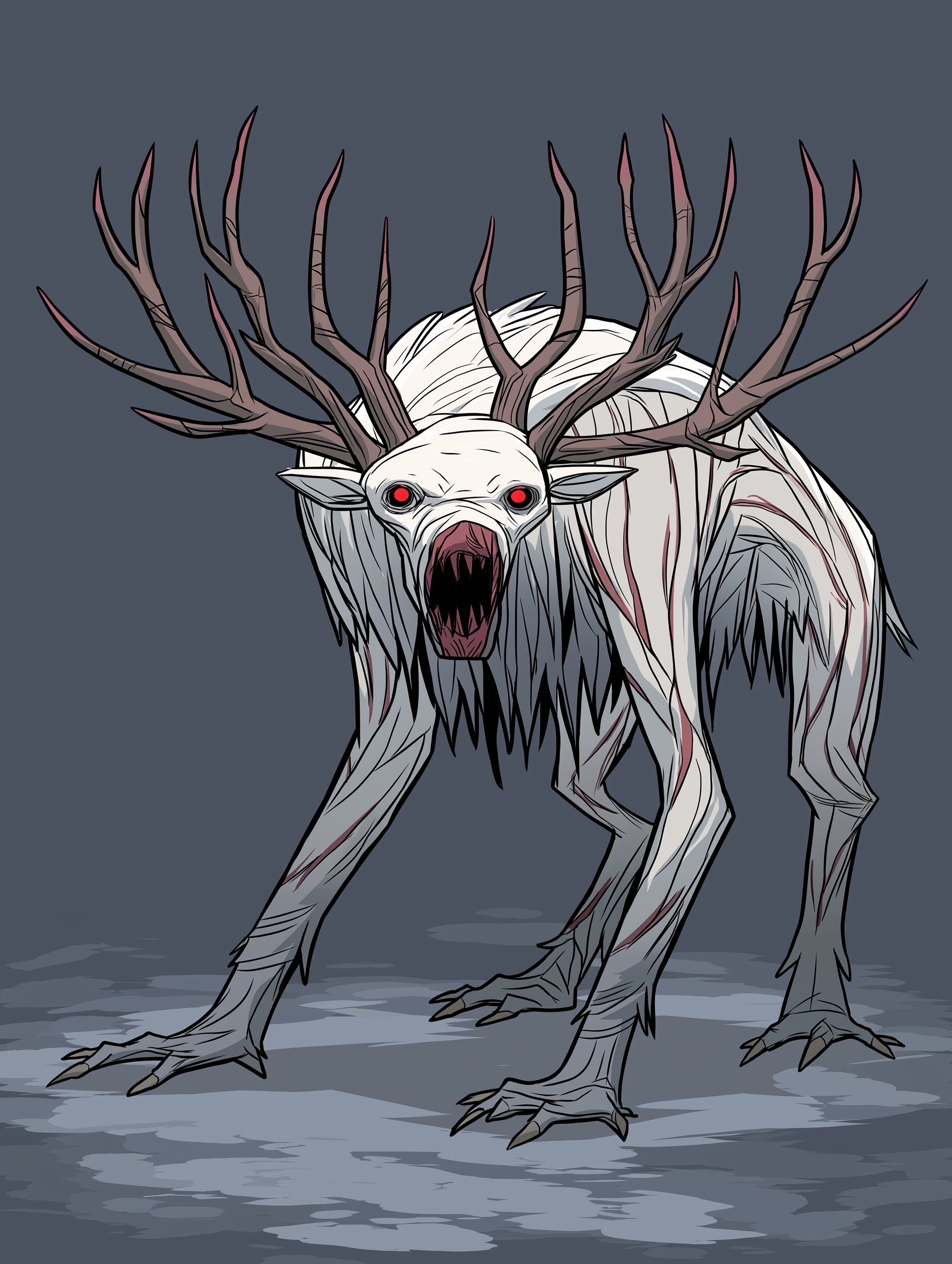
— Old Iorill Ranger's Saying
The Vareth is often described as blind, but this is only partially true. While its tiny crimson eyes are capable of distinguishing light from darkness and detecting broad movement, vision contributes remarkably little to how the creature experiences its surroundings. A Vareth does not watch the forest in the way a wolf or stag might. Instead, it inhabits a world built from vibration, scent, pressure, and movement, assembling countless streams of sensory information into a picture of its environment so complete that eyesight has become largely unnecessary.   The most remarkable of these adaptations is its living crown.   The branching antlers that have earned the creature its many folkloric names are not merely ornamental growths or weapons for display. Every tine remains alive throughout the Vareth's lifetime, supplied by dense networks of blood vessels and nerves that never undergo the hardening process seen in natural deer. Covering every surface are millions of microscopic sensory hairs, each capable of detecting minute disturbances in moving air. Similar structures blanket the creature's neck, shoulders, flanks, and limbs, effectively transforming its entire body into a single, enormous sensory organ.   To human perception, a quiet forest may appear perfectly still.   To a Vareth, stillness does not exist.   Every breeze bends individual blades of grass. Leaves flutter with different frequencies depending on their size and moisture. Beetles disturb loose bark as they crawl. Mice rustle beneath fallen leaves. Birds alter the airflow as they pass between branches. Even the expansion of warming tree trunks beneath the morning sun produces subtle shifts that ripple through the surrounding air.   Most of these countless sensations are immediately ignored. They form the background against which the Vareth measures change. Anything that disrupts this constant rhythm stands out with startling clarity. A cautious footstep, the displacement caused by a drawn bow, or the movement of a hand toward a sword hilt all produce disturbances unlike the ordinary pulse of the forest.   This extraordinary sensitivity explains why the creature remains motionless for such astonishing lengths of time. Movement is unnecessary when the world continually announces itself.   The Vareth supplements this awareness through an equally sophisticated chemical sense. Its permanently open mouth is not an expression of aggression but an anatomical necessity. Specialized tissues lining the mouth, tongue, and upper throat continually sample the surrounding air, identifying microscopic particles carried upon even the gentlest breeze. Blood possesses its own unmistakable chemical signature. So does smoke. Fresh sap, decay, damp earth, sweat, rain, and fear all produce distinct combinations of airborne compounds that the creature interprets instinctively.   Hunters often compare this ability to that of a snake tasting the air, though the comparison greatly understates its sophistication. A Vareth does not simply recognize scent. It follows invisible rivers of chemistry flowing through the forest, identifying where a wounded animal passed, determining how recently it moved, and often distinguishing multiple creatures occupying the same area.   Its eyes contribute only the most basic information.   Bright.   Dark.   Movement.   Nothing more.   This limited vision has shaped the Vareth's entire nervous system. Rather than devoting precious processing power to visual detail, its brain has become astonishingly efficient at integrating thousands of simultaneous tactile and chemical inputs. Researchers who have examined preserved specimens believe much of the creature's enlarged sensory cortex would be nearly incomprehensible when compared to that of ordinary mammals.   Perhaps the strangest aspect of the Vareth's perception is the sound for which it is most infamous.   Every so often the creature produces a quiet, dry click.   "...tkkt."   The sound resembles two weathered branches lightly striking together. So soft is the noise that many travelers dismiss it entirely, assuming it came from settling timber somewhere deeper within the woods.   It did not.   The click serves as a momentary refinement of the Vareth's already extraordinary awareness. The tiny pressure wave spreads through the surrounding air before reflecting from trees, rocks, and moving bodies. While far too subtle to function as true echolocation, these returning disturbances provide additional information about changes already detected through the creature's sensory hairs. A concealed hunter shifting behind a tree, an arrow partially hidden by foliage, or a creature attempting to remain perfectly motionless may all betray themselves through minute alterations in these returning pressure waves.   Contrary to popular belief, the Vareth does not click because it has lost track of its prey.   It clicks because something has changed.   This overwhelming reliance upon nonvisual senses also explains many aspects of the creature's behavior. Camouflage provides little protection against it. Darkness is almost meaningless. Smoke may conceal a target visually while simultaneously making it easier to detect chemically. Even magical illusions often prove surprisingly ineffective if they fail to alter the physical disturbances produced by the creature they conceal.   The Vareth's senses are not without limits. Powerful winds can overwhelm delicate pressure changes. Torrential rain blankets the forest in countless competing vibrations. Waterfalls, crashing rivers, and violent storms create chaotic environments where its normally exquisite perception becomes less precise. Clever prey has occasionally escaped by exploiting these rare conditions, though few possess the knowledge or composure to recognize the opportunity before it disappears.   To those who survive an encounter, the most unsettling realization often comes long afterward.   The Vareth was never searching for them.   It had known exactly where they were all along.

Civilization and Culture

Common Myths and Legends

"Every village has a story about the White Crown. Funny how every village also swears it lives somewhere else."
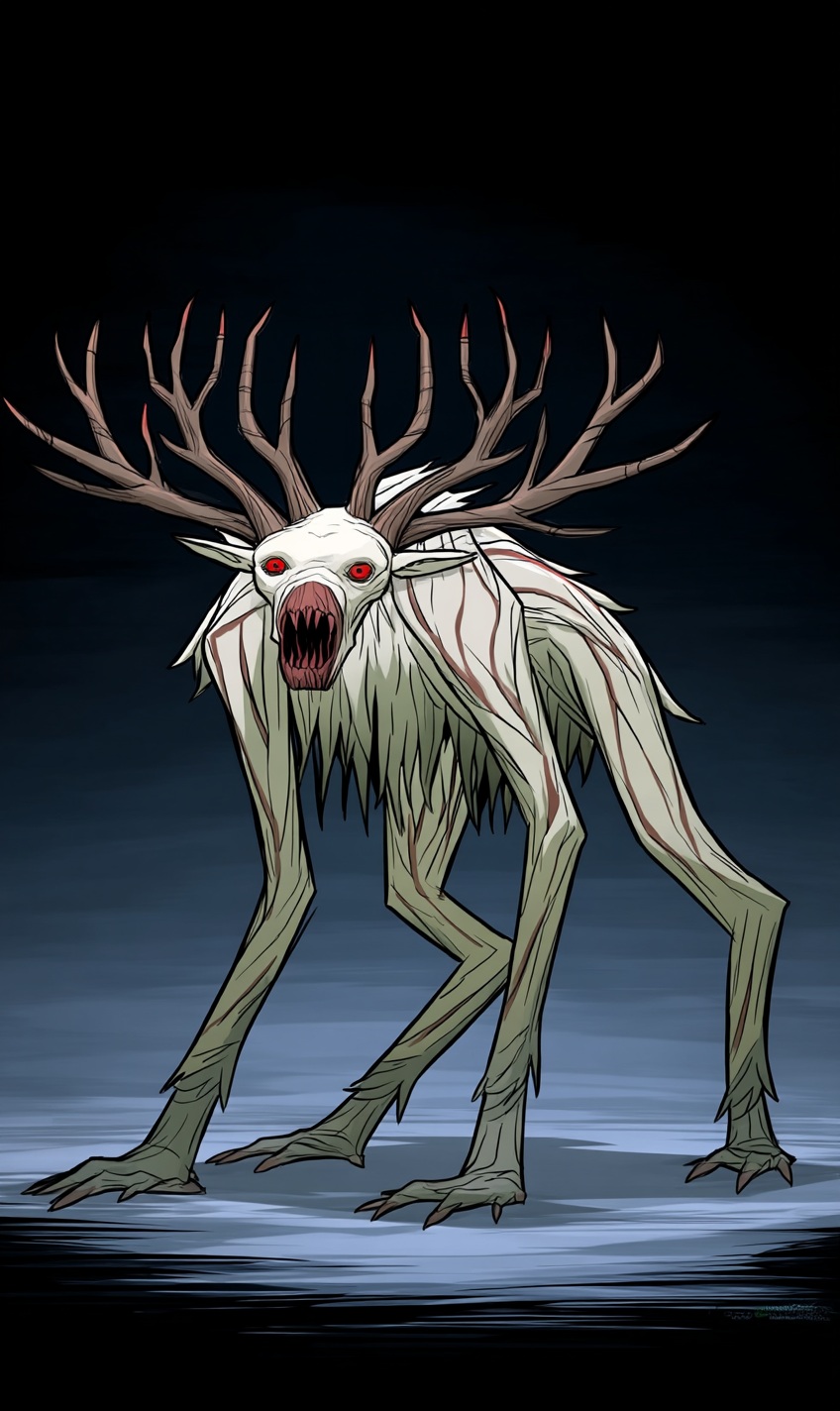
— Enox Qin'tar, caravan master
The Vareth has haunted the oldest forests for so long that, in many parts of the world, its existence has become inseparable from local folklore. Few rural communities know the creature by its scholarly name. Instead, each region has developed its own stories, warnings, and titles, often describing what people believe the creature to be rather than what it actually is. To some it is the White Crown, a ghostly stag that judges those who enter sacred groves with impure intentions. Elsewhere it is called the Church Deer, believed to be the last guardian of abandoned shrines whose congregations vanished centuries ago. In isolated mountain villages it is known only as the Listener, a name spoken quietly and never within sight of the forest itself.   Perhaps no belief is more widespread than the conviction that the Vareth can hear lies.   Across dozens of cultures, children are warned never to boast, make false promises, or speak ill of absent friends while beneath ancient trees, lest the White Crown overhear and come to pass judgment. Travelers unfamiliar with the tale often laugh at the superstition until they discover that even seasoned foresters instinctively avoid unnecessary conversation in old woodland. Whether born from fear or simple caution, silence has become tradition wherever stories of the creature endure.   Many villages also maintain curious customs intended to avoid attracting its attention. Whistling is forbidden once the trees begin to close overhead. Woodcutters pause briefly before felling particularly ancient oaks, offering quiet words of apology to the forest. Hunters avoid striking dead branches together, fearing the sound might be mistaken for the creature's own dry clicking call. None of these practices have ever been shown to influence the Vareth's behavior, yet generations continue to observe them with remarkable consistency.   The creature's habit of remaining perfectly motionless has inspired countless ghost stories.   One particularly enduring legend tells of a pale stag that appears beside forgotten trails shortly before someone disappears. According to the tale, the animal never flees when approached. Instead, it simply watches. If the traveler continues toward it, the stag quietly retreats deeper into the forest, always remaining just visible through the trees. Those who follow are never seen again.   Naturalists dismiss this story as a misunderstanding of the Vareth's camouflage and hunting behavior.   Foresters rarely argue.   Another widespread belief claims that the Vareth cannot cross running water. Others insist it refuses to hunt beneath a full moon, avoids church bells, or fears open flame. While none of these claims withstand careful observation, they persist because they offer something far more valuable than truth.   They offer hope.   Among the oldest druidic traditions, however, the creature occupies a far more somber place.   Some circles teach that the first Vareth was once a magnificent white stag consecrated to watch over a sacred grove before the Sylvan Plague twisted both guardian and sanctuary into something neither could escape. In these accounts, every Vareth represents not an invader or demon, but a wound in the natural world that never fully healed. Slaying one is therefore viewed less as a triumph than as a melancholy necessity, comparable to felling an ancient tree consumed by rot before it topples upon the healthy forest around it.   A handful of religious traditions have reached similar conclusions.   Rather than depicting the creature as evil, they describe it as a living reminder that even the purest corners of creation can be irrevocably changed when the balance of the world is broken. Pilgrims visiting ruined shrines sometimes leave offerings not for the Vareth itself, but for whatever sacred place once stood before its corruption. The distinction matters greatly to those who keep the custom.   The shrine deserves remembrance.   The creature does not.   Perhaps the most unsettling legends concern the forests themselves.   Experienced foresters sometimes claim that woodland inhabited by a Vareth begins teaching its own lessons. Birds cease singing not because they have all been hunted, but because generations have learned that noise brings death. Deer abandon ancient migration routes until their descendants no longer remember they ever existed. Even the wind, some insist, seems quieter beneath those trees, as though the forest itself has adopted the habits of its deadliest resident.   Whether this is superstition or simply careful observation remains difficult to say.   One tradition, however, is shared almost universally wherever stories of the Silent Crown are told.   If the forest suddenly becomes quiet, stop walking.   If the silence continues, leave.   And if, somewhere beyond the trees, you hear two dry branches strike together...   Do not waste time searching for the sound.   It already knows exactly where you are.

"Do not fear the scream that shatters the night. Fear the moment everything grows quiet enough to hear your own heartbeat."
— Ashes Beneath the Canopy, Act I, Scene VII
Genetic Ancestor(s)
Scientific Name
Cervus profanatus
Lifespan
120-180 years
Average Height
6-8 ft.
Average Weight
840-1,150 lb.
Average Length
9 - 12 ft.
Geographic Distribution


Unknown Shores

Vareth CR: 8

Large monstrosity, unaligned
Armor Class: 16
Hit Points: 142 (15d10 + 60) 15d10+60
Speed: 50 ft

STR

22 +6

DEX

18 +4

CON

18 +4

INT

3 -4

WIS

18 +4

CHA

6 -2

Saving Throws: Dex +8, Con +8, Wis +8
Skills: Perception +12, Stealth +8, Survival +8
Senses: blindsight 120 ft., tremorsense 30 ft., passive Perception 22
Languages:
Challenge Rating: 8 ( 3,900 XP)
Proficiency Bonus: +3

Special Abilities

Silent Crown

The Vareth perceives the world through countless sensory hairs covering its body and branching crown rather than through sight. It automatically fails any ability check that relies on visual detail, such as reading, identifying colors, recognizing symbols, or visually distinguishing one creature from another.  

Chemoreception

The Vareth continually samples airborne chemicals using specialized organs within its mouth and throat. It can detect the presence of creatures, blood, smoke, decay, poison, and similar scents within 60 feet unless blocked by an airtight barrier. The Vareth has advantage on Wisdom (Perception) checks that rely on smell.  

False Stillness

While the Vareth remains motionless, it is indistinguishable from a dead tree, weathered stump, or tangled undergrowth. A creature whose passive Wisdom (Perception) score is 18 or higher recognizes the Vareth as a living creature. Otherwise, a creature can use its action to examine the Vareth, determining its true nature with a successful DC 18 Wisdom (Perception) check. A creature proficient in the Survival skill has advantage on this check.  

Explosive Ambush

If the Vareth moves at least 20 feet straight toward a creature immediately before hitting it with its Bite attack, the Bite deals an extra 14 (4d6) piercing damage.

Actions

Multiattack

The Vareth makes two attacks, one with its Bite and one with its Claws. If a creature is grappled by its Bite, the Vareth instead makes two Claw attacks.  

Bite

Melee Weapon Attack: +9 to hit, reach 10 ft., one target.
Hit: 17 (2d10 + 6) piercing damage. The target is grappled (escape DC 17). While grappled in this way, the target is latched.   While a creature is latched, the Vareth can't use its Bite against another creature.   At the start of each of the Vareth's turns, each creature grappled by its Bite takes 7 (2d6) piercing damage and is restrained until the grapple ends.   A creature within 5 feet of the Vareth can use its action to make a DC 17 Strength (Athletics) check, ending the grapple on a success.  

Claws

Melee Weapon Attack: +9 to hit, reach 10 ft., one target.
Hit: 13 (2d6 + 6) slashing damage. If the target is latched, the attack deals an additional 7 (2d6) slashing damage.  

Thrashing Crown (Recharge 5–6)

The Vareth violently twists and lashes with its branching crown. Each creature within 10 feet of the Vareth, including a creature latched by it, must make a DC 17 Dexterity saving throw. On a failed save, a creature takes 21 (6d6) slashing damage and is knocked prone. On a successful save, a creature takes half as much damage and isn't knocked prone.

Bonus Actions

Sensory Click

The Vareth emits a brief, dry chitter that resembles two dead branches lightly striking together.   Until the start of its next turn, creatures can't gain the benefits of being hidden from the Vareth, and the Vareth ignores half cover and three-quarters cover when perceiving creatures with its blindsight.

Reactions

Violent Anchor

When a creature attempts to end the grapple created by the Vareth's Bite, the Vareth makes one Claw attack against that creature.

Usual Tactics

A Vareth waits motionless until prey comes within striking distance before rushing forward to seize a single victim with its Bite. Once latched, it rarely releases its prey voluntarily, attacking anyone who attempts to free the victim.

A pale, deer-like creature with impossibly long limbs and a permanently open, tooth-lined maw watches in unnatural silence.

Comments

Please Login in order to comment!
Powered by World Anvil