


Distending Limb
I Can Reach It
"Reach, if you must," said the jester, eyeing the hand that came where no hand ought to be. "But mind that what you touch may reckon you closer than you reckoned it."
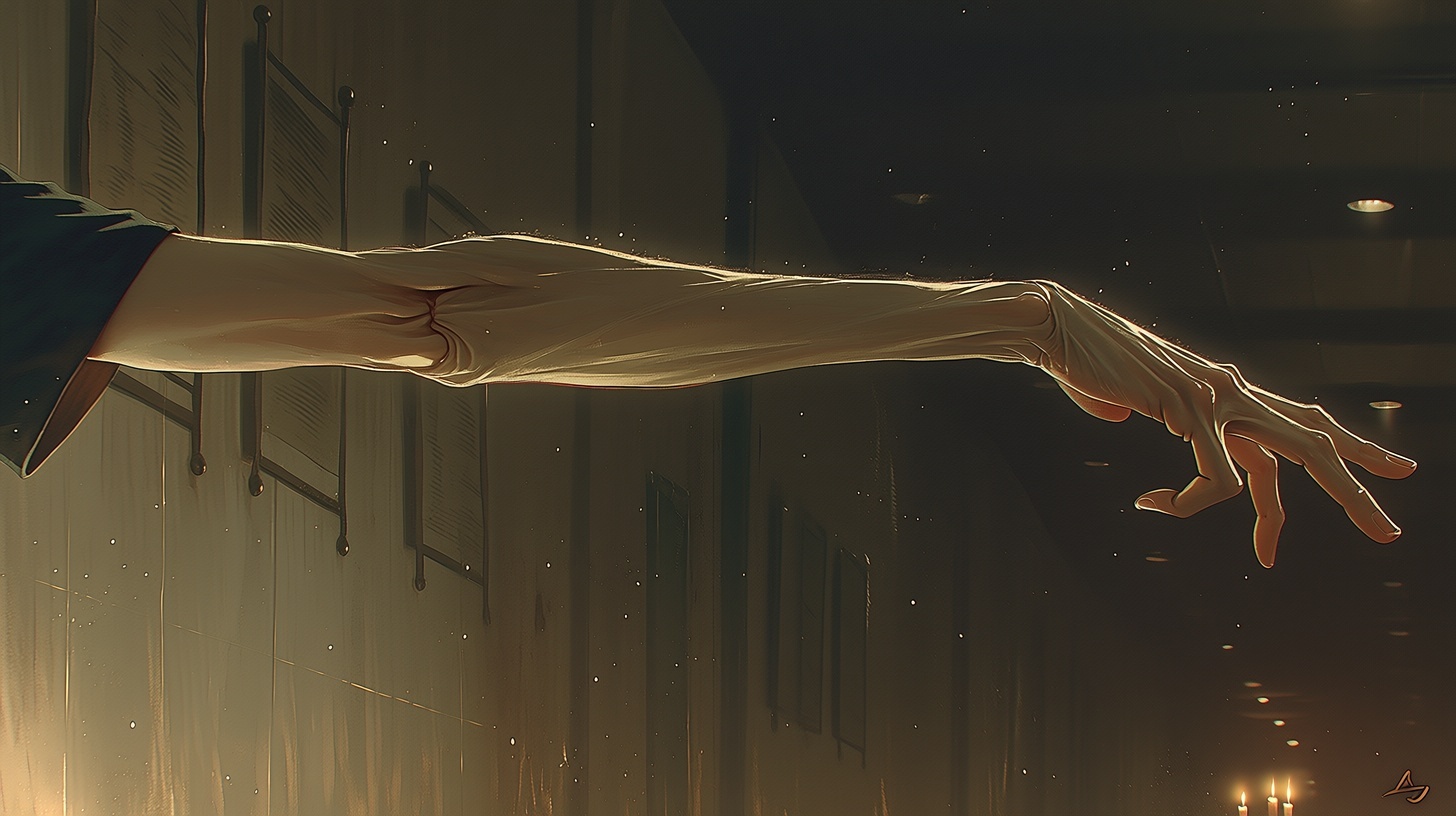
The body defines its interaction with the world through proportion, reach, and structure. These limits determine what can be touched, moved, or manipulated at any given moment. Distending Limb is a transmutation that temporarily overrides one of those limits by extending a single limb far beyond its natural range. The spell does not enhance strength, durability, or speed. It changes reach, and it does so in a way that is immediate, controlled, and brief.
When the spell is cast, the chosen limb extends in a straight line toward a point the caster can see. The extension occurs instantly and follows a direct path through open space. It cannot bend around obstacles or pass through solid barriers. If the path is blocked, the spell fails to reach its intended destination. This constraint ensures that the extension remains tied to physical space rather than functioning as a form of teleportation or displacement.
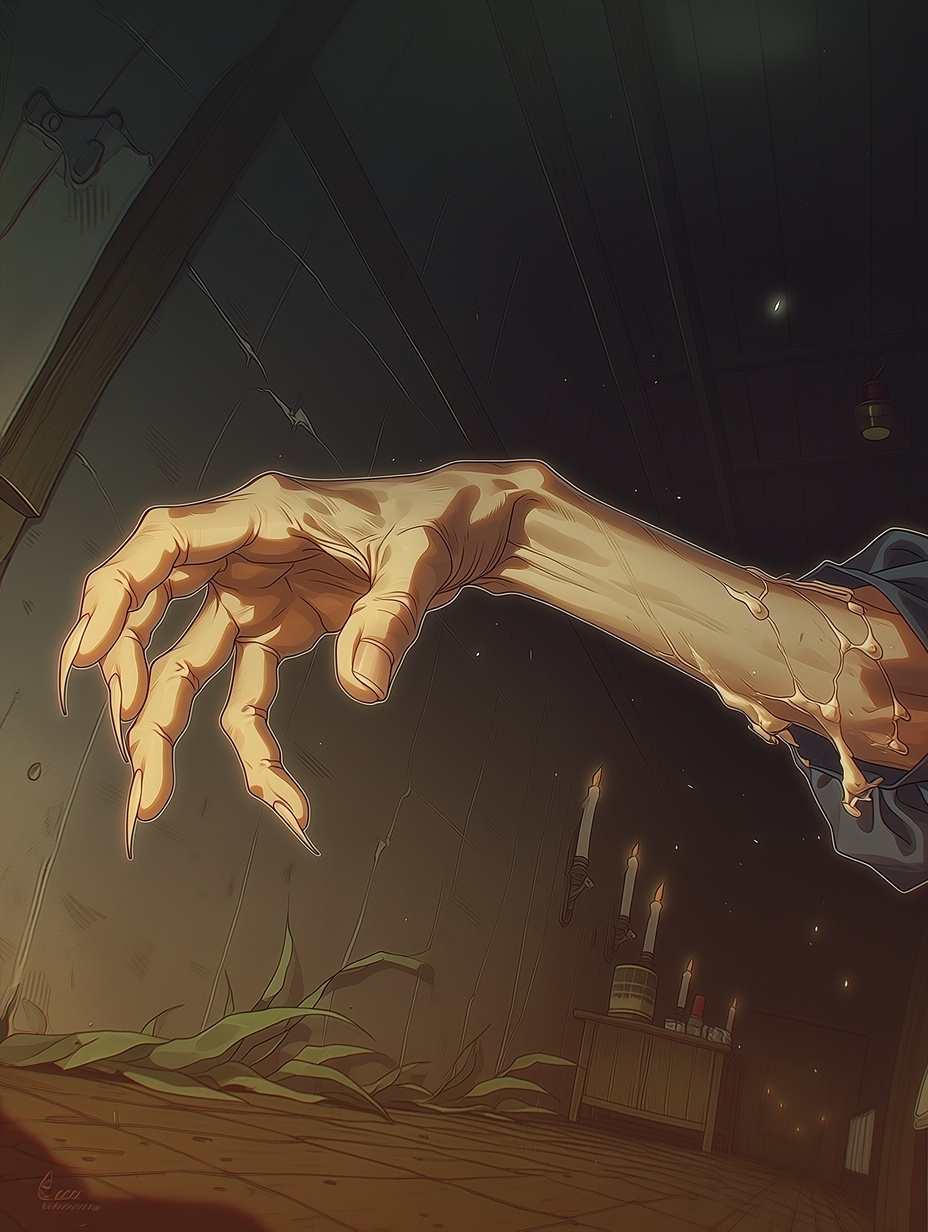
The transformation is visually apparent and difficult to ignore. The limb stretches outward while maintaining its general structure, but the proportions become unnatural as distance increases. Joints extend beyond their expected limits, and the motion lacks the familiar constraints of muscle and bone. Despite this distortion, the limb remains responsive to the caster’s intent. Fine control is preserved, allowing for deliberate and precise interaction with objects at the point of extension.
The spell is designed for manipulation rather than force. The extended limb can interact with unattended objects within its reach, provided those objects are small enough to be handled and are not secured in place. Actions such as pulling a lever, opening an unlocked container, or retrieving a loose item can be performed as though the caster were physically present. The limitation on weight reinforces the spell’s purpose as a utility rather than a means of exerting strength at a distance.
The extension does not grant any offensive capability. The limb cannot be used to make attacks, and it cannot serve as a conduit for other spells. This restriction is intentional and defines the boundaries of the magic. The caster gains access to distant objects, but not the ability to project force or harm through that access. The spell remains focused on interaction rather than confrontation.
Because the extended limb remains part of the caster’s body, it is subject to the same risks as any exposed appendage. Effects that would trigger upon contact apply to the limb as though the caster were physically present at that location. This includes environmental hazards, magical effects, and other forms of interaction that respond to proximity. The extension does not create a separate entity or projection. It is the caster’s body, temporarily extended into a different position.
Creatures within reach of the extended limb can respond to its presence. The unnatural movement and intrusion into personal space are often enough to provoke a reaction. A creature that notices the limb entering its reach can attempt to strike it, treating the extension as a valid target for a brief moment. Any damage dealt is experienced by the caster directly, reinforcing the risk associated with using the spell in contested spaces.
The duration of the spell is limited to the immediate turn in which it is cast. At the end of that turn, the limb returns to its normal length without lingering effect. There is no gradual retraction or residual distortion. The body resumes its natural proportions as though the extension had not occurred. This brief window of functionality requires the caster to act decisively, as there is no opportunity to maintain the effect over time.
In practice, Distending Limb is used in situations where distance presents an obstacle but direct movement is impractical or undesirable. It allows access to mechanisms, objects, or spaces that would otherwise require repositioning. This can be useful in confined environments, hazardous conditions, or moments where speed matters more than subtlety. The spell provides a solution to a specific problem without altering the broader circumstances.
The limitations of the spell are as important as its capabilities. It cannot bypass solid barriers, it cannot exert significant force, and it cannot be sustained. These constraints prevent it from replacing other methods of interaction or movement. Instead, it complements them, offering a temporary extension of reach that must be used with awareness of both its advantages and its risks.
Among practitioners, the spell is often regarded as a study in controlled distortion. It demonstrates that the body can be altered without being fundamentally changed, and that utility can be derived from even brief deviations from natural form. At the same time, it serves as a reminder that proximity carries consequence. Extending reach does not remove the dangers associated with contact. It only relocates them.
"I would not have it near me, sir, though it be yours by right. A thing that travels so far from its master learns, I think, a mind of its own."



Comments