


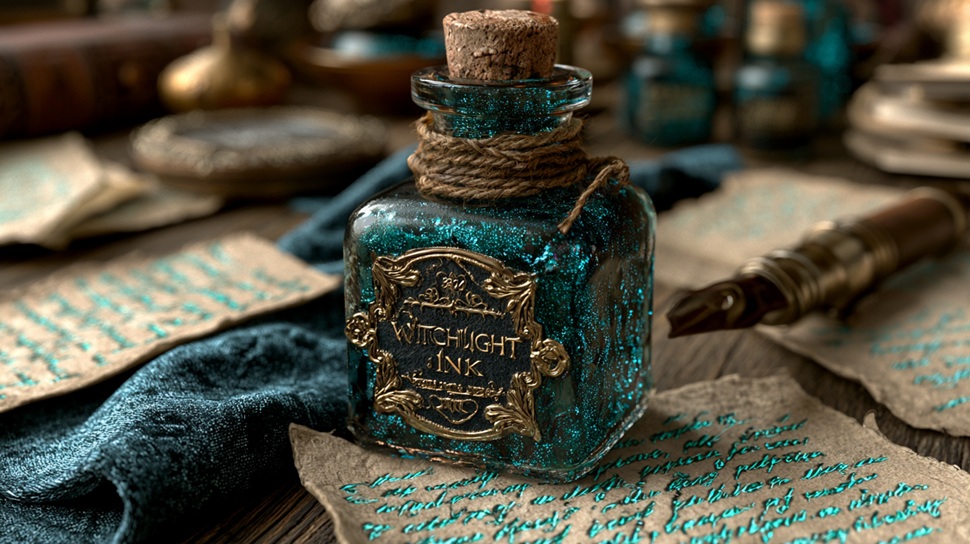
Witchlight Ink
I See It!
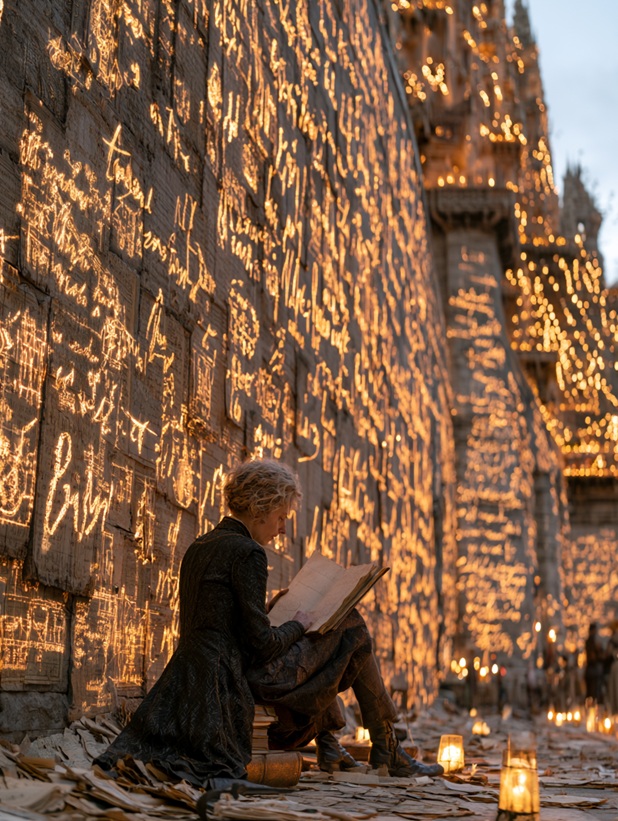
"The finest secret is not hidden in darkness. It is written plainly where everyone can see it and nobody knows to look."
Certain magical inventions emerge from grand arcane research, royal commissions, or the work of renowned wizards. Others originate from far more practical needs.
Witchlight Ink belongs firmly to the second category.
The substance appears unremarkable at first glance. Stored within small glass bottles, it resembles ordinary writing ink save for a faint iridescence visible when held beneath direct light. Its true properties become apparent only after use. Once applied and allowed to dry, the ink becomes virtually indistinguishable from the surface upon which it rests. To creatures relying upon normal sight, a page covered in Witchlight Ink appears blank. A wall marked with its symbols appears untouched. A message written across a door seems not to exist at all.
Those possessing darkvision see an entirely different reality.
To them, Witchlight Ink appears vivid and unmistakable. Words, illustrations, maps, diagrams, warnings, and markings stand out in brilliant color against their surroundings. What appears empty to one observer may contain pages of text to another.
The result is a material that has become remarkably popular among communities where darkvision is common.
Dwarven engineers use Witchlight Ink to place maintenance instructions within mines and tunnels. Elven scholars employ it to annotate manuscripts without altering the visible text. Underworld organizations use it to identify safehouses, meeting locations, and hidden caches. Merchants occasionally mark shipments with symbols visible only to trusted employees.
The ink's usefulness extends far beyond secrecy.
Many settlements containing mixed populations use Witchlight markings as a form of secondary signage. Directions, warnings, ownership marks, and technical instructions can be displayed without cluttering public spaces. Visitors relying upon normal sight may never notice these hidden messages, while those possessing darkvision navigate a parallel layer of information woven throughout the environment.
This practice has produced occasional misunderstandings.
More than one traveler has unknowingly rented a room covered in invisible notes left by previous occupants. Adventurers have discovered abandoned ruins whose walls appeared bare until viewed through darkvision. Guards have uncovered smuggling operations conducted through messages written openly in public places where only certain individuals could perceive them.
Such incidents have contributed to the ink's somewhat mysterious reputation.
Many common folk associate Witchlight Ink with secret societies, conspiracies, hidden knowledge, and clandestine communication. Stories circulate about invisible maps leading to buried treasure, coded messages exchanged between spies, and forgotten libraries whose contents remain concealed from most of the world.
While such tales are often exaggerated, the material certainly encourages secrecy.
Its affordability has also contributed to its popularity. Unlike many magical substances reserved for wealthy patrons or powerful institutions, Witchlight Ink remains accessible to ordinary craftspeople, merchants, travelers, and scholars. A single bottle contains enough ink to produce substantial quantities of text or markings, making it practical for everyday use rather than merely ceremonial purposes.
The profession most associated with Witchlight Ink is undoubtedly cartography.
Maps frequently become crowded with notes, measurements, observations, and revisions. The ability to conceal supplementary information without obscuring the primary map has made the ink invaluable to explorers, surveyors, military planners, and navigators. Entire layers of information can be hidden within a document, visible only to those capable of perceiving them.
Libraries and archives likewise value the material.
Curators often use it for cataloging systems, preservation notes, and reference markings that would otherwise distract from the original document. Scholars occasionally leave hidden commentary within manuscripts, creating private conversations that may continue across generations.
This practice has delighted historians and frustrated them in equal measure.
Nothing quite compares to discovering that a seemingly ordinary document contains an entirely separate text hidden between its visible lines.
Like many magical creations, Witchlight Ink demonstrates that enchantment need not be dramatic to be transformative. It does not summon fire, command storms, or alter reality. Instead, it changes who can perceive information and who cannot.
In many ways, that may be a more powerful ability than it first appears.
After all, knowledge hidden in plain sight has always possessed a peculiar kind of magic.
"The finest secret is not hidden in darkness. It is written plainly where everyone can see it and nobody knows to look."
Item type
Magical
Rarity
Common
Base Price
15 gp





This is fun. I love utilitarian magic :) In a lot of ways, it's more interesting than world-shaking magic
Oh absolutely. I started doing these with potions and making wacky ones is still a bit of a guilty pleasure. And the utilitarian stuff gets used all the time. The world shaking stuff is maybe once a campaign. It's a no brainer.