


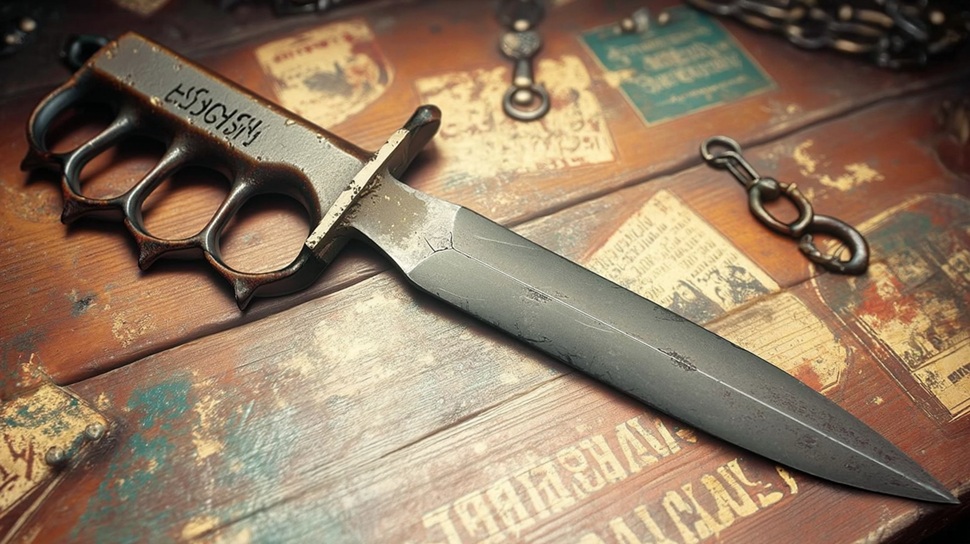
Trench Knife
A Brutal Last Resort
"People think wars are won with rifles. They're wrong. Rifles start fights. Knives finish the ones that got too close."
There are weapons forged for honor, weapons crafted for ceremony, and weapons carried because tradition demands it. The trench knife belongs to none of them.
It was built for the worst moments a battlefield can offer.
The trench knife emerged wherever firearms made open advances suicidal and soldiers found themselves fighting from fortified positions separated by only a few dozen feet. Once volleys had been exchanged, ammunition exhausted, or defensive works breached, combat became immediate, chaotic, and brutally personal. In those desperate moments, long rifles became awkward clubs, swords tangled against walls, and spears found little room to maneuver. A weapon was needed that could be drawn in an instant, survive abuse, and kill decisively at arm's length.
The result was the trench knife.
Short enough to wield inside narrow corridors, shattered buildings, tunnels, ship interiors, and defensive earthworks, the trench knife sacrifices reach in exchange for absolute control. Every inch of its design exists for efficiency. A broad, rigid blade resists snapping under hard thrusts. The reinforced guard protects the wielder's hand while adding enough weight to serve as an effective striking surface. Its grip is shaped to remain secure even when slick with rain, mud, sweat, or blood.
Unlike elegant dueling blades, trench knives are almost never decorative. Their surfaces are left plain, their edges easy to maintain, and their construction intentionally robust. Most bear scratches, dents, and worn grips earned through years of hard service rather than ornamentation bestowed by a craftsman. Soldiers often personalize them with initials, tally marks, regimental insignia, or small charms tied to the pommel, but few mistake them for works of art.
Military organizations across the world issue trench knives to scouts, engineers, sappers, marines, boarding parties, and soldiers expected to operate in confined spaces. They are equally valued by city watch officers patrolling cramped alleys, caravan guards protecting narrow mountain passes, monster hunters exploring forgotten ruins, and adventurers who understand that even the finest sword can become a liability when there is scarcely room to swing it.
Their reputation, however, extends far beyond their practical design.
Veterans rarely speak fondly of trench knives. They speak of necessity.
Every soldier remembers the first time they realized the battle had collapsed beyond orderly ranks and measured volleys. The shouting became indistinguishable from screaming. Smoke reduced visibility to a handful of paces. Friends and enemies stumbled into one another with no time to aim, no opportunity to reload, and no certainty of surviving the next heartbeat. Those who carried trench knives often lived long enough to remember those moments.
Those who did not usually became part of someone else's memory.
For that reason, trench knives carry an uncomfortable stigma among civilians. Unlike a longsword worn openly by a knight or a rapier carried by a gentleman, a trench knife rarely suggests nobility or romance. It suggests someone who expects violence to happen at touching distance. Merchants may eye its owner with suspicion. Innkeepers sometimes ask that it remain peace-bonded. Guards instinctively recognize it not as a symbol of rank, but as a tool belonging to someone who has survived encounters most people pray never to witness.
Despite that grim reputation, many experienced adventurers refuse to travel without one. It serves as a camp knife, utility blade, emergency tool, and last line of defense all at once. It can cut rope, pry open crates, prepare food, fashion splints, or save a life before taking one. Those practical virtues explain why it remains so common long after the wars that inspired its design have ended.
In the end, the trench knife is neither glorious nor infamous because of the steel from which it is forged. It is remembered because of where it is used. Every nick along its edge, every worn patch on its grip, and every scratch upon its guard speaks of battles fought so close that victory was measured not in yards gained, but in inches. Few weapons tell such honest stories, and fewer still leave their owners hoping they never have to draw them again.
Trench Knife
A compact fighting knife fitted with a reinforced knuckle guard, designed for brutal close-quarters combat in trenches, tunnels, ship corridors, and other confined spaces.
| Damage | Properties | Mastery | Weight | Cost |
|---|---|---|---|---|
| 1d6 Piercing | Finesse, Light, Special | Sap | 2 lb. | 10 gp |



Comments