


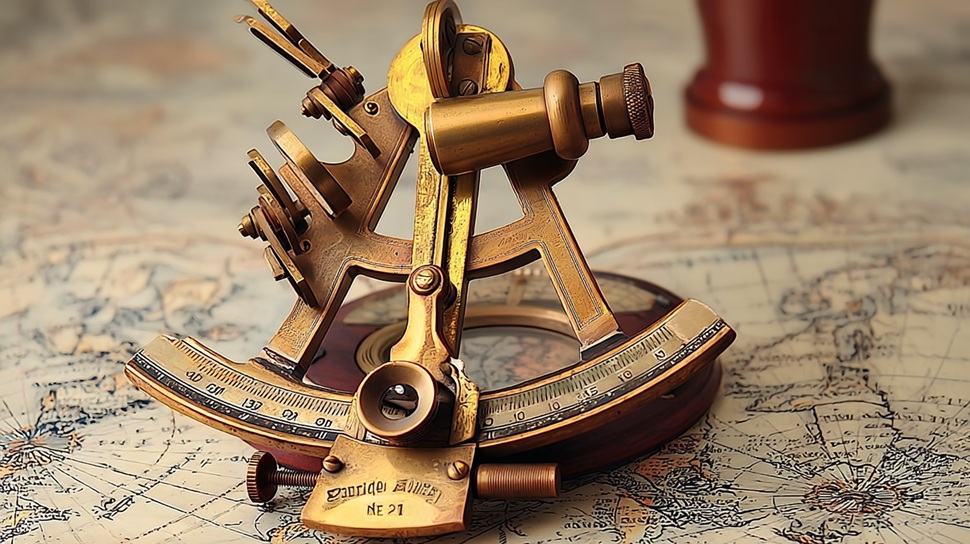
Sextant
On The Horizon
"A compass tells you where north is. A sextant tells you where you are. Confuse the two, and the sea will gladly finish the lesson."
For most of history, the greatest challenge facing any mariner was not surviving the sea, but knowing where they were upon it. Once the coastline disappeared beneath the horizon, every direction became indistinguishable from the next. Before the invention of the sextant, navigators relied upon dead reckoning, estimating their position from speed, heading, and experience. Skilled captains could cross entire oceans this way, but even the finest among them accumulated small errors that grew into disastrous mistakes over the course of a long voyage.
The sextant changed that forever.
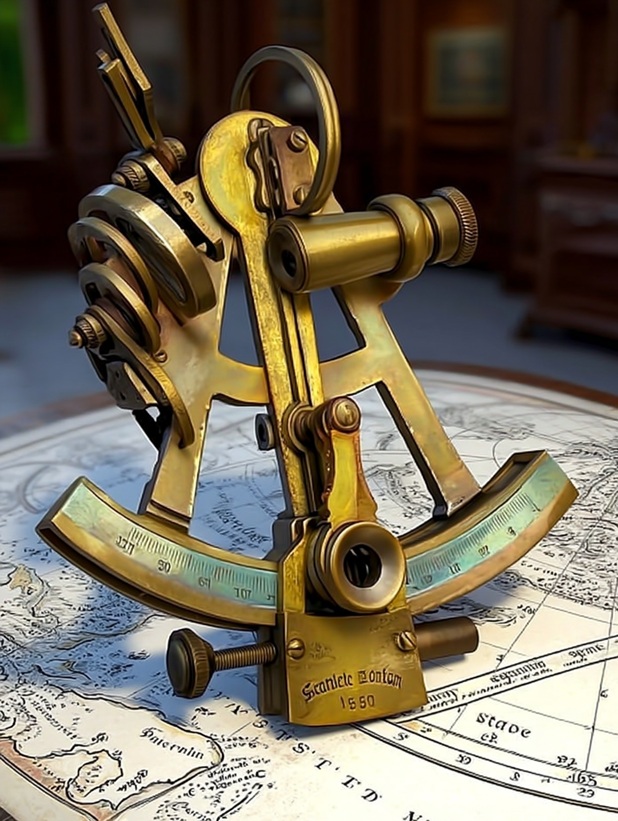
At first glance, the instrument appears almost delicate. A carefully graduated brass arc forms its body, while polished mirrors, adjustment screws, and a finely balanced sighting mechanism allow astonishing precision from a device small enough to fit comfortably within a wooden case. Every component is crafted to exacting tolerances, for a fraction of a degree can represent many miles upon the open sea.
Its operation is founded upon a remarkably simple principle. By measuring the angle between a known celestial body and the visible horizon, a trained navigator can determine the vessel's latitude with impressive accuracy. Combined with reliable charts, carefully maintained timepieces, and experience, these observations allow a captain to estimate their position far more accurately than guesswork alone ever could.
Because of this, the sextant has become one of the defining tools of the Age of Exploration. Merchant captains protect them as carefully as their cargo. Naval officers often possess finely engraved personal instruments presented upon promotion. Explorers venturing beyond known waters rarely travel without one, for an accurate position recorded today may become tomorrow's chart, trade route, or discovery.
The instrument is not limited to the sea. Desert caravans crossing endless dunes, expeditions traversing frozen tundra, and travelers navigating vast salt flats have all adapted celestial navigation where recognizable landmarks are scarce. Whenever a clear horizon meets an unobstructed sky, a sextant becomes one of the most reliable guides a traveler can possess.
Yet the instrument is only as useful as the conditions allow. Thick cloud cover hides the stars. Storms erase the horizon. Dense forests, mountain valleys, magical darkness, or unnatural weather can make observation impossible. A sextant does not create knowledge. It measures the world with extraordinary precision, provided the world allows itself to be measured.
Nor is the instrument useful without education. Reading a sextant requires an understanding of astronomy, navigation, mathematics, and chart making. An untrained traveler may admire its craftsmanship without ever learning what its measurements mean. In capable hands, however, it transforms the heavens into a map that stretches across the entire world.
Many experienced captains describe the first successful celestial fix as a moment of quiet revelation. The endless ocean no longer feels empty. Every familiar star becomes a landmark. Every observation confirms that even in the middle of a featureless sea, a patient navigator is never truly lost.
"The stars have never guided sailors. They have only rewarded those patient enough to learn their language."
Item type
Navigational Aid / Instrument
Rarity
Common
Weight
2 lb
Base Price
25 gp



Comments