


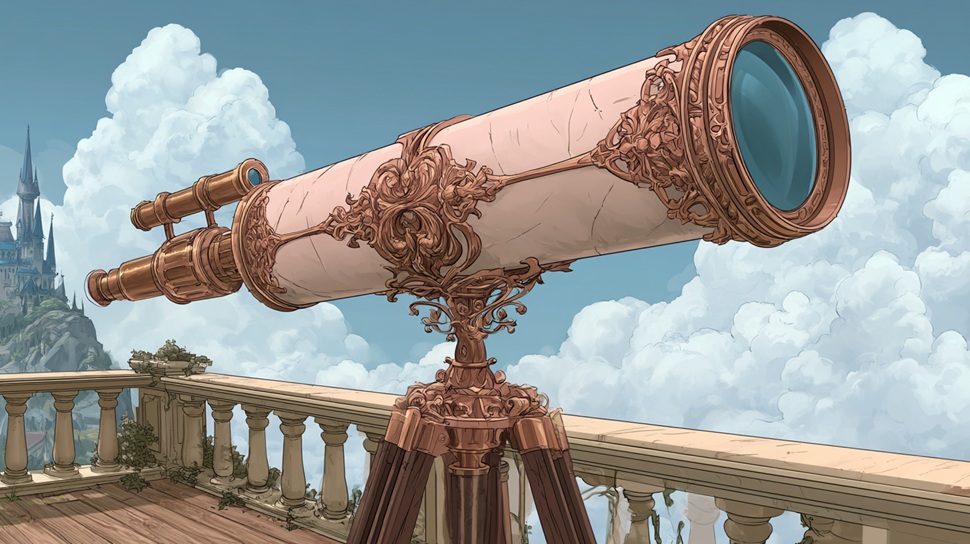
Reflecting Telescope
Study The Stars
"The stars are not beyond our reach. They have only been waiting for us to learn how to look."
The reflecting telescope stands among the greatest achievements of practical optics. Where a refracting telescope bends light through carefully ground lenses, the reflecting telescope gathers it upon an immense curved mirror, allowing far greater quantities of light to be collected with remarkable clarity. The result is an instrument capable of revealing details so distant that they would otherwise remain forever hidden to the unaided eye.
Its construction is anything but simple. Every mirror must be polished to extraordinary precision, for even the slightest imperfection scatters light and degrades the image. The tube that houses the optics must remain rigid despite changes in temperature and weather, while the mounting itself must hold the instrument steady enough that the movement of a single fingertip does not throw an object entirely out of view. Because of these demands, reflecting telescopes are seldom portable in the ordinary sense. Though they can be transported with sufficient planning, assembling or dismantling one is a deliberate process requiring patience rather than haste.
Most large reflecting telescopes are found within observatories, where permanent stone foundations protect them from vibration and allow them to track the slow movement of the heavens with exceptional accuracy. Wealthy universities, royal courts, naval academies, and the Temple Observatory maintain some of the finest examples ever constructed, their domes becoming as recognizable a symbol of scholarship as libraries or laboratories. A handful of explorers and military surveyors also carry more compact field models mounted upon sturdy tripods, though even these require careful handling and considerable effort to transport safely.
On land, the instrument has transformed cartography and surveying. A distant mountain pass can be examined long before a traveler reaches it. Engineers inspect bridges and fortifications across broad valleys without crossing them. Harbor masters identify incoming vessels hours before they arrive, while border wardens watch roads and mountain trails from towers that command entire horizons. In regions where visibility stretches for dozens of miles, a reflecting telescope can mean the difference between surprise and preparation.
Its greatest contribution, however, lies above rather than below.
For countless generations, the stars were little more than brilliant points scattered across the night sky. Through a reflecting telescope they become worlds of astonishing complexity. Craters emerge upon distant moons. The wandering planets reveal shifting colors and subtle markings. Comets display delicate tails invisible to ordinary sight. Dense clouds of starlight separate into countless individual suns, while faint celestial objects previously dismissed as pale smudges reveal intricate structures beyond imagination.
These discoveries have reshaped astronomy throughout Aerith. Mariners refine their charts by observing stellar motion with unprecedented accuracy. Natural philosophers debate the nature of distant worlds once believed unreachable. Mathematicians predict celestial events years before they occur. Each improvement in mirror making expands the horizon of what can be known, driving scholars to build ever larger instruments capable of gathering even more light from the depths of the heavens.
Yet for all its remarkable capability, the reflecting telescope remains bound by the same physical world it seeks to reveal. It cannot see through mountains, forests, dense fog, heavy storms, magical darkness, or solid walls. Smoke, haze, poor weather, and the shimmering distortion of heated air all diminish its usefulness. Even the finest instrument is only as effective as the conditions in which it is used.
There is also an element of discipline required. Observing through a reflecting telescope is not a matter of glancing through an eyepiece. The observer must patiently adjust focus, compensate for the movement of the heavens, and train both eye and mind to recognize details that reveal themselves only after long periods of careful study. Many discoveries have come not from better instruments, but from patient astronomers willing to spend entire nights watching a single point of light drift across the darkness.
In an age increasingly defined by rediscovery and exploration, the reflecting telescope has become more than a scientific instrument. It is a declaration that distance is not ignorance, that the world is larger than the horizon, and that there are still mysteries waiting patiently above for those willing to spend the night looking upward.
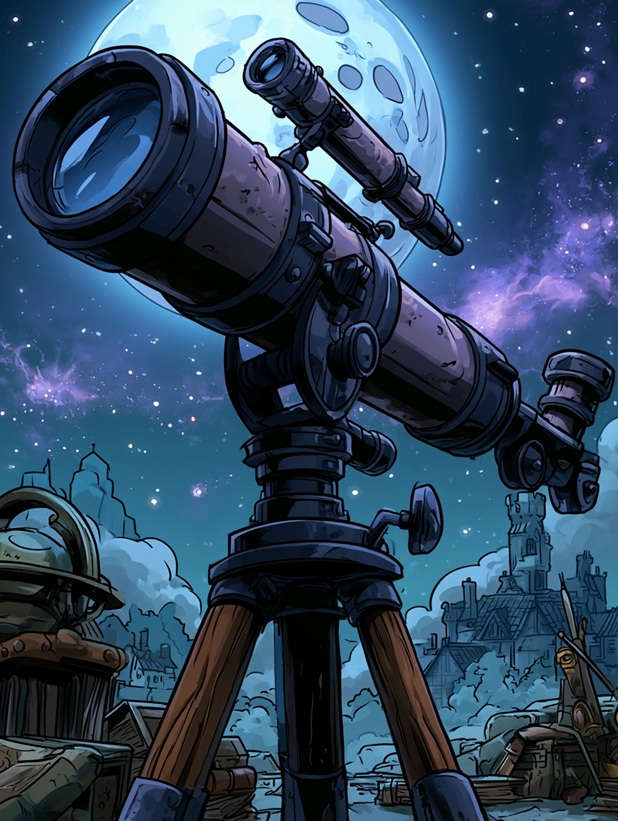
"Every generation believes it has measured the heavens. Then someone builds a better telescope, and the universe politely reminds us how little we have actually seen."
Item type
Navigational Aid / Instrument
Rarity
Rare
Weight
18 lb
Base Price
1,500 gp



Comments