


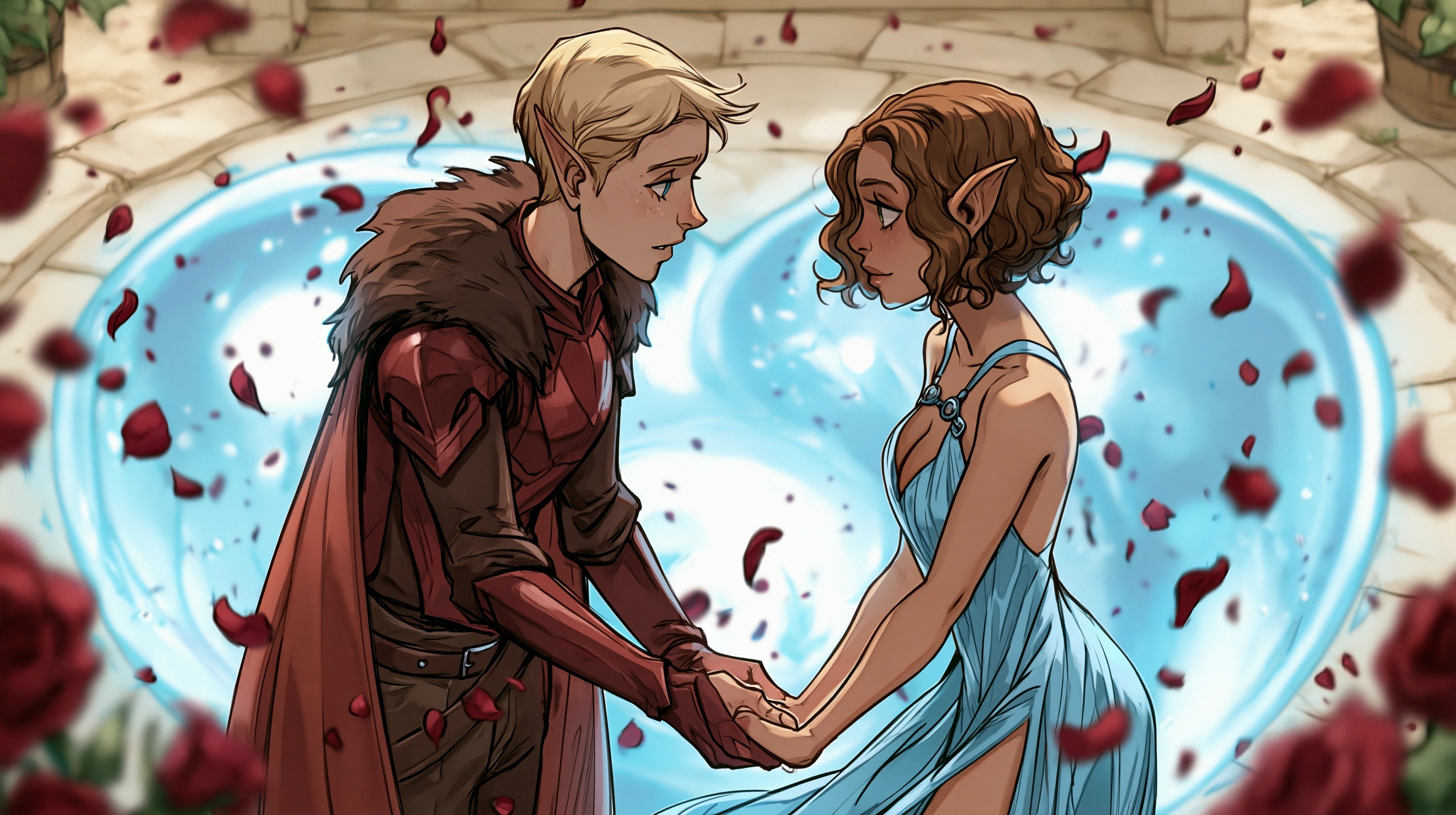
Price of Love
Run Away With Me
“I would have chosen you in poverty, exile, or disgrace. The tragedy is not that I loved you too deeply. The tragedy is that the world noticed.”
Price of Love is the kind of past people call romantic when they hear it from a safe distance.
Up close, it looks more like running.
Not always from cruelty. Not always from villains in black cloaks or fathers with locked towers and hired blades. Sometimes the prison is a uniform. Sometimes it is a family name. Sometimes it is a guild seal pressed into wax beside a life already planned before the heart was ever consulted. People like to say love conquers all because it sounds better than the truth. Love survives all. Conquest is another matter.
Those marked by this life made a choice that could not be politely explained afterward. They chose a person over a duty. A hand held in secret over a public oath. A future uncertain and dangerous over a respectable one already arranged for them. Perhaps they abandoned a military post the night before deployment. Perhaps they fled an engagement meant to bind two houses together. Perhaps they broke temple vows, family expectations, or a contract written by people who believed affection was another asset to be managed.
Whatever the shape of it, the decision left damage behind.
Love has a way of making enemies out of people who previously called themselves guardians. Families speak of betrayal when they mean embarrassment. Nobles speak of honor when they mean control. Religious authorities speak of purity when they mean obedience. Former comrades speak of loyalty when they mean ownership. The person who runs for love learns quickly that old obligations do not simply vanish because the heart found courage. They follow. They gather names. They hire riders. They wait at ports and border roads with descriptions just accurate enough to be dangerous.
So the lovers learn the geography of escape.
They learn which inns ask no questions and which ones ask too many. They learn how to travel as cousins, pilgrims, merchants, mourners, servants, or strangers who definitely did not arrive together. They learn the value of back doors, spare names, cheap rings, sympathetic widows, and musicians willing to play loudly while two people slip out through the kitchen. They learn that secrecy can feel like intimacy at first, until it becomes another room with no windows.
Those who carry the Price of Love often become unnervingly good at reading private tension. They notice glances that last half a heartbeat too long. They hear the careful pause before a false name. They understand the strange, brittle cheer of people pretending nothing has happened between them. This makes them useful companions in courts, taverns, temples, and anywhere else desire has been made inconvenient.
It also makes them dangerous to confide in, because they usually understand far more than they say.
Their keepsakes matter. An old letter folded so many times the creases have become permanent. A ribbon. A ring worn under clothing. A pressed flower from a city they can never safely revisit. These objects are not merely sentimental. They are proof that the choice happened. Proof that the life before was real, that the love was real, that the cost was not paid for nothing.
Sometimes the lover is still there, traveling beside them beneath a false name and a hood drawn low against recognition. Sometimes the lover is hidden somewhere safe, which is another way of saying somewhere lonely. Sometimes they are dead, missing, changed, married to someone else, or transformed by hardship into a stranger wearing the beloved face. Love stories do not always end when people choose each other. Often that is where the harder story begins.
The world is rarely kind to those who embarrass power.
A noble house does not forget the runaway bride who ruined a treaty. A military order does not forgive the officer who chose a lover over command. A guild does not shrug off a broken contract when money and pride are involved. Even years later, old consequences can surface in the shape of bounty notices, family agents, blackmail, inheritance disputes, annulment papers, or quiet invitations that are not invitations at all.
Those who survive this life become experts in the politics of the heart. They know where secret couples meet. They know which communities will overlook scandal because they have seen enough sorrow to know better. They know how to speak to the frightened daughter of a merchant prince, the soldier who cannot return to barracks, the priest who has discovered that vows made in youth can become cages in adulthood. They know when to advise patience and when to say, plainly, run tonight.
Yet there is a flaw in them too, one born from the same fire that saved them.
They can romanticize ruin.
They know love can justify courage, but they may forget how easily it can justify cruelty. They may cling too long to someone who has already left in every way that matters. They may mistake suffering for proof of depth, secrecy for devotion, and danger for destiny. They may believe, quietly and stubbornly, that if enough was sacrificed, the love must have been worth it.
Sometimes it was.
Sometimes that belief is all that remains.
A person shaped by the Price of Love walks through the world carrying both tenderness and consequence. They understand that affection is not soft when the world forbids it. It becomes sharp. It learns roads. It lies convincingly to guards. It sleeps lightly. It keeps one bag packed and one eye on the door.
And still, despite everything, when they see two frightened people reaching for each other across the wreckage of duty and expectation, they understand the impulse.
They may even help.
Not because love always wins.
Because once, for one impossible moment, it was worth losing everything else.

“We escaped the palace, the vows, the future they wrote for us… and still I wake each morning listening for horses on the road. Tell me, my love, at what point does freedom stop sounding like pursuit?”



Comments