


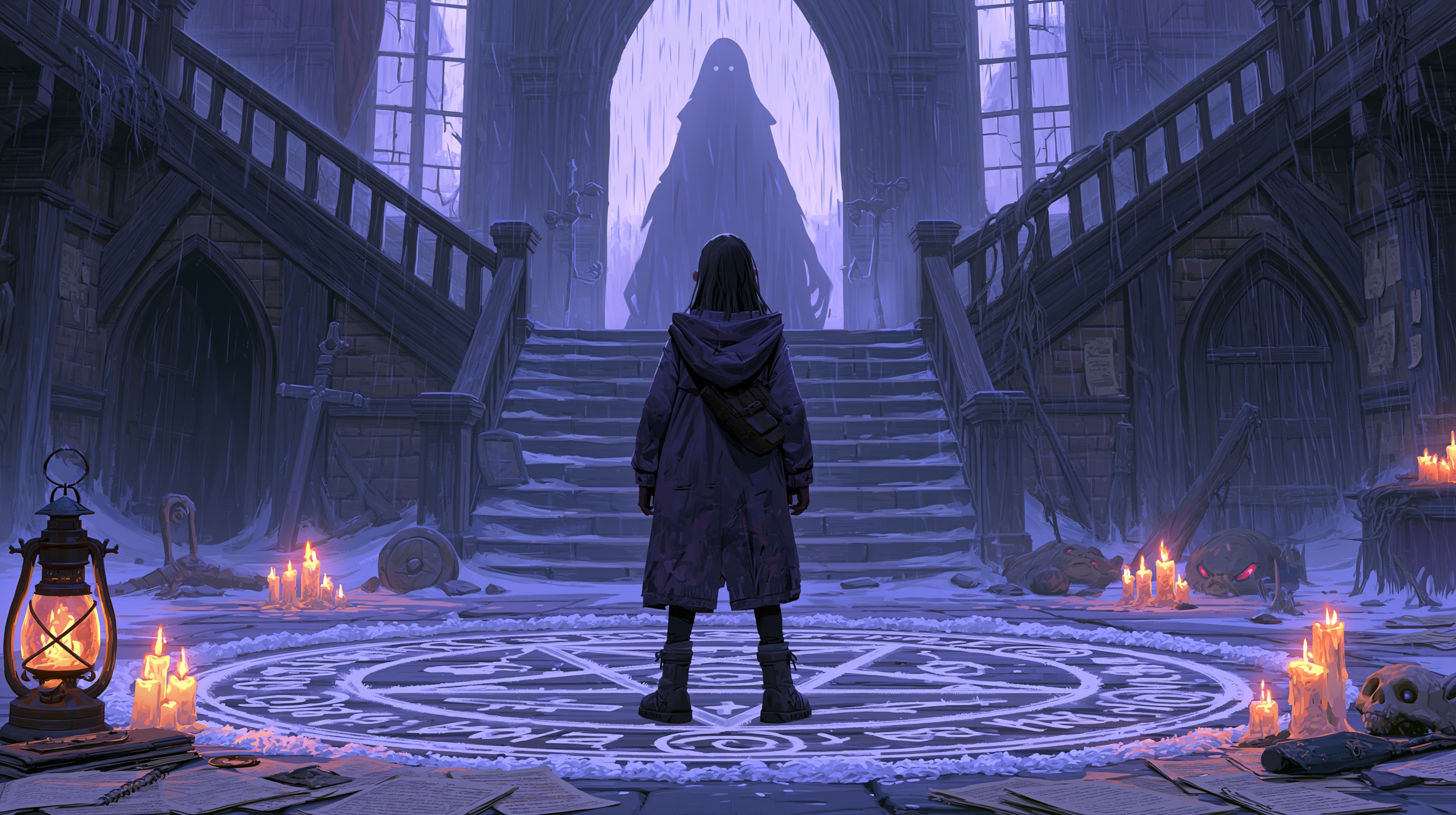
Paranormal Investigator
Did You Hear That?!
“I don’t mind ghosts. Ghosts are predictable. It’s the living people who start collecting teeth in jars and insisting the walls are whispering helpful advice that keep me awake at night.”
Paranormal Investigators spend most of their careers proving ghosts do not exist.
At least, that is what they tell themselves in the beginning.
A frightened family hears footsteps in empty hallways and discovers loose pipes beneath old walls. Villagers blame curses for a wasting sickness that turns out to be poisoned water. A grieving widow swears her dead husband speaks through mirrors while a clever relative quietly manipulates inheritance documents from behind the scenes. Most supernatural investigations end this way, with fear collapsing into something painfully ordinary once somebody patient enough bothers asking the right questions.
That patience keeps Paranormal Investigators alive.
Unlike priests, exorcists, or famous monster hunters, they survive through caution rather than power. They know panic distorts memory. They know isolated people invent explanations because uncertainty is unbearable. They know desperate communities would rather blame demons than disease because demons feel simpler somehow. A good investigator enters every case assuming there is probably a rational explanation hidden beneath the theatrics.
Probably.
The problem is that eventually one case refuses to cooperate.
A voice answers questions no hidden accomplice could have heard. Footprints appear in locked rooms. A corpse continues moving after every reasonable explanation has been exhausted and then buried. The investigator spends days searching for fraud, weeks dismantling theories, months convincing themselves there must still be something ordinary underneath it all.
Then the thing in the basement speaks using the dead child’s voice, and ordinary stops mattering very much afterward.
That is usually the moment the profession changes from occupation to burden.
Paranormal Investigators develop a strange relationship with fear. They are not fearless people. Most are deeply frightened, constantly. They simply learn how to function while frightened because experience teaches them something important. Terror itself is evidence. It spreads. Distorts judgment. Creates patterns where none exist. The investigator’s job is to remain calm long enough to determine whether the danger is imaginary, human, supernatural, or some catastrophic combination of all three.
This makes them deeply unsettling company.
They notice things other people dismiss. Salt placed incorrectly around a doorway. Protective charms hanging upside down. Witness accounts that contradict themselves in exactly the same way. They listen carefully when frightened people describe impossible experiences because they understand panic often hides small pieces of truth beneath exaggeration and confusion.
Their journals become collections of half explained nightmares. Copied ritual diagrams. Interview notes from survivors nobody believed. Maps marked with disappearances local authorities insist are unrelated. Observations written in exhausted handwriting at three in the morning while trying desperately to remain rational about whatever scratched at the attic door for six consecutive hours.
Most investigators develop rituals of their own eventually.
Not because they fully believe in them. Because after enough encounters, disbelief stops feeling like protection. Iron nails above windows. Salt carried in coat pockets. Quiet prayers spoken despite uncertainty. Wards purchased from suspicious old women in market districts. Tiny habits performed automatically because somewhere along the line they learned the horrifying truth that superstition and survival occasionally overlap just enough to become difficult to separate.
They hate this about themselves.
It does not stop them.
The profession attracts complicated people. Former guards ruined by a single unexplained case. Scholars who looked too closely into forbidden subjects. Clergy who discovered faith becomes more difficult after witnessing genuine horror directly. Some investigators become cynical. Others become obsessed. Many simply become tired.
Very tired.
Because the work teaches an ugly lesson about the supernatural. Genuine horrors survive not because they are unstoppable, but because disbelief protects them. Villagers dismiss warning signs as folklore. Officials suppress incidents to avoid panic. Wealthy patrons conceal dangerous events to preserve reputation. By the time someone finally contacts an investigator, the situation has usually deteriorated badly enough that ordinary solutions are no longer available.
And still the investigator goes.
Another isolated village. Another locked room. Another family insisting something watches the house at night. They arrive carrying notebooks, charms, skepticism, and just enough courage to walk into places wiser people abandoned already.
Sometimes they expose frauds and leave irritated but alive.
Sometimes they uncover murders disguised as hauntings.
And sometimes they find evidence of things no civilized mind should comfortably accept exist at all.
Those cases linger.
Veteran investigators speak carefully afterward, if they speak at all. They stop laughing at certain stories. They become uneasy around specific symbols or melodies or children describing imaginary friends with too much detail. They begin separating impossible events into categories. Things that merely kill people. Things that change people. Things that should never under any circumstances be acknowledged aloud because attention itself seems to help them somehow.
That final category grows larger with age.
Because eventually every Paranormal Investigator reaches the same dreadful realization.
The world is not haunted because the dead refuse to leave.
It is haunted because something else noticed how often the living invite things inside without understanding what they opened the door to.
“The mayor assured me the manor wasn’t haunted. Said every previous investigator simply suffered ‘stress induced hallucinations.’ Then he handed me a room key carved from bone and refused to touch it himself.”
Type
Arcane



Comments