


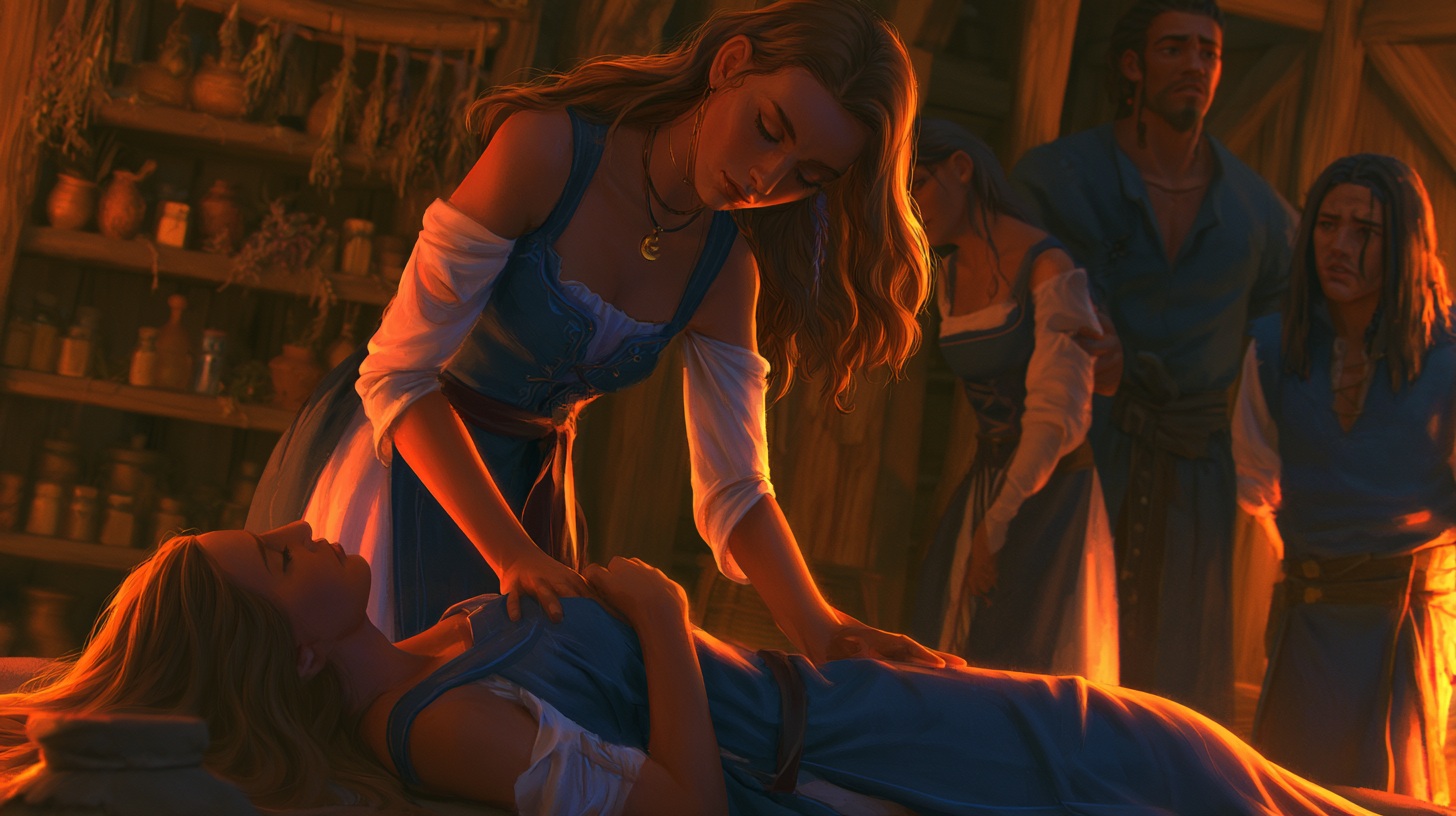
Midwife
Loving Hands
"I have watched kings celebrate victories, generals return from wars, and priests proclaim miracles. None of them were as brave as the woman who gripped my hand and said, 'If anything happens, save the child first.' "
Most people remember the day a child is born.
A midwife remembers all the days leading up to it.
Long before the first cry echoes through a home, there are months of preparation, uncertainty, hope, fear, and quiet labor. There are questions that cannot be answered, worries that cannot be entirely dismissed, and countless small decisions that shape the lives of families long before a child enters the world. Midwives stand at the center of these moments, guiding others through experiences that are at once deeply personal and universally human.
Whether serving a small farming village, a crowded city neighborhood, a nomadic caravan, a noble household, or an isolated frontier settlement, a midwife's responsibilities extend far beyond childbirth alone. They provide care, advice, reassurance, and practical knowledge to people navigating some of the most important transitions of their lives. In many communities, a midwife may know several generations of the same family, having helped deliver children who eventually grow up, marry, and begin families of their own.
This unique position grants midwives a perspective few others possess. They witness communities not through politics, commerce, warfare, or religion, but through families. They see the moments people rarely discuss publicly. They hear private concerns, hidden fears, cherished hopes, and closely guarded secrets. They learn who cares for others when times become difficult and who disappears when responsibility arrives. Over years of service, they develop a profound understanding of the people around them.
Many midwives begin as apprentices, learning from experienced practitioners through observation and practice. While scholars may study anatomy from books and physicians may debate theories in lecture halls, midwives often acquire their knowledge through direct experience. They learn which herbs ease discomfort, how to recognize complications, how to calm frightened parents, and how to make difficult decisions when circumstances leave little room for certainty. Their education combines practical medicine with patience, intuition, and an understanding of human nature.
In many societies, midwives also serve as informal healers, counselors, and caretakers. People seek them out not only for childbirth but for advice regarding illness, grief, family disputes, and personal concerns. Their homes frequently become gathering places where information flows naturally through conversation. Because they are trusted by people across social classes, midwives often possess a broader understanding of their communities than local officials, merchants, or religious leaders.
This trust carries significant responsibility. Families invite midwives into their homes during moments of vulnerability. They rely upon their judgment when circumstances become uncertain and place enormous faith in their abilities when lives hang in the balance. Many midwives carry vivid memories of both triumph and tragedy throughout their lives. They remember children who arrived healthy against all odds, parents whose courage inspired everyone around them, and losses that remain painful decades later.
Such experiences often shape a midwife's character. Many develop extraordinary patience because panic rarely helps those in distress. Others become fiercely protective of children and families after witnessing how fragile life can be. Some carry deep grief for lives they could not save despite their best efforts. Nearly all acquire a practical understanding of resilience. They learn that joy and sorrow often exist side by side and that communities survive hardship by caring for one another.
In lands scarred by the Shattering, midwives occupy an especially important role. Wars, disasters, migrations, and upheavals have scattered families across vast distances and disrupted traditions that once seemed permanent. Entire communities have been forced to rebuild from ruin. In such circumstances, midwives frequently become keepers of continuity. They preserve knowledge, maintain connections between generations, and help ensure that life continues even after catastrophe.
Because of this, many midwives become respected figures whose influence extends well beyond medicine. Village elders seek their opinions. Travelers carry their recommendations between settlements. Nobles remember their services long after political alliances have shifted. A person who has helped bring hundreds of children safely into the world often earns a degree of trust that cannot be purchased or commanded.
Yet despite their importance, most midwives view themselves as ordinary people performing necessary work. They understand that every life begins with dependence upon others. They witness firsthand how communities are built through countless acts of care that rarely receive recognition. They know that strength is not measured solely by power or achievement, but by the willingness to support others when they are at their most vulnerable.
A midwife's work is rarely celebrated in songs or recorded in histories. Their names may never appear in royal chronicles or military accounts. Yet generations carry their influence forward all the same. Entire communities exist because someone remained calm during a difficult night, offered comfort during a frightening moment, or refused to give up when hope seemed distant.
Most people remember the day they entered the world.
A midwife remembers the people who helped them arrive.

"People speak of bloodlines as though they are forged by destiny. They are forged by exhausted mothers, anxious fathers, sleepless nights, and the stubborn refusal of ordinary people to let one another face hardship alone."
Type
Healthcare



Comments