


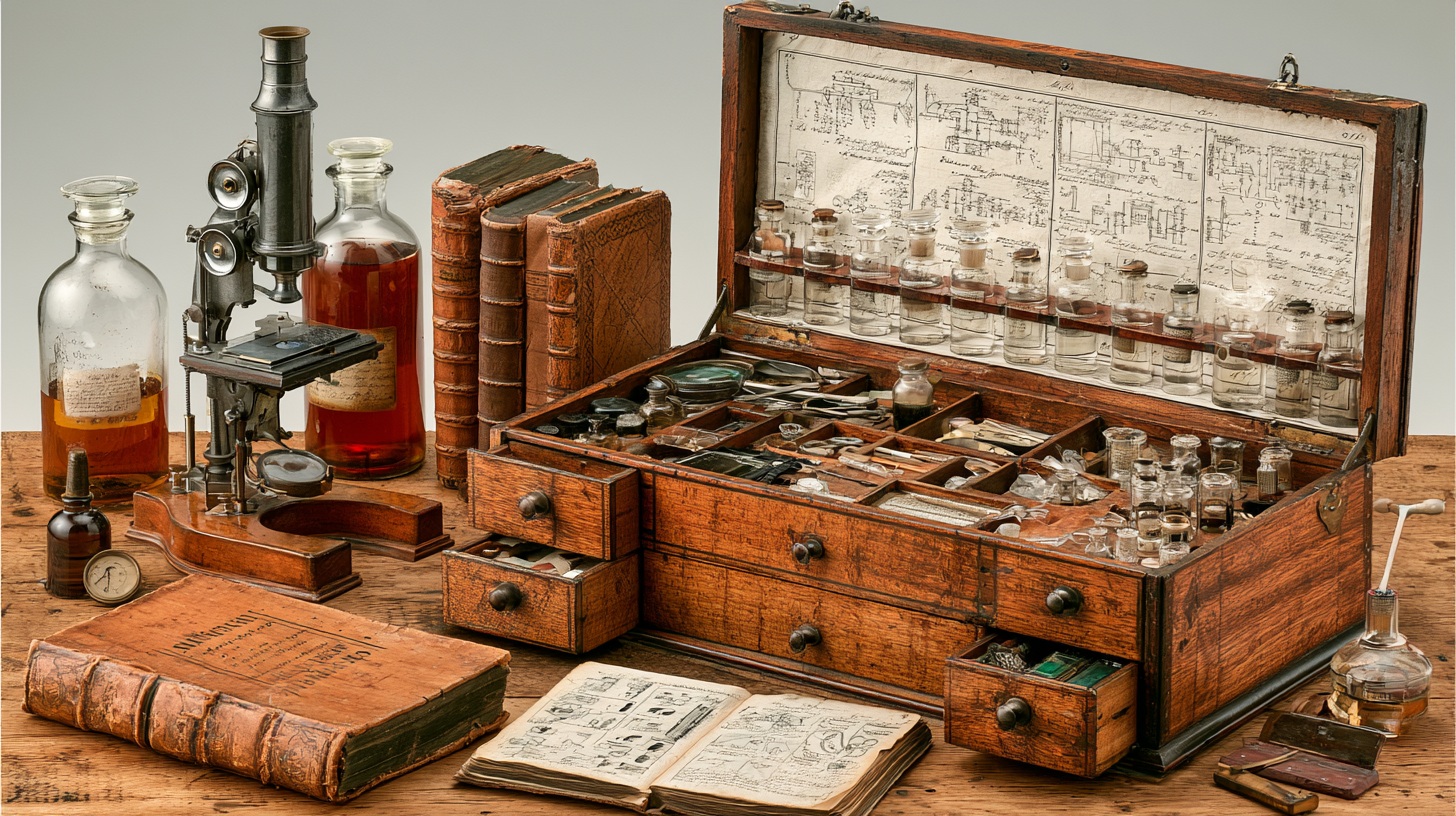
Microscope
An Unseen Universe
"The telescope taught us the universe was larger than we imagined. The microscope taught us so were the worlds beneath our fingertips."
Among the many instruments born from the study of optics, few have transformed scholarship as profoundly as the microscope. Where telescopes extend mortal sight across unimaginable distances, the microscope turns that same curiosity inward, revealing astonishing complexity within objects once thought simple. A drop of water, a grain of pollen, a fragment of cloth, or the edge of a blade becomes an entire landscape of hidden structures waiting to be explored.
Its construction demands extraordinary precision. Multiple finely polished lenses are arranged within a rigid brass frame, allowing light to pass through increasingly powerful magnifications without sacrificing clarity. Tiny adjustment screws raise and lower the viewing stage by fractions of an inch, while carefully engineered focus mechanisms permit details finer than the width of a human hair to emerge into view. Every component must be crafted with remarkable accuracy, for imperfections too small to notice with the naked eye become glaring flaws under magnification.
Unlike most scientific instruments, a microscope does not simply observe the world. It demands preparation. Samples must often be carefully sliced, mounted upon thin glass plates, stained with specialized reagents, or illuminated from carefully chosen angles before their hidden structures become visible. This meticulous work has elevated microscopy into a discipline of its own, requiring patience, steady hands, and considerable training.
Physicians were among the first to recognize its value. Tiny parasites once mistaken for curses have been identified as living organisms. Diseased tissue reveals subtle changes invisible during ordinary examination. Blood, skin, hair, and bodily fluids all possess characteristics that can distinguish one illness from another, allowing experienced healers to make diagnoses with a confidence previously impossible. Though the microscope cannot cure disease, it has forever changed how learned physicians understand it.
Alchemists quickly found equally remarkable applications. Powders that appeared identical proved to possess entirely different crystalline structures. Minute impurities hidden within ores explained why certain alloys behaved unpredictably. Residues left behind after magical experiments revealed patterns that would otherwise escape notice. For those who seek precision in their craft, the microscope became as indispensable as a furnace or alembic.
Natural philosophers embraced the instrument with particular enthusiasm. Plant tissues reveal intricate networks hidden beneath smooth leaves. Insect wings become masterpieces of delicate engineering. Fungal spores drift through the air unseen until magnified into elaborate forms. Entire ecosystems flourish within stagnant water, populated by creatures so small that generations lived and died without anyone ever suspecting they existed.
Investigators have also adopted the microscope as an unexpected ally. A single thread caught upon a splinter, a fragment of unusual pollen, a shaving of metal, or grains of unfamiliar dust may reveal where a suspect has traveled or what object they recently handled. Skilled examiners learn to distinguish the nearly identical from the truly identical, uncovering evidence invisible to ordinary inspection.
Despite its extraordinary capabilities, the microscope remains a demanding instrument. It requires stable placement, careful lighting, and specimens small enough to fit beneath its objective lens. Dust upon the optics, poor illumination, or careless preparation can obscure the very details the observer hopes to reveal. It is also entirely unsuited for viewing distant objects, serving as the perfect counterpart to the telescope rather than its replacement.
The greatest contribution of the microscope may be philosophical rather than practical. It reminds scholars that ignorance exists in every direction. Just as the heavens conceal wonders beyond ordinary sight, so too does every stone, feather, leaf, and drop of water conceal worlds of astonishing complexity.
Those who first peer through its lenses rarely emerge unchanged. They begin seeing ordinary objects with new respect, wondering what unseen intricacies still wait beneath every surface, patiently hidden until curiosity looks closely enough.
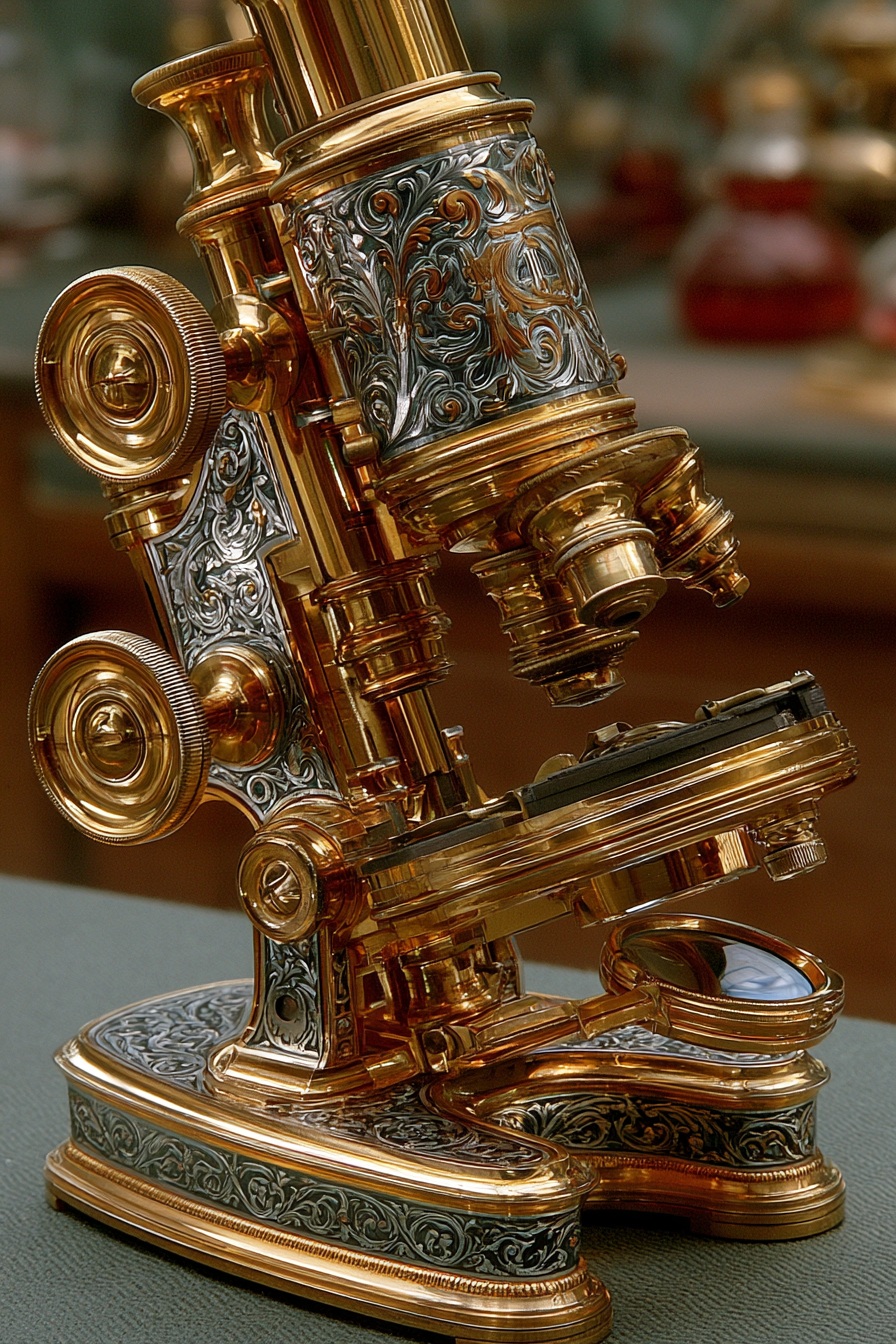
"Most people spend their lives looking farther. The wisest eventually remember to look smaller."
Item type
Tool
Rarity
Rare
Weight
6 lb
Base Price
1000 gp



Comments