


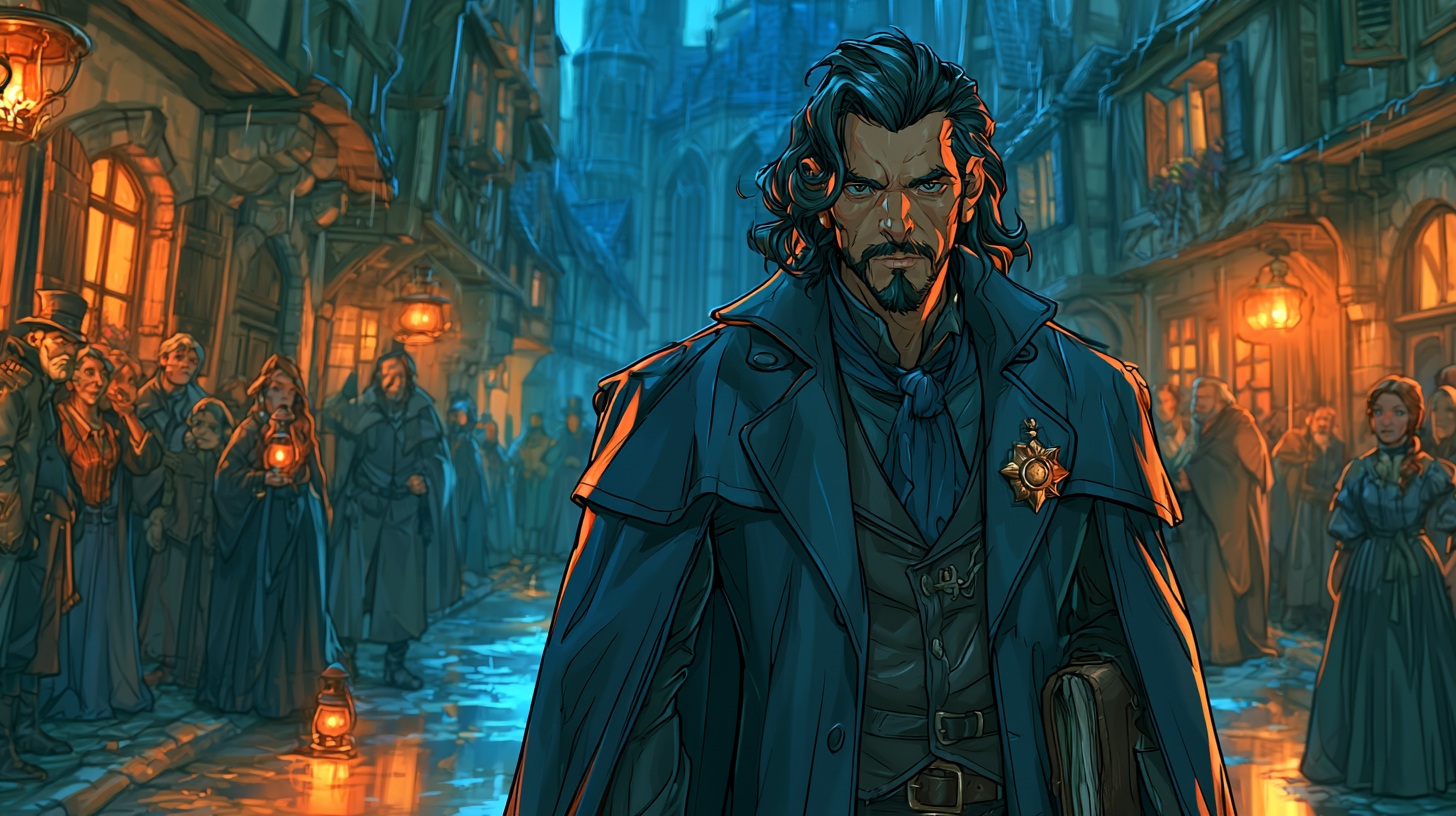
Gendarme
Round Up The Usual Suspects
“The law is a remarkably simple thing in theory. The difficulty begins when you introduce people.”
Every government has laws.
The real question is what happens after someone breaks them.
The Gendarme exists in the space between written authority and practical reality. They are neither soldier nor simple watchman. Soldiers fight external threats. Local guards maintain immediate order. The Gendarme occupies the vast territory between those responsibilities, serving as investigator, peacekeeper, officer, escort, mediator, and representative of the law itself.
Their profession begins with a simple truth.
A law written in a book accomplishes nothing on its own.
Someone must enforce it.
This responsibility places Gendarmes in a uniquely complicated position within society. They interact with nearly everyone. Magistrates rely upon them. Merchants negotiate with them. Criminals avoid them. Citizens seek their protection. Politicians issue instructions. Victims demand justice. The Gendarme learns quickly that every person believes the law should favor their own interests.
Reality is rarely so convenient.
Most people imagine law enforcement as a matter of identifying wrongdoers and punishing them accordingly. Experience teaches otherwise. Witnesses make mistakes. Evidence disappears. Officials disagree. Laws conflict. Circumstances complicate straightforward answers. Entire communities may support behavior technically prohibited by law while condemning actions that remain perfectly legal.
The Gendarme must navigate these contradictions.
This requirement develops a particular mindset. Good Gendarmes become observers. They learn to pay attention to details others overlook. Contradictory statements. Unusual behavior. Shifting loyalties. Unspoken tensions. The profession rewards patience because rushing toward conclusions often creates new problems rather than solving existing ones.
Every investigation becomes a lesson in human nature.
Over time, Gendarmes develop an intimate understanding of authority. They learn how institutions actually function rather than how official documents claim they function. Written procedures matter, but so do customs, relationships, reputations, traditions, and political realities. A veteran officer can often identify the true centers of influence within a community long before newcomers realize they exist.
This knowledge proves invaluable.
Laws may be universal in principle, but enforcement is always local.
One town overlooks minor smuggling because trade keeps the community alive. Another aggressively prosecutes the same offense. One magistrate prioritizes public order above all else. Another focuses on fairness and procedure. One city possesses competent officials. Another survives through informal arrangements nobody openly acknowledges.
The Gendarme learns to recognize these differences quickly.
Such experiences often force difficult questions. Every veteran officer eventually encounters situations where legality and morality diverge. A corrupt noble avoids punishment through influence. An innocent person faces accusation because evidence points the wrong direction. A lawful order demands an outcome that feels fundamentally wrong.
These moments shape careers.
Some officers become rigid defenders of procedure. Others develop a more flexible approach. Most spend years balancing competing obligations. Justice. Order. Compassion. Duty. Truth. The profession offers no perfect formula for reconciling them.
Only experience.
This complexity explains why many Gendarmes become surprisingly thoughtful individuals. Popular stories often portray law officers as unquestioning enforcers. Reality tends to produce something more nuanced. The best officers understand that maintaining order requires more than authority. It requires judgment.
A community cannot be governed solely through fear.
People must believe the law serves a purpose.
As a result, successful Gendarmes frequently become skilled mediators. Preventing violence often proves more valuable than responding afterward. Defusing disputes, identifying problems early, and understanding local tensions can accomplish more than any arrest. Experience teaches that most crises announce themselves long before they explode.
Someone simply has to notice.
The profession also creates a lasting relationship with responsibility. Gendarmes witness society during its most difficult moments. Crimes. Disasters. Corruption. Violence. Desperation. They see people at their worst and occasionally at their best. Such experiences can create cynicism.
They can also create perspective.
The veteran officer understands that order is not a natural state. It requires effort. Communities function because countless people perform difficult, often unglamorous work every day. Officials, laborers, merchants, teachers, healers, and ordinary citizens all contribute to stability in ways rarely celebrated.
The Gendarme sees this clearly because they also see what happens when those systems fail.
Perhaps that is the profession's defining lesson.
Authority is not the badge.
It is not the uniform, the warrant, the title, or the law itself.
Authority is responsibility accepted and exercised wisely.
Everything else is merely a symbol.
The Gendarme spends their career learning the difference.

“A good officer learns three truths. Most witnesses are mistaken, most criminals are careless, and most paperwork arrives on the day you planned to go home early.”
Type
Military



Comments