


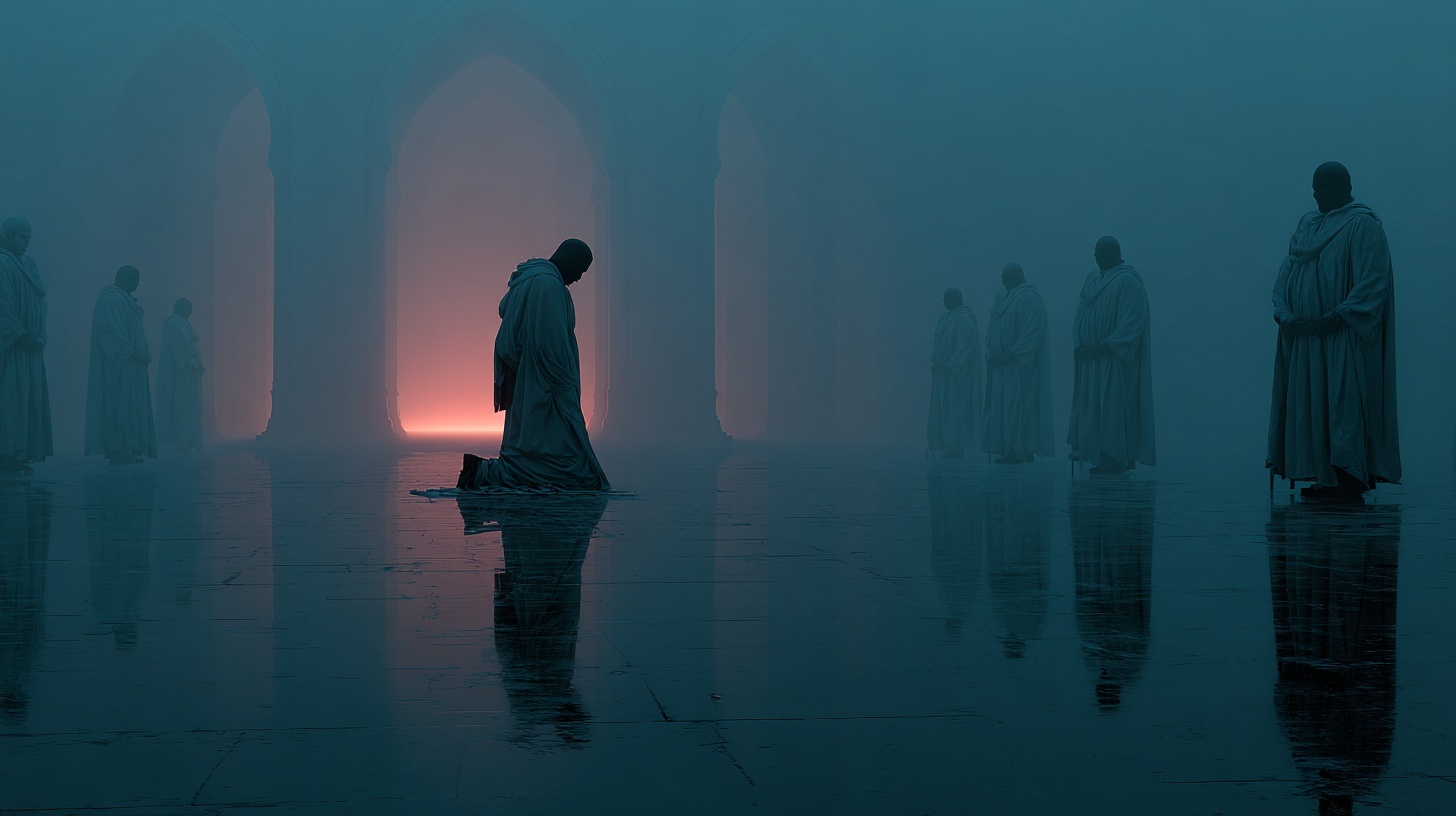
Defrocked Priest

Faithless

“There are truths a man can survive, and truths that unmake him. The cruel part is that they often wear the same face until it is far too late.”
— Flynn Makarin, former cleric of Derenthen
A defrocked priest is not simply a former servant of a faith. They are what remains after belief has been tested past the point of endurance.   There was a time when the world made sense. The structure of it was clear, defined by doctrine, ritual, and the quiet certainty that someone, somewhere, understood the shape of things. The priest stood within that structure, not as an observer, but as a voice. They spoke the words. They carried the rites. They believed, or at least knew how to live as though belief were unquestionable.   Then something entered that certainty.   It does not arrive loudly. Not at first. It comes as a contradiction that refuses to resolve, a question that does not yield to prayer, a moment where the expected answer fails to appear. A ritual that does nothing. A command that demands too much. A truth glimpsed in the wrong place, at the wrong time, that does not align with what was taught.   From that point forward, the fracture spreads.   Religious institutions are built to contain doubt, to shape it, redirect it, and ultimately suppress it beneath tradition and authority. But there are limits to what can be contained. When a priest reaches that limit, the outcome is inevitable. They break their vows, or they refuse an order, or they ask a question that cannot be allowed to stand.   Sometimes they leave.   More often, they are removed.   The institution does what it must to preserve itself. It reframes the departure as failure, sin, or instability. It isolates the individual from the structure that once gave them purpose. It ensures that whatever was seen, heard, or understood does not spread beyond a controlled boundary.   But removal does not erase knowledge.   A defrocked priest carries with them the memory of how things are done behind closed doors. They know the cadence of sacred language, the hierarchy of authority, and the subtle ways power is exercised under the guise of devotion. They can walk into a place of worship and read it the way others read a ledger, seeing not only what is presented, but what is carefully omitted.   That familiarity grants access.   It also invites scrutiny.   In places where the faith still holds influence, the defrocked priest exists in a state of contradiction. Recognized, but not trusted. Known, but not welcomed. Some will offer quiet sympathy, seeing in them a reflection of doubts they dare not voice. Others will react with hostility, not out of certainty, but out of fear that whatever caused the fall might be real.   Because doubt spreads.   And doubt, once it takes hold, does not behave.   The deeper truth, the one rarely spoken, is that the crisis does not end with defrocking. It continues. The loss of position does not restore certainty. It removes the framework that once held uncertainty in place. What remains is something far less stable.   There are nights where the absence of belief feels like freedom. There are others where it feels like standing at the edge of something vast and indifferent, realizing that the structure that once gave the world meaning may have been a thin and fragile thing all along.   Some attempt to rebuild. They adopt new beliefs, or return to old ones in altered form, reshaping faith into something they can live with. Others reject it entirely, choosing reason, survival, or simple denial over the risk of believing again.   And some never recover.   They remain suspended between what they were taught and what they now suspect, unable to reconcile the two. They speak with authority they no longer trust. They remember rituals that no longer comfort. They carry knowledge that cannot be shared without consequence.   To encounter a defrocked priest is to meet someone who has seen behind the curtain and found that whatever was holding it up may not have been what anyone hoped.   Whether that revelation was truth, madness, or something worse is a question they are often still trying to answer.   And the answer, when it comes, is rarely gentle.

“They taught him how to speak for the divine. They never considered what would happen if he chose to speak against it.”
— Junsai Aman, Chosen Prophet of Derenthen


Unknown Shores

Defrocked Priest


You once held a position within a religious order, temple, or organized faith. You were trusted, trained, and given access to sacred rites and inner workings. For a time, you were part of something larger than yourself.   Then something happened.   You may have broken your vows, uncovered a truth you were not meant to know, fallen in love, committed a grave sin, or refused to carry out an order. Whatever the cause, you no longer hold your position. You left, were cast out, or were quietly removed.   Though you no longer serve, your past has not released you. Those who share your former faith may react with suspicion, anger, pity, or secret sympathy. You still remember what lies behind their doors.


Skill Proficiencies: Insight, Religion
Tool Proficiencies: Choose one: calligrapher’s supplies or herbalism kit
Languages: One language of your choice (typically a sacred or liturgical language)
Equipment: A set of common clothes, a holy symbol that has been altered, hidden, or defaced, a book of prayers or religious text, a set of your chosen tools, a letter of dismissal, accusation, or quiet instruction to leave, and a pouch containing 10 gp

Feature: Fallen from Grace

You are familiar with the inner workings of religious institutions, including their hierarchy, customs, and expectations.   In settlements where your former faith is practiced, you can identify places of worship, religious authorities, and likely points of influence. You can often secure an audience with lower-ranking clergy or lay members, though their attitude toward you may vary.   Depending on the circumstances of your departure, members of your former faith may offer reluctant aid, demand answers, or treat you with hostility or distrust.   The DM determines how individuals react. Your past can open doors, but it just as often creates obstacles.  

Reason for Defrocking

d6Reason
1Broke Your Vows. You knowingly violated a sacred oath.
2Forbidden Love. You formed a relationship your faith would not allow.
3Discovered a Secret. You learned something that could not be ignored.
4Refused an Order. You would not carry out a command given by your superiors.
5False Accusation. You were blamed for something you did not do.
6Crisis of Faith. You no longer believed and could not pretend otherwise.
 

Current Standing

d6Standing
1Exiled. You are unwelcome but not actively pursued.
2Disgraced. Your name is spoken with shame.
3Watched. The faith keeps quiet tabs on your actions.
4Hunted. You are considered a threat that must be contained.
5Forgotten. Your departure was buried or erased.
6Sympathized With. Some within the faith quietly support you.
 

Personality Traits

d8Trait
1I still follow habits from my former life without thinking.
2I speak about faith with familiarity, even when I reject it.
3I am uncomfortable around places of worship.
4I question authority, especially religious authority.
5I offer guidance to others, even when I doubt myself.
6I avoid discussing why I left my faith.
7I treat sacred things with respect, even now.
8I expect judgment from others before they speak.
 

Ideals

d6Ideal
1Redemption. I will prove I am more than my past.
2Truth. No belief is worth following blindly.
3Faith. I still believe, even if I do not belong.
4Freedom. No institution should control the soul.
5Duty. I may have left, but I still carry responsibility.
6Reform. The faith must change, and I will help force it.
 

Bonds

d6Bond
1Someone within the faith still believes in me.
2I carry knowledge that could damage my former order.
3I left something important behind when I was cast out.
4I seek to confront those who forced me out.
5I still care about the people I once served.
6I am trying to find where I truly belong.
 

Flaws

d6Flaw
1I am bitter toward those who cast me out.
2I doubt my own judgment after what happened.
3I struggle to trust institutions or authority.
4I cling to old beliefs even when they hurt me.
5I avoid responsibility when it reminds me of my past.
6I am quick to judge others’ morality.


Comments

Please Login in order to comment!
Powered by World Anvil