


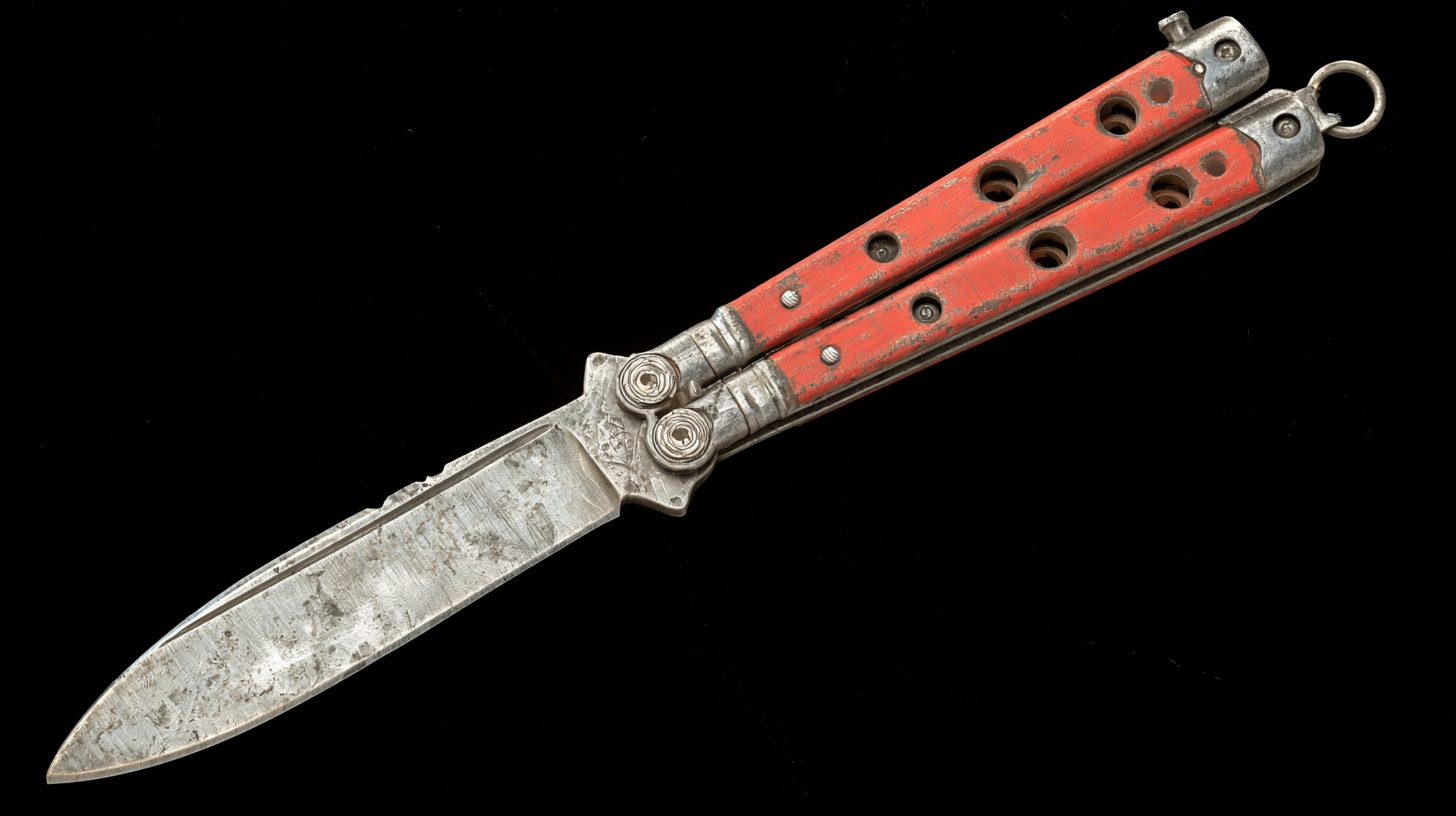
Butterfly Knife
When Then Other Hand Is Busy
"Most folks see a butterfly knife and think they're lookin' at a show-off. Truth is, the only man who gets truly good with one has spent enough lonely nights with it to make you wonder what else he's practiced."
The butterfly knife is proof that a tool can become an art form.
At first glance, it appears to be little more than a compact folding knife. Its blade disappears completely between two pivoting halves of the handle, protecting the edge while allowing it to be carried safely in a pocket, belt pouch, or boot. Unlike traditional folding knives, however, the butterfly knife opens through the coordinated movement of both handles, rotating around the blade in a smooth sequence that, with enough practice, can be completed in a single fluid motion.
To the untrained observer, that motion seems almost magical.
To those who carry one daily, it is simply muscle memory.
The design originated as a practical answer to an old problem. Travelers, laborers, sailors, and tradespeople needed a sturdy knife that could be carried safely without a sheath while remaining instantly accessible. The butterfly knife answered both needs. When folded, its blade is completely enclosed, reducing the risk of accidental injury or damage to clothing. When opened, the locking handles create a surprisingly rigid grip capable of handling nearly every task expected of a utility knife.
Its popularity spread quickly beyond craftsmen.
Sailors appreciated being able to operate the knife with one hand while the other clung to rigging in rough seas. Caravan guards found it convenient to carry discreetly without sacrificing readiness. Hunters relied upon it for skinning game, cutting rope, and preparing camp. Even city dwellers valued its compact size, making it an everyday companion rather than a weapon left hanging on a wall.
Its reputation, however, owes as much to performance as practicality.
The butterfly knife rewards patience unlike almost any other blade. Beginners inevitably strike their own knuckles, pinch their fingers, or send the knife tumbling into the dirt. Veterans, by contrast, manipulate the handles with astonishing confidence, opening, closing, and reversing the blade through movements so fluid they appear choreographed. Many owners spend years refining these motions, treating them less as tricks and more as exercises in coordination and precision.
Naturally, this has given the weapon an undeserved reputation.
Street performers, gamblers, confidence artists, and thieves often flourish butterfly knives simply because they attract attention. The knife itself has become associated with daring personalities and nimble hands, despite the overwhelming majority of owners using theirs to cut rope, sharpen stakes, prepare meals, or perform countless ordinary tasks. The showmanship belongs to the wielder, not the blade.
In combat, the butterfly knife offers no mystical advantage over any other well-made knife of similar size. Once opened, it is simply a reliable blade, valued for its balance, sturdy construction, and ease of carry rather than any exceptional lethality. Those who survive by the knife generally understand that the spinning display ends the instant the fighting begins.
That balance between utility and spectacle has allowed the butterfly knife to endure for generations. It is equally at home in a sailor's sea chest, a craftsman's apron, an adventurer's pack, or a gambler's pocket. Few tools invite so much practice outside of necessity, and fewer still inspire their owners to keep turning them over in idle conversation simply because the motion itself has become second nature.
Few tools inspire as much practice for so little practical gain. Long after the work is finished, many owners find the knife still turning through their fingers by habit alone, its polished handles flashing through familiar motions learned over years of quiet repetition. Whether carried by sailors, craftsmen, gamblers, or adventurers, the butterfly knife remains a curious blend of utility, precision, and performance, a humble blade that somehow manages to reveal a little about the person holding it.
Butterfly Knife
A compact folding knife whose blade is concealed between two hinged handles. It is designed for easy concealment and quick deployment rather than throwing.
| Damage | Properties | Mastery | Weight | Cost |
|---|---|---|---|---|
| 1d4 Piercing | Finesse, Light, Special | Nick | 1 lb. | 5 gp |



Comments