


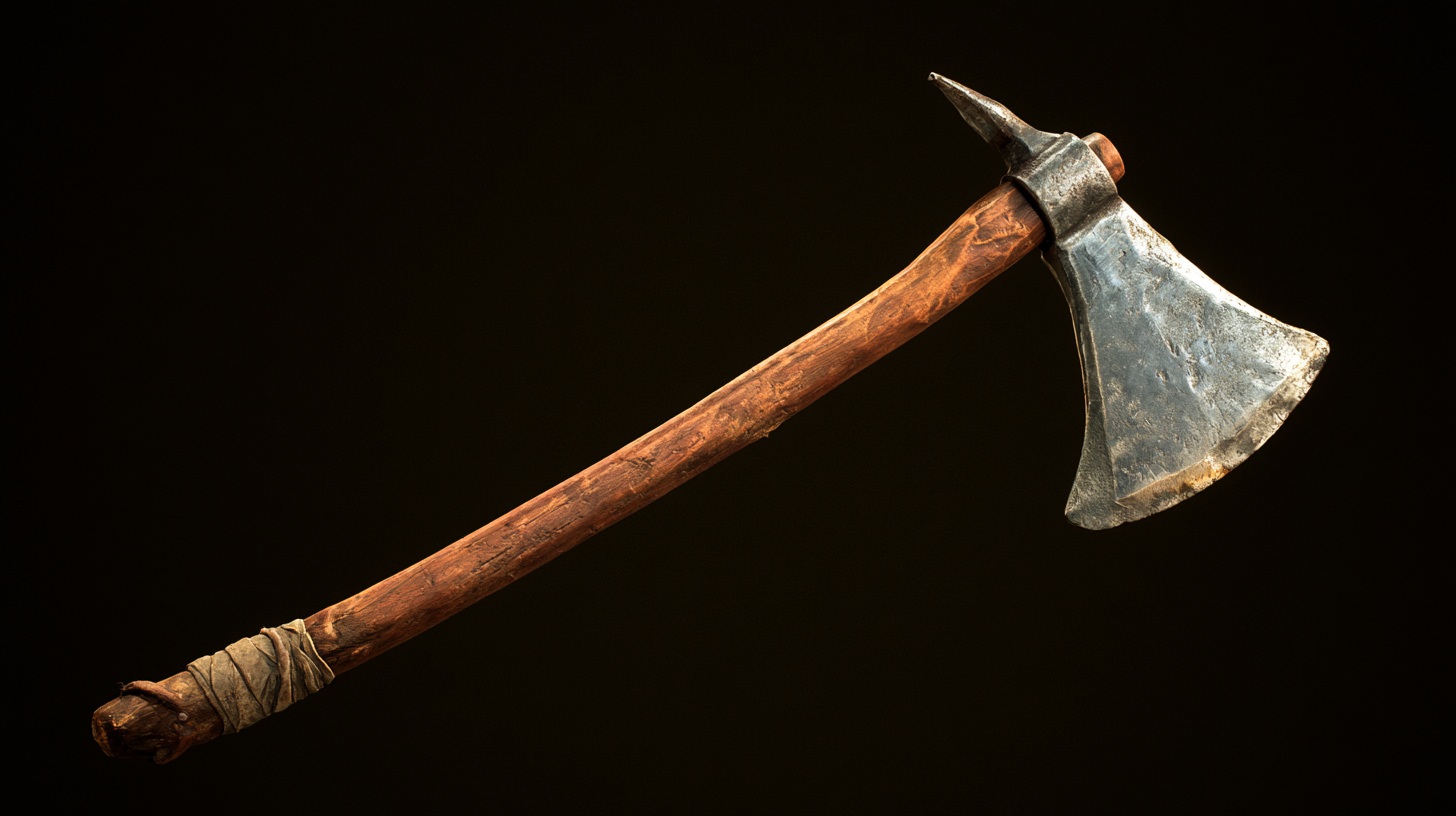
Boarding Axe
A Forced Boarding
“A boarding axe is for doors, ropes, rails, and men. The trick is remembering which of those deserves a second swing.”
The boarding axe is a compact, heavy-bladed weapon designed for the brutal realities of fighting aboard ships. It is shorter than a woodsman’s axe, heavier than a hatchet, and built to serve as both a weapon and an emergency tool in conditions where space is limited, footing is uncertain, and every length of rope or timber may become a matter of life and death.
Its broad cutting edge is made to bite deeply into wood, rope, canvas, bone, and flesh. Opposite the blade, most boarding axes carry a stout spike or narrow pick intended for piercing planks, catching rigging, wrenching apart damaged fittings, or providing purchase while climbing. The head is mounted on a reinforced haft short enough to use below deck and strong enough to survive repeated impact against hard timber.
No sailor mistakes it for an elegant weapon.
The boarding axe exists because ships are crowded with things that must sometimes be broken immediately.
During ordinary voyages, it serves as an indispensable emergency tool. Sailors use it to cut away damaged rigging before a collapsing mast pulls more of the vessel down with it. It can break open jammed hatches, split shattered beams, free trapped crew members, and clear wreckage from a flooded passage. When fire spreads aboard ship, the axe may be used to tear apart burning walls, cut through locked doors, or create access for buckets and pumps before the flames reach powder stores.
The spike on the reverse is nearly as useful as the blade. It can be driven into decking or hull timbers as an improvised handhold, hooked over a rail while climbing, or used to drag loose rope within reach. Sailors caught on steeply pitching decks sometimes bury the point into timber simply to keep from being thrown into the sea.
Its reputation, however, was earned during boarding actions.
When two vessels close, combat becomes a struggle fought across rails, ladders, planks, rigging, and narrow strips of wet deck. Long weapons become difficult to wield. Swords catch against ropes and beams. Spears lose much of their advantage once opponents press into arm’s reach. The boarding axe thrives in that confusion.
Its compact haft allows powerful strikes without requiring a wide swing. A sailor can chop downward over a rail, hack at hands gripping a ladder, or strike an enemy crowded against a bulkhead. The heavy head delivers enough force to break shields, split helmets, and batter through lighter armor. Even a blow that fails to cut may stagger an opponent or knock them from uncertain footing.
The rear spike offers a different kind of brutality. It can punch into mail, hook behind a shield, catch clothing or straps, and pull an enemy off balance. In the cramped chaos of a boarding fight, dragging someone into a rail or down onto the deck can be more effective than attempting to kill them outright. A fighter who falls beneath the feet of a boarding party is rarely given the chance to rise.
The weapon is equally valuable for destroying the tools of the boarding action itself. Grappling lines can be severed. Boarding nets can be chopped apart. Rope ladders may be cut away while attackers are still climbing. Planks laid between ships can be split, dragged aside, or knocked free. A defender armed with a boarding axe does not merely fight the people coming aboard. They attack the path beneath them.
Pirates favor the boarding axe because it is cheap, durable, and useful before, during, and after a raid. Naval marines prize it for much the same reasons. Merchant crews often keep several near important hatches and deck stations, knowing that a tool capable of clearing wreckage may become a weapon with no warning at all.
Some captains require every boarding party to carry at least one axe. A locked cabin, barred door, cargo crate, or jammed hatch can halt an attack as effectively as armed defenders. The boarding axe ensures that few obstacles remain intact for long. Once aboard an enemy vessel, a crew may use it to smash weapon racks, break open storage rooms, cut prisoners free, or destroy steering controls to prevent escape.
Construction varies little between regions because the demands of shipboard use are universal. The haft is commonly made from ash, hickory, or another dense wood capable of absorbing shock without splitting. Leather wrapping or carved grooves improve the grip when the handle becomes wet. Metal strips may reinforce the upper haft, protecting it from blades and reducing the risk of the head breaking loose after repeated hard use.
Boarding axes are rarely kept polished. Salt stains the steel. Tar blackens the handle. The blade bears scars from nails, chain, rope, and timber. A sailor cares less about appearance than whether the edge holds and the head remains secure. Many axes serve through multiple ships and several owners, their handles replaced while the original iron continues its work.
On land, the weapon is sometimes carried by dock guards, wreckers, marines, and adventurers who expect to fight in ruins or confined passages. It is capable enough in ordinary combat, but its true value remains tied to environments where a single tool may be called upon to break a door, sever a rope, climb a wall, and kill an enemy within the span of a minute.
The boarding axe was never designed to look heroic. It was designed to be within reach when something had to be broken and there was no time to ask twice.
Boarding Axe
A compact boarding weapon with a reinforced blade and hooked poll, built for close-quarters fighting, climbing, and breaching wooden defenses.
| Damage | Properties | Mastery | Weight | Cost |
|---|---|---|---|---|
| 1d8 Slashing | Special | Sap | 4 lb. | 10 gp |



Comments