


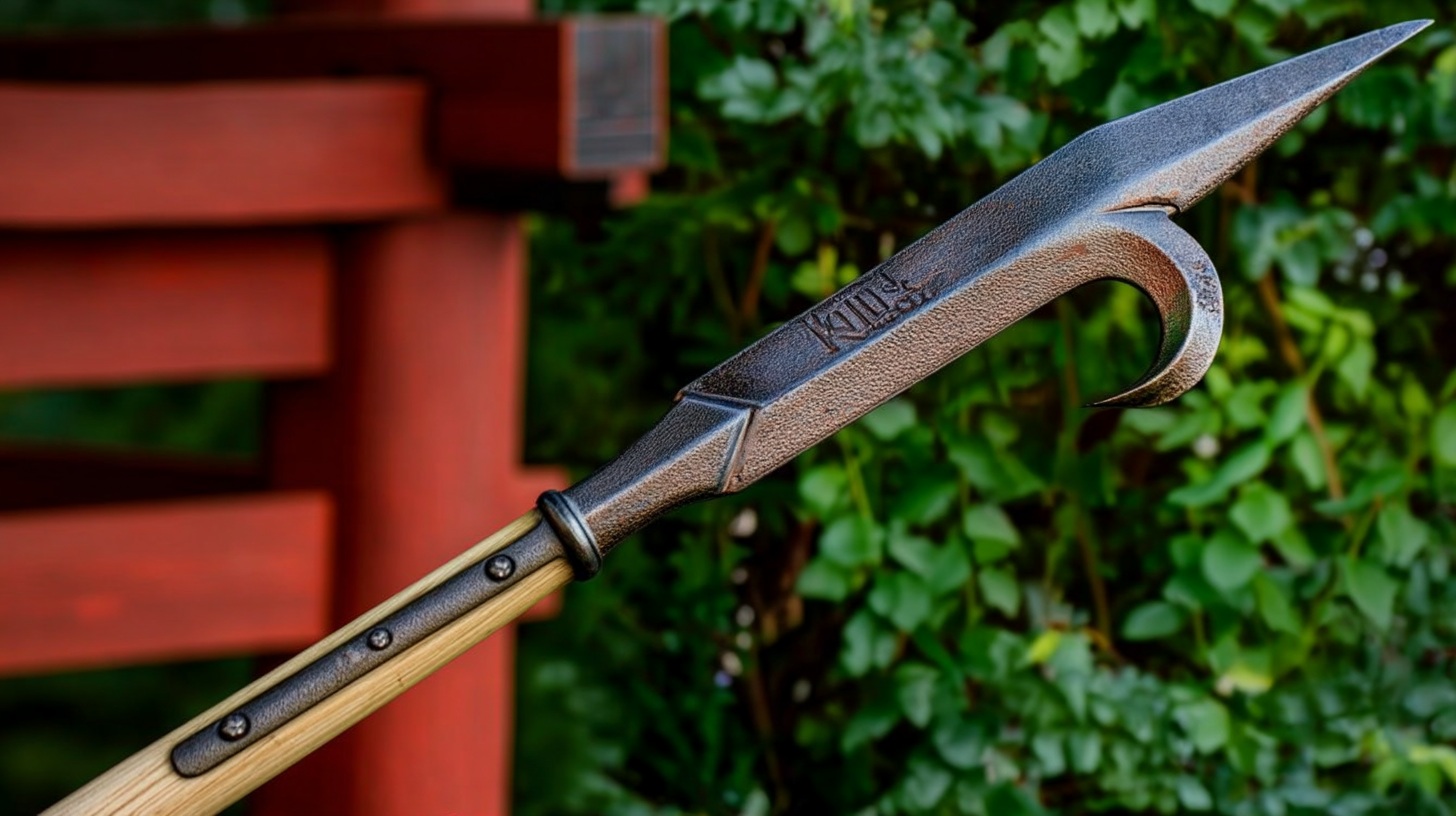
Billhook
Cut Their Shrouds!
“Keep your sword. I’ll take the hook. Steel cuts a man, but a good pull sends him where the sea can finish the argument.”
The billhook is a long-hafted shipboard weapon designed for controlling rigging, repelling boarders, and dragging enemies from positions they believed were secure. Though its hooked blade resembles the agricultural tools used by foresters and hedge cutters, the maritime form is built specifically for life aboard a vessel. Its reinforced shaft, heavy cutting edge, and extended reach allow sailors to work across rails, through tangled lines, and over the shifting gap between two ships.
A typical billhook consists of a broad, forward-curving blade mounted upon a stout wooden haft. The inner curve is sharpened to catch and sever rope, canvas, leather, netting, and flesh with a powerful pulling motion. The outer edge is shaped for chopping through wooden spars, boarding poles, and other hard obstructions. Many examples also include a narrow point above the hook, allowing the weapon to be thrust like a short spear, while others carry a rear spike suited to piercing wood, mail, or lighter armor.
The haft is commonly between five and seven feet long, though shorter versions are favored aboard smaller vessels where deck space is limited. Metal langets often run down the upper portion of the shaft to prevent swords and axes from cutting through it. The lower end may be capped with iron, providing a counterweight and allowing the wielder to strike with the butt when there is insufficient room to bring the blade around.
During ordinary shipboard work, the billhook serves as a practical extension of the sailor’s reach. It can pull loose lines closer, free rigging caught around a spar, tear away damaged canvas, and recover cargo or equipment drifting just beyond the rail. Sailors use it to guide floating debris away from the hull, clear nets from the rudder, and manipulate heavy ropes without placing their hands beneath dangerous tension.
Its reach is especially valuable during storms. A sailor attempting to cut away a damaged sail or fouled line may be unable to approach safely while the deck rolls beneath them. With a billhook, the offending rope can be caught, pulled within reach, or severed from several feet away. The same tool can provide an improvised brace, catch a ladder, or recover a companion who has fallen against the rail.
The weapon’s true purpose becomes apparent when another vessel comes alongside.
Boarding actions are chaotic affairs fought across wet planks, crowded decks, and narrow passages filled with rigging, smoke, and broken timber. The ships themselves rise and fall independently, sometimes grinding together and sometimes opening a deadly gap between them. In such conditions, balance is often more important than armor, and a weapon capable of taking that balance away can decide a fight before a blade ever reaches flesh.
A billhook can catch an enemy climbing over the rail and pull them backward into the sea. It can hook behind a shield, knee, belt, or shoulder and wrench the target off balance. A sailor crossing a boarding plank may be dragged sideways with a single sharp pull, while an attacker clinging to rigging can be torn loose before reaching the deck.
The hook is equally useful against the equipment that permits boarding. Grappling lines can be caught and severed. Rope ladders can be pulled away from the hull. Boarding nets can be ripped down or hauled into the path of advancing enemies. A plank laid between ships can be pushed aside or hooked from beneath, sending anyone standing upon it into the water below.
The weapon’s length also allows defenders to strike across the rail before an attacker gains firm footing. Several sailors armed with billhooks can form a bristling defensive line, thrusting with the points and pulling with the hooks whenever an enemy comes within reach. Unlike spears, which rely primarily upon forward pressure, billhooks can attack around shields and obstacles, catching the edge of a defense and dragging it out of position.
Against armored opponents, the billhook is less concerned with cutting through protection than with finding something to seize. Armor straps, belts, scabbards, shield rims, and loose fittings all provide purchase. Once caught, the target can be turned, pulled forward, or forced onto unstable footing. A heavily armored marine may be difficult to wound, but weight becomes a serious liability when someone is hauling them toward the rail.
The weapon requires strength, control, and an awareness of the surrounding deck. A careless swing may catch in the rigging or strike a fellow sailor. An overcommitted pull can drag the wielder forward if the target is stronger or better braced. Experienced users therefore fight with measured movements, using the length of the haft to maintain distance and allowing the hook to do the work.
Billhooks are commonly carried by marines, harbor guards, boarding parties, privateers, pirates, and merchant crews sailing through dangerous waters. They are often stored near rails, ladders, and weapon racks where they can be seized quickly during an attack. Some captains insist that every watch keep at least one close at hand, regarding the tool as essential emergency equipment rather than merely a weapon.
Shipboard examples are rarely ornate. Their shafts are stained with tar and salt. Their blades show scars from rope, wood, iron fittings, and repeated sharpening. Sailors judge them by the strength of the hook, the balance of the haft, and whether the metal holds an edge after hard use.
On open ground, the billhook can seem awkward beside a spear or glaive. Aboard a ship, where every rope can become a snare and every railing marks the edge of a fatal drop, its purpose is immediately clear.
The billhook does not need to cut a man down. It only needs to catch him once.
Billhook
A long-shafted boarding weapon fitted with a heavy cutting blade and inward-facing hook, designed to slash through defenses and drag enemies out of position.
| Damage | Properties | Mastery | Weight | Cost |
|---|---|---|---|---|
| 1d8 Slashing | Reach, Special, Two-Handed | Topple | 6 lb. | 10 gp |



Comments