


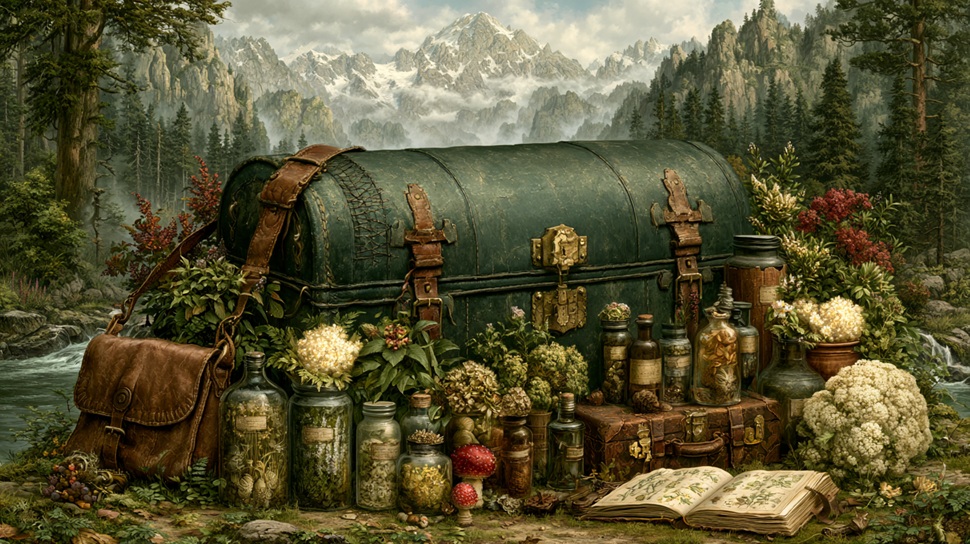
Apothecary
Herbal Remedy
"Every medicine begins as a rumor. Someone notices a plant easing pain, a root lowering fever, or a tincture calming a cough. The difficult part is proving the rumor is true before someone dies proving it false."
Most people think medicine begins with a cure.
You learned that it begins with observation.
Long before a remedy can be prescribed, a wound treated, or a disease understood, someone must notice what others overlook. A fever that rises at a particular hour. A rash that appears only after certain meals. A strange smell in a patient's breath. A subtle discoloration in the eyes. The smallest details often reveal the difference between recovery and tragedy.
As an apothecary, you spent years studying those details.
Whether you worked from a small village shop, a bustling city dispensary, a military infirmary, a monastery, or a noble household, your profession required equal parts knowledge, patience, and caution. People came to you seeking relief from pain, illness, injury, and uncertainty. Some sought cures. Others sought hope. Many could not distinguish between the two.
Your education exposed you to an astonishing variety of substances. Herbs gathered from distant forests. Minerals extracted from deep mines. Rare spices imported from foreign lands. Venoms harvested from dangerous creatures. Powders, oils, tinctures, tonics, salves, poultices, and compounds whose names most people would never recognize.
Each possessed its own properties.
Each carried its own risks.
The study of medicine quickly teaches a lesson that few outsiders appreciate. Very little in the world is entirely beneficial or entirely harmful. The same plant that eases pain may become deadly if improperly prepared. A poison can become a medicine in the correct quantity. A remedy that saves one patient may harm another.
The difference is often measured in knowledge.
Because of this, apothecaries develop habits that others sometimes find peculiar. You learned to label everything carefully. You learned to record observations in meticulous detail. You learned to verify information before acting upon it. Assumptions can be dangerous in your profession. Certainty can be even more dangerous.
A physician may focus on diagnosis.
A healer may focus on treatment.
An apothecary learns to focus on causes.
Why did the illness appear?
Why did the symptoms worsen?
Why did one treatment succeed while another failed?
Those questions matter because solving a problem often requires understanding its origins.
Years spent among the sick also taught you lessons about people.
Illness reveals aspects of human nature that ordinary circumstances often conceal. The wealthy discover that coin cannot solve every problem. The proud learn to accept assistance. Families reveal the depth of their devotion. Communities reveal their strengths and weaknesses. Fear, generosity, selfishness, courage, desperation, and compassion all become visible when health is threatened.
You witnessed people at some of the most vulnerable moments of their lives.
You also witnessed remarkable resilience.
Many apothecaries eventually develop a fascination with unusual conditions and uncommon substances. The world contains countless mysteries waiting to be understood. Strange fevers emerge from remote regions. Exotic plants possess unexpected properties. Rare toxins create symptoms unlike anything described in existing texts. Every new discovery offers an opportunity to expand humanity's understanding of health and disease.
Curiosity becomes both a professional asset and a personal temptation.
Some apothecaries devote their lives to discovering new remedies. Others become collectors of rare ingredients. A few pursue dangerous knowledge that responsible scholars would rather leave untouched. The line between innovation and recklessness is not always obvious until someone crosses it.
The profession also teaches humility.
For all the advances made by physicians, herbalists, and scholars, there remain illnesses that cannot be cured, wounds that cannot be healed, and lives that cannot be saved. Every experienced apothecary carries memories of failures alongside successes. Every notebook contains unanswered questions.
Yet those failures rarely diminish the importance of the work.
Communities depend upon people willing to confront sickness rather than avoid it. Epidemics are contained because someone recognizes the signs early. Poisonings are prevented because someone understands dangerous compounds. Injuries heal because someone took the time to prepare the proper treatment.
Much of that work goes unnoticed.
Successful medicine often appears invisible. Patients recover. Life continues. People forget how close disaster once stood.
That is enough.
The reward for an apothecary is not fame.
It is knowing that knowledge, preparation, and care made a difference.
Even now, you find yourself studying unfamiliar plants, examining unusual substances, and asking questions others fail to consider. A strange powder on a merchant's glove. An unfamiliar scent lingering in a tavern. A rumor of sickness spreading through a nearby village. Such things immediately capture your attention.
Most people see a bottle and wonder what it contains.
An apothecary wonders what it might do.

"The difference between a healer and an apothecary is that one asks what hurts. The other asks why."
Type
Healthcare



Comments