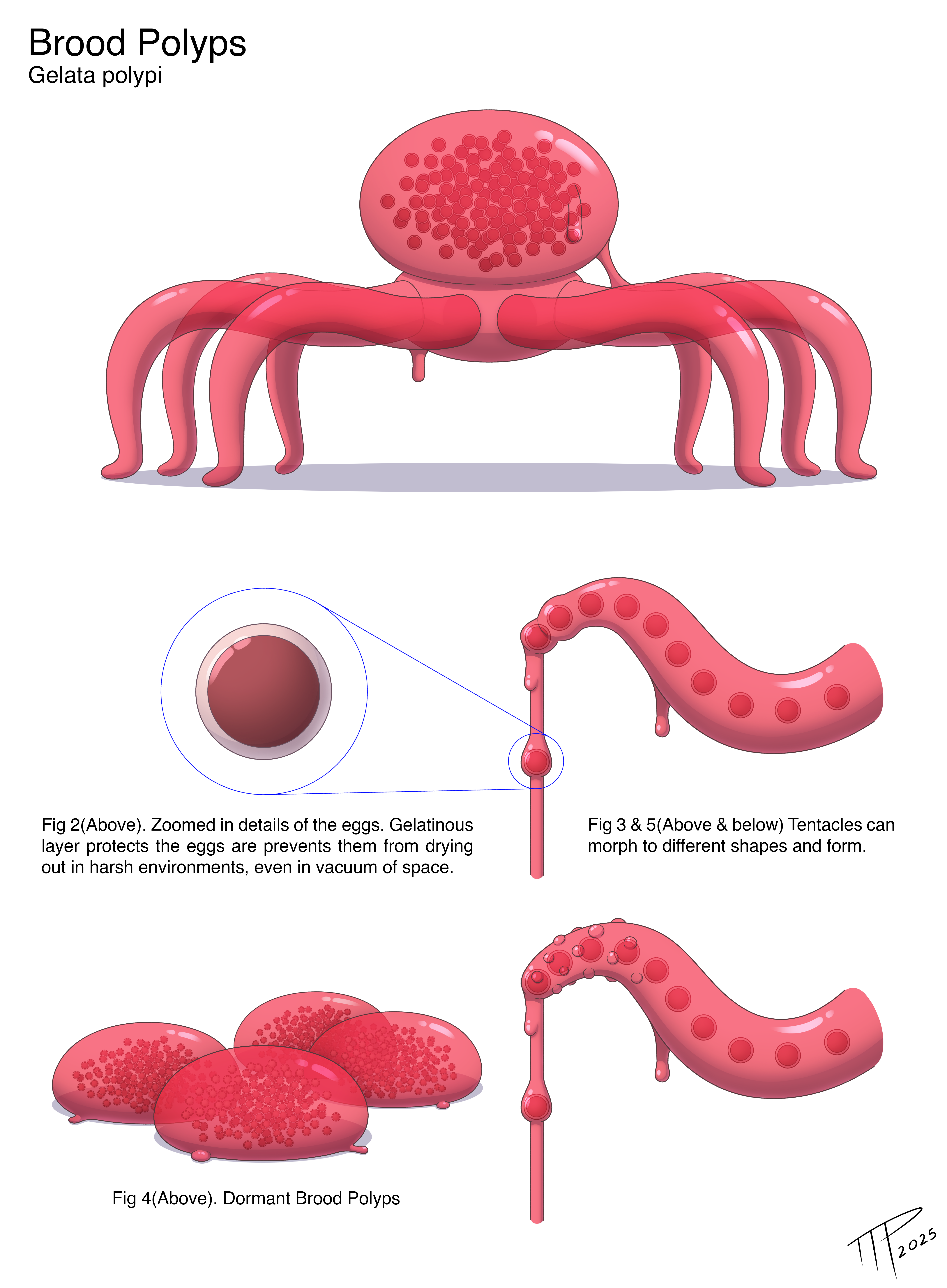
Brood Polyps
Common throughout Galactic Enforcement Agency space, Brood Polyps are a mostly harmless species of parasite that hijacks the reproductive systems of other species to plant its spores and reproduce.
In areas where their amorous tentacles and spore depositors are NOT welcome, they've proven difficult to eradicate. Brood Polyp Spores can endure extremely hazardous conditions, including hard vacuum, radiation, and intense cold. Spores stored at 0 Kelvin have a 60% viability rate on average. They are also sticky and easy to lose track of inside a ship. A single outbreak of Brood Polyps can spread across interstellar distances ; as such, some systems or stations classify them as illegal/invasive species and fine any ship that brings them into the forbidden environment.
Spores remain quiscient until they detect the correct conditions for development -- atmosphere, sufficient temperature to maintain gelatinous motility, and the presence of suitable host organisms. Upon development, they grow from a simple egg into a dormant form--not unlike a lump of dough. Newly developed polyps spend much of their initial energy on producing spores, so they are ready to reproduce within a few days of development. Overall, the process takes no more than 9-14 days from Spore to Developed.
Developed Brood Polyps use their gelatinous flexibility and surprising jump distance to pounce on suitable organisms. Their body structure is made up of naturally occuring, gel-suspended Pink Venom--a powerful organic aphrodesiac--which they introduce to the target host via skin contact , followed by Orifice Penetration. While not possessed of a traditional nervous sytem, their cells are attuned to the nerve signals of nearby organic life. This allows them to interpret the physiological response of their target and adjust their movements and actions, all the better by which to stimulate the target to orgasm.
Once the target creature is brought to climax, the Brood Polyp introduces its spores via any of the tentacles, transforming them into rudimentary ovipositors. Because the spores are gelatinous, one host can usually accomodate multiple Brood Polyps worth of spores.
Unlike most species with a similar life cycle, a Brood Polyp that has expended its spores does not immediately die. However, for an expended polyp to survive, it must find a source of nutrients. They do not have a strong evolutionary drive to do so but if exposed to a lactating creature, they will attempt to latch and nurse. Thus sustained, a brood polyp's maximum possible lifespan has no obvious limit; their simplistic biology and regenerating cellular slime means aging has little to no effect on them.
Brood Polyps can be kept as pets or for recreational purposes, as seen with the crew of the Rabbit's Foot